Freitag, 4. November 2022

Shostakovich - Symphony No. 11 (Mravinsky, Leningrad Philharmonic Orchestra)

The Symphony No. 11 in G minor (Opus 103; subtitled The Year 1905) by Dmitri Shostakovich was written in 1957 and premiered, by the USSR Symphony Orchestra under Natan Rakhlin, on 30 October 1957. The subtitle of the symphony refers to the events of the Russian Revolution of 1905.
The symphony was conceived as a popular piece and proved an instant success in Russia - his greatest, in fact, since the "Leningrad Symphony" just over a decade earlier. The work's popular success, as well as its earning him a Lenin Prize in April 1958, marked the composer's formal rehabilitation from the Zhdanov Doctrine of 1948.
A month after the composer had received the Lenin Prize, a Central Committee resolution "correcting the errors" of the 1948 decree restored all those affected by it to official favor, blaming their treatment on "J.V. Stalin's subjective attitude to certain works of art and the very adverse influence exercised on Stalin by Molotov, Malenkov and Beria."

The symphony has four movements played without break, and lasts approximately one hour.

The Eleventh is sometimes dubbed "a film score without the film". Indeed the musical images have an immediacy and simplicity unusual even for Shostakovich the epic symphonist, and an additional thread is provided by the nine revolutionary songs which appear during the work. Some of these songs date back to the 19th century, others to the year 1905. Shostakovich does not merely quote these songs; he integrates them into the symphonic fabric within the bounds of his compositional style. This use of pseudo-folk material was a marked departure from his usual technique. However, it lent the symphony a strong emphasis on tonality and a generally accessible musical idiom. They were also songs the composer knew well. His family knew and sang them regularly while he was growing up.

Shostakovich originally intended the Eleventh Symphony to mark the 50th anniversary of the Russian Revolution of 1905 and would have written it in 1955. Several personal factors kept him from composing the work until 1957. These factors included his mother's death, his tumultuous second marriage and the arrival of many newly freed friends from the Gulag. Events in Hungary in 1956 may have stirred Shostakovich out of his compositional inertia and acted as a catalyst for his writing the symphony.

According to the composer's son-in-law Yevgeny Chukovsky, the original title sheet for this symphony read not "1905" but "1906," the year of the composer's birth. This, some critics have suggested, can allow us to hear the Eleventh Symphony as a requiem not only for himself but for his generation. The trials that the composer's generation suffered were unprecedented in Russian history - two world wars, a civil war, two revolutions plus the horrors of forced collectivism and the Great Purge of the Stalin years. The only thing that spared this generation a second purge was the death of Stalin himself in 1953.

Nevertheless, the same critics suggest, this idea of the symphony about the fate of a generation does not contradict its official theme of revolution. Unlike the October 1917 Revolution, the 1905 Revolution was not politicised by the Party; therefore, it had not lost its romantic aura in the eyes of later generations. Because of this romantic aura, a spirit of struggle for a just cause imbues such diverse works about that period as Sergei Eisenstein's film The Battleship Potemkin and Boris Pasternak's narrative poems "1905" and "Lieutenant Schmidt" as well as Shostakovich's symphony.

The title, The Year 1905, recalls the start of the first Russian Revolution of 1905, which was partially fired by the events on 9 January (9 January by the Julian calendar still in use in Russia at the time, modern date of 22 January 1905) date of that year. Some Western critics characterized the symphony as overblown "film music" - in other words, as an agitprop broadsheet lacking both substance and depth. Many now consider the work to carry a much more reflective attitude, one which looks at Russian history as a whole from the standpoint of 1957, four years after the death of Stalin. Another common interpretation is that the symphony is a response to the crushing of the Hungarian Revolution of 1956; it was composed immediately after the uprising, and his widow Irina has said that he had it "in mind" during composition.

Regardless, Shostakovich considered this work his most "Mussorgskian" symphony. Mussorgsky for him symbolised two things - the people and recurrence. Since it was about the people who suffered as a result of the Bloody Sunday, he wrote it in a simple, direct manner. The people would basically be destined to suffer at the hands of indifferent autocrats; they would periodically protest in the name of humanity, only to be betrayed or punished. The composer reportedly told Solomon Volkov, "I wanted to show this recurrence in the Eleventh Symphony.... It's about the people, who have stopped believing because the cup of evil has run over." While this passage may have seemed far-fetched to some critics when Testimony first appeared, especially in the context of linking the symphony to the Hungarian Revolution, the concept of recurrence is reportedly one which has been central to Russian artists in the wake of that event and held tremendous significance among the intelligentsia in Russia.

The revolutionary song quotations in the work itself can support many interpretations: the first movement quotes a song, "Slushay!" ("Listen!") with the text "The autumn night is...black as the tyrant's conscience", while the final movement refers to one including the words "shame on you tyrants." Volkov compares this movement's juxtaposition of revolutionary songs (notably the Varshavianska song) to a cinematic montage, while quoting Anna Akhmatova's description of it as "white birds against a black sky."
Some have argued that Shostakovich's inclusion of these songs makes more explicit in the symphony the actual chain of consequences as well as events being portrayed - namely, that had Tsar Nicholas II listened to the people's demands and liberalized the government in 1905 to the point where widespread social change was enacted, there would not have been a recurrence of protest 12 years later to topple him from power.  Failing to listen, the tsar's head is bowed as he inherits the consequences portrayed in the symphony's finale. Thus, in Shostakovich's formal scheme for the symphony, denial of the people merely incites violence and a further cycle of recurrence. Cementing this message is the subtitle for the symphony's final movement, "Nabat" (translated in English as "tocsin" or "alarm" or "the alarm drum"). Nabat was also the name of a 19th-century review, edited by Narodnik Petr Tkachev, who was notorious for maintaining that nothing, however immoral, was forbidden from the true revolutionary. Tkachev advocated that revolution should be carried out by a small, motivated Party willing to use whatever means necessary, rather than by the people themselves.

From arkivmusic.com:

This reissue takes us right back to one of Shostakovich’s most authoritative interpreters. Yevgeny Mravinsky (1903-1988) gave the first performances of no fewer than six Shostakovich symphonies - numbers 5, 6, 8, 9, 10 and 12 - and though he didn’t lead the première of the Eleventh symphony, he performed it in Leningrad on 3 November 1957, just four days after it had been unveiled in Moscow. Regis give no information about the date of the recording beyond stating that it was “first published in 1961”. However, in his very informative notes Gavin Dixon says that this recording was set down in 1959, presumably for the Melodiya label.

As you might expect, given that the source is a Soviet recording made over fifty years ago, the sound is on the raw side at times. However, I found nothing in the sound that detracted from the performance; on the contrary, the sound plays its part in imparting a sense of the history of the piece itself. Because the symphony was first performed in 1957 and because it was inspired by the unsuccessful revolution of 1905 in Russia it’s often been thought that it may be the composer’s response to the suppression of the 1956 Hungarian uprising. It’s possible that that is indeed the case - at least up to a point. However Gavin Dixon tells us that the symphony was originally intended to mark the 50 th anniversary of the 1905 uprising but that personal preoccupations prevented Shostakovich from finishing it on schedule though he had made a good deal of progress on the work before the tumultuous events in Hungary.

If there was a subversive political agenda behind the work Shostakovich managed to cover his tracks well: the work was a conspicuous success both with the public and with officialdom and it was awarded the Lenin Prize in 1958.

Mravinsky leads an imposing performance. The first movement, ‘The Palace Square’, opens in what I can only call glacial expectancy though the rather close recording doesn’t allow the orchestra to sound as hushed as is the case on, say, Vasily Petrenko’s 2008 Naxos recording or, indeed, James DePriest’s very eloquent 1988 reading with the Helsinki Philharmonic on Delos; both of those are modern digital recordings. However, any sonic limitations are more than offset by the brooding intensity and tension that Mravinsky generates. Furthermore, even when playing quietly, the Leningrad orchestra plays with significant weight of tone. I think this must be a very difficult movement for a conductor to bring off since it’s all about atmosphere rather than development; but Mravinsky never lets the music sag.


From classicstoday.com:

Let’s face it, Shostakovich’s Symphony No. 11 is not a great work, but it’s enjoyable nonetheless for the lurid aural spectacle it presents. Not just the whirling strings, the screaming brass, and thunderous percussion, but also the quiet yet tension-filled moments. To bring all this off requires a virtuoso orchestral performance of the type provided by the Concertgebouw under Haitink (Philips), and the Bournemouth Symphony under Berglund (EMI, recently reissued). For recordings there is the added requirement of vivid and realistic sonics - something that’s sadly lacking in this blistering performance by Evgeny Mravinsky and the Leningrad Philharmonic.

Mravinsky has this huge and seemingly unwieldy work firmly within his grasp, and he paces it impeccably. The tension never flags for even an instant, and climaxes are so well timed that they possess an inevitability that is both natural and thoroughly convincing. Mravinsky emphasizes the music’s broad melodic lines and makes the most of their individual rhythmic character, as in the well-sculpted opening of the finale. But for all this, the flat mono-broadcast sound is a hindrance. Without three-dimensional spatial effects and fully fleshed out instrumental colors, the “Year 1905″ symphony can sound like the film soundtrack some critics have accused it of being. Nevertheless, this disc will be useful to Mravinsky devotees, or as a supplement to the better-recorded alternatives.

Shostakovich - Symphony No. 11 (Mravinsky, Leningrad Philharmonic Orchestra)
(320 kbps, front cover included)

Maria Tănase ‎– Ciuleandra

Maria Tănase ( 25 September 1913 – 22 June 1963) was a celebrated Romanian singer and actress. Her music ranged from traditional Romanian music to romance, tango, chanson and operetta.
Maria Tănase has a similar importance in Romania to that of Édith Piaf in France or Amália Rodrigues in Portugal.
In her nearly three-decade-long career, she became widely regarded as Romania's national diva, being admired for her originality, voice, physical beauty and charisma. In Romania, she is still regarded as a major cultural icon of the 20th century.

Born in Bucharest suburb of Cărămidarii de Jos, or Cărămidari, Maria Tănase attended Primary School number 11 from Tăbăcari. Her father, Ion Coanda Tănase, was a master gardener and a florist, also owner of a big nursery on the outskirts of Bucharest, which employed female workers from different various regions of Romania. These women, in turn, would share traditional folk songs and tales which deeply enthralled little Maria, which was to leave a permanent mark on her.
She made her stage debut in Cărămidarii de Jos, at the "Ion Heliade Rădulescu" High School. In 1934, she joined the "Cărăbuş" Theatre of Constantin Tănase with the help and advice of newspaper writer Sandu Eliad, who, at that time was her partner. Her real debut took place on June 2, 1937 with the stage name Mary Atanasiu in the musical hall theatres, Alhambra and Gioconda. Shortly after, she started to develop a local and international following. She represented Romania at the International Exhibition in Paris in 1937, as well as at the 1939 New York World's Fair. On February 20, 1938 her voice was heard for the first time on the radio. In that year, she made her first recordings for the Romanian Radio Society, which contributed to her fame. Unfortunately, these early recordings are said to have been destroyed by the "authorities" during the first months of the National Legionary State, the time when Maria Tănase was also banned from performing in public.
During World War II, together with George Enescu, George Vraca and Constantin Tănase, she was making stage tours singing in front of soldiers injured on the battlefield. In December 1943, she sang at the Christmas festivities at the Royal Cavalry Regiment, where King Michael I of Romania, Ion Antonescu, Mihai Antonescu and all the members of the government were present as guests. In 1944 Maria Tănase took time to sing in Edmond Audran's operetta "Mascota" (The Mascot).
After World War II, she performed in Review Ensemble Theatre and "Constantin Tănase" Satirical and Musical Theatre. She had parts in the plays "The Living Corpse" by Leo Tolstoy in 1945, and "Horia" by Mihai Davidoglu in 1956. In 1946 she held the main part in the musical comedy "The Hollywood Sphinx", by Ralph Benatzky. She sang in the movie "Romania" in 1947, and in 1958 she performed in both "Ciulinii Bărăganului" (The Thistles of the Bărăgan), and the short-reel film "Amintiri din Bucureşti" (Memories from Bucharest). During these years Maria was also touring a lot, she had over forty trips only to New York City.
In 1952, Maria Tănase was offered a position at the Music School No. 1 in Bucharest, in the newly created traditional folk song department; 1962 found her guiding "Taraful Gorjului" (The Gorj Folk Music Band) in Târgu Jiu and the artists from "taraf", at her own request.
On May 1, 1963, after a concert in Hunedoara, she was forced to cancel her tour and any other performances due to sickness. On June 22, 1963, she died of cancer. She was buried at the Bellu cemetery in Bucharest, Romania.

Tracklist
1Pe Vale, Tato, Pe Vale (In The Valley, My Love, In The Valley)2:12
2Marie, Si Marioara (Mary, Sweet Mary)2:27
3Frica Mi-e Ca Mor Ca Maine (I Am Frightened Of Death)4:09
4Ciuleandra3:16
5Trenule, Masina Mica (Train, Little Train)3:38
6Maine Toti Recrutii Pleaca (Tomorrow The Recruits Are Leaving)4:11
7Asta Iarna Era Iarna (This Was A Winter And A Half)3:12
8Doina Din Maramures (Doina From Maramuresh)4:01
9Uhai, Bade (Hey Lover!)2:12
10Butelcuta Mea (My Little Wine Bottle)1:31
11Mai Gheorghita, Und-te Duci? (Hey Gheorgita, Where Are You Going?)3:07
12Tulnicul (Alpenhorn)2:36
13Agurida (Sour Grapes)4:27
14Asta Noapte Te-am Visat (Last Night I Dreamt Of You)3:06
15Eu Pe Badea-am Intrebat (I Asked My Lover)2:27
16Aseara Ti-am Luat Basma (Yesterday I Bought You A Headscarf)3:09
17Bade, Din Dragostea Noastra (Oh Lover, Our Love)4:02
18Paraus, Apa Vioara (Little Stream, Violin Creek)3:43
19Toderel2:36
20As Ofta Sa-mi Iasa Focul (Pain Of Love, Burning Fire)3:02
21Valeleu (Oh My!)1:50

Maria Tănase ‎– Ciuleandra                                   
(256 kbps, cover art included)

Samstag, 22. Oktober 2022

Familie Hesselbach - Familie Hesselbach (1982)

Familie Hesselbach
was a German new wave and punk rock band from Tübingen, active from 1981 to 1985.

The album "Familie Hesselbach" was a South German private press post-punk curio from 1982 that failed to capitalize on any sort of Neue Deutsche Welle hype at the time of its original release.The repeated mentions of Familie Hesselbach having been “the German Talking Heads” are a little bit strange - there’s some surface-level parallels between the two groups, namely a reliance on rubber-band bass snap to guide anxious, funk-influenced rhythms, although if anything, Familie Hesselbach seem to have pulled those elements from UK-based primary sources (the taut, scratchy groove-agitation of both Gang Of Four and A Certain Ratio would be high on the list). Some skronking horns and inside-out disco beats do point to a certain New York influence, but it’s one drawn from the No Wave universe of bands like the Cortions that never even remotely included the Talking Heads, and the vocals (in both German and Italian language) are frequently delivered in an urgent, clipped bark in stark opposition to David Byrne’s buttoned-up poindexter yelp. Most of Familie Hesselbach’s seventeen tracks are around two minutes or less each, just ping-ponging from one idea to another with the sort of econo-minded attention span of the scrappiest DIY outfits, but executed with the necessary tightness and control required to translate to the post-punk dancefloor. Won’t completely burn down the house, but some flames are still sparked.

Tracklist:

Vorne:
A1 Warnung vor dem Hunde 4:36
A2 Certo Fascino 1:15
A3 Mein Fetisch ist der Teetisch 1:48
A4 Blut im Stuhl 2:01
A5 Komm mit 2:56
A6 Wo bist du zu finden 1:32
A7 Gesichter 2:52
A8 Hesselbach 1:07
A9 Kein Mann für eine Nacht 0:55

Hinten:
B1 Eia toll ja 2:03
B2 Trübsal 2:08
B3 Ich seh in eure Augen 3:16
B4 Sansellium 2:38
B5 Für Lizzy 1:29
B6 Blonde Frau 2:19
B7 Ich weiß nicht 3:16
B8 Dille und seine Tante 1:18


Familie Hesselbach - Familie Hesselbach (1982)
(256 kbps, cover art included)

The Almanac Singers - Talking Union - Original 1941 - 1942 Recordings, Volume 1


Naxos here begins its compilation of the recordings of the trailblazing Almanac Singers, starting with one version of the group and ending with quite another. The core members of this folksinging collective were Pete Seeger, indefatigable Harvard-educated boy wonder of American folk; the barrel-chested-voiced singer/playwright Lee Hays; and Millard Lampell, an actor who, it is alleged, used the group as a means to meet girls.

Other drop-ins from time to time are the now-canonized Woody Guthrie who, despite his prominent billing, only sings lead on one song ("Babe O'Mine), and Josh White, whose distinctive timbre can be heard in the earliest recordings.

Another element that changes as this CD spins is the political stance of the Almanacs. The first seven tracks comprise the 78 RPM album "Songs for John Doe", a collection of peace songs that toe the isolationist (and Soviet) line against participation in World War II, hitting lustily away at President Franklin Roosevelt. The next six are union songs from the Keynote album "Talking Union" - a touching reminder of how much fervor the now-maligned union movement could stir up in its heyday during and after the Great Depression. Luckily, the Almanacs had a sense of humor - particularly Seeger in his still-entertaining take on the talking blues, "Talking Union" - and Naxos' fine transfers bring out nuances that couldn't be heard over the brutish surface noise of the original 78s. When Hitler invaded Russia and Pearl Harbor was bombed, the Almanac party line took a breathtaking 180-degree swerve. Changing their tune in a hurry, they put aside their squabbles with the Administration and threw themselves into the war against Fascism - best-served by Seeger's mea culpa talking blues "Dear Mr. Roosevelt," and a rousing "Round and Around Hitler's Grave."

The urban folk boom in the United States essentially started right here - a good decade-and-a-half ahead of its time - and however their political views changed, the Almanacs still sound exuberant and life-affirming on these aging grooves. This CD reissue was released everywhere in the world except the United States; one would like to think that the reason is that these songs are still as politically dangerous now as then, but no; licensing restrictions are probably to blame.

Tracklist:

1. The Strange Death Of John Doe
2. Plow Under
3. Ballad of October 16th
4. Liza Jane
5. Billy Boy
6. "C" for Conscription
7. Washington Breakdown
8. Talking Union
9. Union Train
10. Which Side Are You On ?
11. Get Thee Behind Me, Satan
12. Union Maid
13. All I Want
14. Song for Bridges
15. Babe O' Mine
16. Dear Mr. President
17. Belt-Line Girl
18. Round and Round Hitler's Grave
19. Side by Side
20. Deliver The Goods
21. The Sinking of the Reuben James

Tracks 1 - 7 issued as " Songs For John Doe", Almanac Records Album 102:
Pete Seeger - vocal, banjo; Lee Hays - vocal; Millard Lampell - vocal; Josh White - vocal, guitar; Sam Gary - vocal.
Tracks 8 - 13 issued as " Talking Union " , Keynote Album K-106:
Pete Seeger - vocal, banjo; Lee Hayes - vocal Millard Lampell - vocal; Josh White - vocal, guitar; Sam Gary, Carol White, Bess Lomax Hawes, vocal.
Tracks 14 - 15, issued as single record Keynote 304:
Pete Seeger - vocal, banjo; Lee Hays - vocal; Millard Lampell - vocal; Woody Guthrie - guitar, vocal, harmonica.
Tracks 16 - 21 issued as " Dear Mr. President", Keynote Album K - 111:
Pete Seeger - vocal, banjo; Millard Lampell - vocal; Arthur Stern - vocal; Agnes "Sis" Cunningham - accordion, vocal; Bess Lomax Hawes - vocal, mandolin; Baldwin "Butch" Hawes - vocal, guitar.

The Almanac Singers - Talking Union Vol. 1
(192 kbps, front cover included)

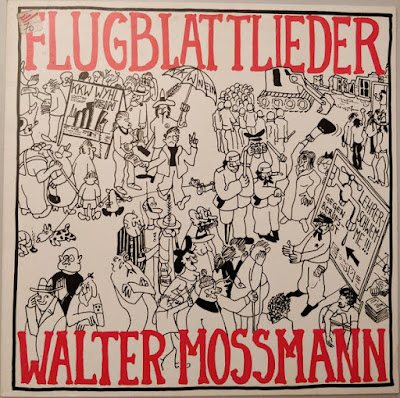
Walter Mossmann - Flugblattlieder (Trikont, 1975)

Walter Mossmann was a German singer / songwiter and political activist. He was a veteran of the 1960s Burg Waldeck Festivals.

Under the influence of the student movement, he had become a supporter of the anti-authoritarian wing of the Socialist German Students Association. In the 1970s, after a long artistic break, he performed in the anti-nuclear movement as a singer of Flugblattlieder and supporter of a socialism of "the Third Way". As a vehement opponent of the DKP, he articulated a widespread feeling in the folk and Liedermacher scene that the Party (DKP) was dogmatic, conservative and incompatible with the "New Left" with which many of us identified.

He represented the typo of intellectual political singer who, from a decidedly anti-capitalist position, used songs to politically enlighten his audience. He held an undogmatic left-wing viewpoint and found himself in constant battles with other left-wing groups in the anti-nuclear movement, who, like the K-Gruppen or the DKP, tried to use the protests for their own ends. 

He called his songs Flugblattlieder to emphasize their everyday use value (Gebrauchswert) as opposed to being a performance art form for public consumption. 

The album "Flugblattlieder" was recorded at Tonstudio Zuckerfabrik, Stuttgart. "Westendsong" is a translation of a song written by Phil Ochs. 

In 1974  an alliance of anti-nuclear action groups from South Baden (Germany) and Alsace (France) organized the occupation of the planned construction site for the AKW Whyl.  Mossmann´s song "In Mueders Stübele" was his contribution to the site occupation - the song became a kind of anthem for the Whyl anti-nuclear movement. It was originally a traditional German folk song known to large sections of the population in this part of Germany and France. Mossmann kept the melody, structure and first verse of the song, but his new text gave it an anti-capitalist slant relating to the situation in Whyl. The new message was that there was a war, this time not between the French and Germans, but between the farmers and the rich men of the nuclear industry. By using an everyday, naive language, Mossmann connected with the everyday experiences of his audience in such a way that his analysis of the conflict and the concequences appeared plausible. 

In the "Offenburger Erklärung" of 1976 the Baden-Württemberg regional government agreed on a moratorium with the nuclear opponents and finally renounced their plans to build the Whyl atomic plant in 1977 after a negative court decision. At the same time plans for a nuclear plant in Kaiseraugust in Switzerland and a chemical plant in Marckolsheim in France were cancelled. 


Tracklist:

A1 Der KKW Nein Rag
A2 Mueders Stübele
A3 Bruckelied
A4 Ballade von der salzigen Monika ...
A5 Lied von der Gedankenfreiheit
A6 Lied vom grünen Gras

B1 Lied vom Betriebsfrieden
B2 Ballade vom Hexenhammer
B3 Sieben Fragen
B4 Westendsong


(320 kbps, cover art included)

Josh White - Presenting...

A gifted and charismatic entertainer, Josh White (1914-1969) was a blues star of the 1930s, a cabaret star of the 1940s, and a folk star of the 1950s and the 1960s. In 1963, a Billboard magazine poll ranked him America's third most popular male folksinger, surpassed only by Pete Seeger and Harry Belafonte, and ahead of Bob Dylan. White brought American folk and blues to audiences around the world and released several dozen albums, all featuring his distinctive guitar style, supple voice, and unique showmanship.

In this compelling biography, Elijah Wald traces White's journey from a childhood leading blind singers on the streets of Greenville, South Carolina, to the heights of Manhattan cafe society. He explores the complexities of White's music, his struggles with discrimination and stereotypes, his political involvements, and his sometimes raucous personal life.

White was always drawn to music and made his first recordings at age fourteen. By the 1930s he had become a recording star, with equally strong careers in blues and gospel. In the 1940s he was discovered by white audiences and regularly appeared in New York cabarets alongside such artists as Billie Holiday. He also became an outspoken proponent of civil rights and frequently appeared at rallies and benefits, as well as at the Roosevelt White House, becoming known as "the Presidential Minstrel." He was one of the few black figures to star on Broadway and appear in Hollywood films, the only black solo performer to have his own national tour, and a daring sex symbol with adoring fans on both sides of the color line.

In the 1950s, White won acclaim in Europe, then saw his achievements collapse in the polarized political ferment of the McCarthy era. Attempting to strike a balance that would keep his career afloat, he instead ended up alienating both political camps. Although still a star in England, he became the forgotten man at home until his resurrection during the folk revival.

Tracklist:
 1. Apples, Peaches And Cherries
  2. Bad Depression Blues
  3. Black and Evil Blues
  4. Fare Thee Well
  5. Frankie & Johnny
  6. Free And Equal Blues 
  7. Howlin' Wolf Blues
  8. I Gave My Love A Cherry
  9. John Henry
  10. Little Brother Blues
  11. Nobody Wants You When You're Down And Out
  12. Prison Bound
  13. Foggy Foggy Dew
  14. House Of The Rising Sun
  15. The Lass With The Delicate Air
  16. I'm Gonna Move To The Outskirts Of Town
  17. Hard Time Blues
  18. Strange Fruit
  19. Lord, I Want To Die Easy

Josh White - Presenting...
(320 kbps, front cover included)

Freitag, 21. Oktober 2022

Lizzy Mercier Descloux ‎– Mambo Nassau

Out in some alternate universe, where old songs float around in space, there is a bridge that links Talking Heads' "I Zimbra" to the same band's "Born Under Punches." That bridge is formed by nine of the ten songs that make up "Mambo Nassau", Lizzy Mercier Descloux's second solo album.

Whether or not Descloux's severe yet foreseeable change in approach had anything to do with Talking Heads' own development is not (widely) known. It is known that she had become inspired by the traditional world music released on France's Ocora label, and in 1980 she took drummer Bill Perry down to Nassau to record at Compass Point, where she was aided by a number of people, including keyboard wiz, arranger, and -- ding ding! -- future Talking Heads associate Wally Badarou. The intent was to incorporate African elements into Descloux's existing vibrant mix of arty funk, disco, and film music, and the result was an album that nearly rivals just about any other rhythmically inventive release that came from the rock world at the time. 

Naturally, "Mambo Nassau" is even more adventurous than "Press Color". The instrumental setup - with the exception of some of the percussion - is completely Western and rock-oriented, with Badarou's excitable synthesizer often figuring prominently, whether churning out squiggled melodies or affecting the mood of the song with sensitive accents. The interplay between all of the instruments is positively acrobatic, including off-kilter time-keeping, wriggling guitars, and plump basslines that seem to twist in place. And, of course, there's Descloux's voice at the center of it all, adding even more life to the material with infectious wide-eyed exuberance. Eight of the album's ten songs are originals. Once you hear the cover of Kool & the Gang's "Funky Stuff," you'll realize that no one has ever had as much fun as Descloux had playing that song.


Tracklist:

Lady O K'Pele 2:24
Room Mate 3:37
Sports Spootnicks 4:20
Payola 4:19
Milk Sheik 0:45
Funky Stuff 4:05
Slipped Disc 3:35
It's You Sort Of You 2:14
Bim Bam Boom 3:05
Five Troubles Mambo 2:12

Lizzy Mercier Descloux ‎– Mambo Nassau (1981)
(256 kbps, cover art included)

Mekanik Destrüktiw Komandöh – Live! Die Kriegserklärung (1982)

"Live! Die Kriegserklärung" ("Live! Declaration of war") is a rare live recordings from the West-Berlin Punk & Avantgarde scene. "Mekanik Destrüktiw Komandöh" was an interesting project between punk, industrail and avantgarde. Alexander Hacke played in the weirdest projects and became famous with Einstürzende Neubauten.

Review from RateYourMusic:
"Babies von heute sind die Soldaten von morgen" ("Today's babies are tomorrow's soldiers").
Lots of overlap on this live album with the first "Weg zum Frieden" tape. The A-side was recorded in the Kant-Kino in June 1980 and is a bit more polished, the B-side was recorded in the SO 36 a month earlier, and the sound quality is much rougher. Which is a pity, as the band seems in a great form there – its incredibly intense, theatrical, dark punk with occasional jazz notes and loads of atmosphere, and it grooves like hell on tracks like "Babies von heute". Of course, if you don't speak German, you'll miss half the fun, as Volker Hauptvogel's lyrics are just as good as the music.

Tracklist:
Side A · Live at Kant-Kino, Berlin
01. Banane/Zitrone (1:52)
02. Rhythmus der Musik (3:40)
03. Rohe Gewalt (2:23)
04. Das Mörderlied (5.23)
05. Die Superbraut (3:18)
06. Kreuzberg 36 (1:02)

Side B · Live at SO36, Berlin
01. Kleine Mädchen (1:48)
02. Das Friedenslied (4:50)
03. Babies von Heute (2:15)
04. Falsche Freunde (2:30)
05. Liebeslied (3:07)
06. Propaganda durch die Tat (2:29)
07. Spaß muß sein (3:49)
Total Time: 38:06

Musicians
Volker Hauptvogel: vocals
Alexander Hacke: guitar
Edgar Domin: bass
Uli Radtke: drums
Stefan Schwietzke: sax

(ca. 256 kbps, cover art included)

Leadbelly, Big Bill Broonzy & Josh White - A Treasury Of Folk Music (1966)


Huddie William Ledbetter (January 1888 – December 6, 1949) was an iconic American folk and blues musician, notable for his strong vocals, his virtuosity on the 12-string guitar, and the songbook of folk standards he introduced. He could also play the piano, mandolin, harmonica, violin, concertina, and accordion. In some of his recordings, such as in one of his versions of the folk ballad "John Hardy", he performs on the accordion instead of the guitar. In other recordings he just sings while clapping his hands or stomping his foot.
The topics of Lead Belly's music covered a wide range of subjects, including gospel songs; blues songs about women, liquor and racism; and folk songs about cowboys, prison, work, sailors, cattle herding and dancing. He also wrote songs concerning the newsmakers of the day, such as President Franklin Roosevelt, Adolf Hitler, Jean Harlow, the Scottsboro Boys, and Howard Hughes.

Big Bill Broonzy (26 June 1898 – 15 August 1958) was a prolific American blues singer, songwriter and guitarist. His career began in the 1920s when he played country blues to mostly black audiences. Through the ‘30s and ‘40s he successfully navigated a transition in style to a more urban blues sound popular with white audiences. In the 1950s a return to his traditional folk-blues roots made him one of the leading figures of the emerging American folk music revival and an international star. His long and varied career marks him as one of the key figures in the development of blues music in the 20th century.
Broonzy copyrighted more than 300 songs during his lifetime, including both adaptations of traditional folk songs and original blues songs. As a blues composer, he was unique in that his compositions reflected the many vantage points of his rural-to-urban experiences.

Joshua Daniel White (February 11, 1914 – September 5, 1969), best known as Josh White, was an American singer, guitarist, songwriter, actor, and civil rights activist. In the early 1930s, he also recorded under the names "Pinewood Tom" and "Tippy Barton."
He became a 1920s and 1930s star of "race records", with a prolific output of recordings in genres including Piedmont blues, country blues, gospel, and social protest songs. He was billed in concert as "The Sensation of the South". In 1931, White moved to New York and within a decade his fame had spread widely, and his repertoire expanded to include urban blues, jazz, Tin Pan Alley, cabaret, folk songs from around the world, and hard-hitting political protest songs. He soon was in demand as an actor on radio, Broadway, and film. However, his pioneering guitar playing never altered or diminished, while some would even argue it broadened with the expansion of his musical repertoire.

Tracklist:

A1. Leadbelly - How Long                  
A2. Leadbelly & Sonny Terry - John Henry
A3. Leadbelly & Josh White - Don't Lie Buddy
A4. Leadbelly - Ain't You Glad
A5. Big Bill Broonzy - Letter To My Baby
B1. Josh White - Saint James Infirmary
B2. Josh White - Lass With The Delicate Hair
B3. Josh White - When I Lay Down & Die Do Die 
B4. Josh White - Early Morning Blues
B5. Big Bill Broonzy - Baby Please Don't Go

Leadbelly, Big Bill Broonzy & Josh White - A Treasury Of Folk Music (1966)
(ca. 170 kbps, cover art included)

Familie Hesselbach - Süddeutschland (1984)

Familie Hesselbach was formed in Tübingen, West Germany in 1981.

The South German punk and new wave band caused a sensation between 1981 and 1985, first regionally and then nationwide. They indulged in a deliberate eclecticism from the musical preferences of the individual family members and formed these into their unmistakable sound. Disco, pop, punk, rap, the main thing is danceable. The lyrics in German and Italian, later also in English - and always with a wink. Their trademarks were the rousing live quality of the performances and the use of brass instruments, trumpet and clarinet from the beginning - the tenor saxophone was added later. 

 The 12´´ "Süddeutschland" was released on the Zickzack label in 1984.

Tracklist:


A1 Süddeutschland 5:15
A2 Das Bild 4:48
B1 Rimini 3:35
B2 Zur Kur 4:11


Familie Hesselbach - Süddeutschland (1984)
(256 kbps, cover art included)

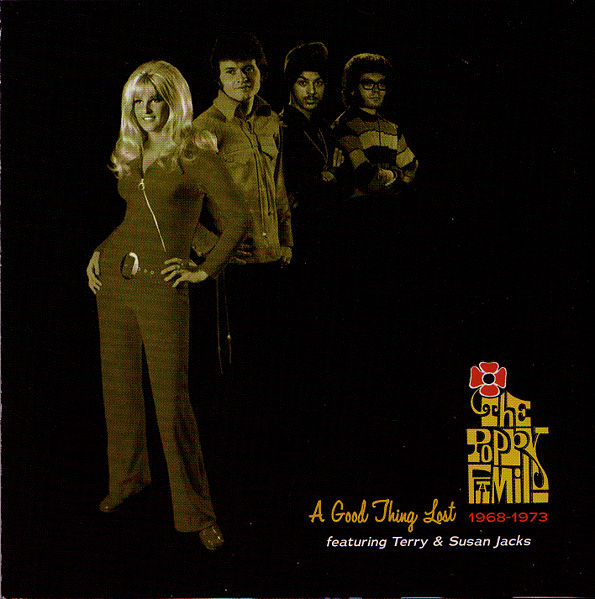
The Poppy Family - A Good Thing Lost 1968 - 1973

Susan Pesklevits and Terry Jacks met in the band Powerline.

They later married and formed the Poppy Family in 1968. With guitarist Craig McCaw and percussionist Satwan Singh, the duo's third single, "Which Way You Goin' Billy," became a hit in the U.S. and their native Canada, selling over two million copies.

The group recorded three albums in the early '70s: "That's Where I Went Wrong" and "Which Way You Goin' Billy" in 1970 and "Poppy Seeds" in 1971.

Terry and Susan were divorced by 1973, however, and both began solo careers. Susan released "Dream" (1976), "Ghosts" (1980) and "Forever" (1982), but Terry became more successful when his "Seasons in the Sun" single went platinum in Canada (more than 150,000 units). His albums include "Seasons in the Sun" (1974), "Y'Don't Fight the Sea" (1976), "Pulse" (1983) and "Into the Past" (1989).

Tracks:
Beyond The Clouds
Free From The City
What Can The Matter Be?
Which Way You Goin', Billy?
Happy Island
There's No Blood In Bone
A Good Thing Lost
You Took My Moonlight Away
Shadows On My Wall
That's Where I Went Wrong
Where Evil Grows
I Was Wondering
Tryin'
Winter Milk
Good Friends?
I'll See You There
You Don't Know What Love Is
I Thought Of You Again
Another Year, Another Day
Evil Overshadows Joe
Endless Sleep

The Poppy Family - A Good Thing Lost (1968 - 1973)
(192 kbps, cover art included)

Donnerstag, 20. Oktober 2022

Cassiber - Man Or Monkey (1982)

"Man or Monkey" was Cassiber's first album. It was released in 1982 on the German label Riskant as a set of two 45 rpm LPs - a format that turned it into a pricy collector's item. For this first effort, 

Christoph Anders, Chris Cutler, Heiner Goebbels, and Alfred 23 Harth entered the studio with only a handful of the drummer's lyrics and a few melodic ideas. They improvised, letting structures and arrangements develop by themselves, so to speak, and singer Anders threw in a text when he felt it appropriate. 

Even on the ReR Megacorp CD reissue, the structure of the four-sided LP remains strongly detectable. Side A presents three short improvised songs. Lyrics are more declamated than sung and the musical flooring is loosely rhythmical but very intense ("Red Shadow" is a highlight). Side B focuses on more prepared songs and Anders' singing. The festive music of "Our Colourful Culture" creates a disgusting contrast with the somber lyrics ("I came from the country/Arriba! Arriba!/They were killing my family/Ha ha ha ha"). "O Cure Me" sets the lyrics from one of Bach's cantatas against a delicate keyboard motif and thunderous clashes of noise. Both of these pieces would remain in the group's live sets until the end ten years later. Side C contains the 16-minute free improvisation "Man or Monkey." It has interesting moments but never really lifts up -- a failed attempt for the most part. Side D contains nice percussion work. "Man or Monkey" is miles away from the conciseness and strength of  "A Face We All Know", but it already shows all the ingredients for the maturation of this seminal avant rock group.


Tracklist:
1. Not Me (3:38)
2. Red Shadow (3:50)
3. Chor der Gefangenen (4:51)
4. Our Colourful Culture (3:05)
5. O Cure Me (5:54)
6. This Core (4:20)
7. Man or Monkey (16:39)
8. Django vergibt (3:10)
9. Die Verunreinigung des Flusses ist gerade noch ertraeglich (6:38)
10. Sag mir wo die Blumen sind (2:41)

(ca. 192 kbps, cover art included)

Terry Jacks - Seasons In The Sun (1973 / 2008)

Terry Jacks (born March 29, 1944 in Winnipeg, Manitoba) is a Canadian singer, songwriter, record producer and environmentalist.His family having relocated to Vancouver, Jacks took up guitar in his teens and at 18 joined a Vancouver, British Columbia, band called The Chessmen. The group had a few minor local hits before disbanding, after which Jacks teamed up with singer Susan Pesklevits (born 1948, Saskatoon, Saskatchewan). Jacks played guitar while Pesklevits sang lead vocals. Initially, their material consisted mainly of cover songs but eventually, Jacks began writing more and his songs were added to the repertoire. The duo performed at small Vancouver clubs before adding another guitarist (Craig McCaw) and tabla player (Satwant Singh) to restyle themselves as The Poppy Family.

Jacks and Pesklevits married in 1968 and eked out a living until the band burst onto the national charts in 1969 with their debut album, "Which Way You Goin' Billy?" which was written and produced by Jacks. The 45rpm single went to No. 1 in Canada and reached No. 2 on the Billboard charts in the United States, selling over three million copies. The single was the first million-selling record to ever recorded in British Columbia. It won a Juno Award for best performance while Jacks earned a Juno for best producer of a single. The Poppy Family won a Juno for best group and immediately followed up with a second album, Poppy Seeds, but it did not match the success of the first album. The Poppy Family did place two other singles in the top five in Canadan and the U.S. Top 50, "That's Where I Went Wrong" (No. 29, 1970) and "Where Evil Grows" (No. 45, 1971), the latter of which was a duet (unusual since Susan was lead singer on most of the group's singles). Jacks then released the solo single "Concrete Sea" which went to number one in Canada. It was never released in the US.

In 1973, Susan and Terry separated but Jacks produced two more albums before the marriage officially ended, Susan's first solo album "I Thought Of You Again" and Terry's "Seasons in the Sun." Jacks had worked with the Beach Boys to record the song "Seasons In The Sun" but the project was never finished so he recorded the song himself. Released in 1973 on his own record label, Goldfish Records, the song became the largest-selling international single by a Canadian artist and earned Jacks four Juno Awards. The song was based on an original called "Le moribond" by Jacques Brel with lyrics and melody modified by Jacks in honour of a friend who had died of leukemia. In the United States, where it was released on Bell Records, the song went to No. 1 on the charts. He released two more singles entitled "If You Go Away" (another English-language version of a Jaques Brel song entitled "Ne Me Quitte Pas") and "Rock & Roll (I Gave You The Best Years Of My Life)", both of which were substantial hits in Canada and placed well on the Billboard Hot 100 chart in the USA.

Jacks wrote and recorded a number of other songs and went on to produce Nana Mouskouri, Chilliwack (including the groups' first hit, ``Crazy Talk.``) and other Canadian artists. He earned Juno and Gold Leaf awards for his production work.

In the late 1970s Jacks married Margaret Zittier and gradually withdrew from the music world. The couple had a daughter, Holly Michelle Jacks, in 1985 and Jacks became involved in the environmental movement, focusing on pulp mill pollution issues in Canada. Jacks`environmental work has earned him several awards including one from the United Nations and the Western Canada Wilderness Committee. He has worked extensively in film and video, producing several shorts on environmental themes including "The Tragedy of Clearcutting", "The Southern Chilcotin Mountains" and "The Warmth of Love" (The Four Seasons of Sophie Thomas). The video production "The Faceless Ones" earned an Environmental Gold Award from the New York International Film Festival.
Jacks`second marriage ended in 2001. In 1996, Jacks released the CD, "A Good Thing Lost 1968-1973", a collection of The Poppy Family songs. He lives in Pender Harbour, British Columbia, and still does the occasional performance.


Tracklist:
01. Concrete Sea
02. I'm Gonna Love You Too
03. Pumpkin Eater
04. Again and Again
05. Since You Broke My Heart
06. Fire on the Skyline
07. The Love Game
08. I'm So Lonely Here Today
09. It's Been There from the Start
10. Sail Away
11. Seasons in the Sun
12. Put The Bone In *
13. If You Go Away *
14. Me And You *
15. Rock N Roll *
* — Bonus tracks

Terry Jacks - Seasons In The Sun (1973 / 2008)
(320 kbps, cover art included)

The Poppy Family - Which Way You Goin´ Billy? (1969)


The Poppy Family was a late 1960s and early 1970s Canadian pop music group, based in Vancouver, British Columbia. Susan Pesklevits and Terry Jacks met in the band Powerline. They later married and formed the Poppy Family in 1968.
"In the late summer of 1969 the Canadian record buying public chose to endorse The Poppy Family by establishing "Which Way You Goin' Billy?" as the biggest Canadian hit ever. 'Billy' successfully climbed to the No.1 spot on all radio stations across Canada. Having watched The Poppy Family from Vancouver, British Columbia, evolve as a recording group has been a satisfying and rewarding experience. The constant creative growth, both musically and lyrically, within the group is evident in the album "Which Way You Goin' Billy?".
The versatility of the group, from Terry Jacks' meaningful writing, to his wife Susan's beautiful and emotion-packed voice allow them to explore avenues of musical expression hitherto uncharted. All the while The Poppy Family retain their own sound so unique to themselves". (Fraser Jamieson, President London Records, Canada - November 17 1969).
Managed and produced by Terry Jacks, with featured vocalist Susan Jacks (tambourine/bean pod) and musicians Craig McCaw (guitar/sitar) and Satwant Singh (tablas/drums), the group recorded two albums.
At their career peak, Terry and Susan Jacks performed "Which Way You Goin' Billy?" on Bobby Darin's 1970 television variety special, "The Darin Invasion". The special also featured a young Linda Ronstadt performing her first solo hit, "Long Long Time". They also appeared on numerous other variety shows including "Rollin' On The River" with Kenny Rogers, the Bobby Vinton Show and The George Kirby Special.

The Poppy Family disbanded in 1973 when Susan ended their five and a half year marriage, the same year their solo albums were released - Terry's "Seasons in the Sun" and Susan's "I Thought of You Again". Terry Jacks scored an international No. 1 hit with Jacques Brel's "Seasons in the Sun". which earned him Juno awards for Male Vocalist of the year 1973 and 1974 and top selling single in 1973 and 1974. It still remains the best selling single ever released by a Canadian artist with sales of over 13 million worldwide. He was also charted with the singles "If You Go Away" (#45 1974) (another Brel cover, previously a minor hit for Damita Jo), "Concrete Sea" (#16 1972), "Christina" (#9 1975), "Rock'N Roll (I Gave You The Best Years Of My Life)" (#22 1975) (a bigger American hit by Mac Davis), and the Buddy Holly cover "I'm Gonna Love You Too" (#7 1973). He has since faded from the recording scene.

Susan Jacks went on to release three more solo albums and had a series of Juno nominated hits in Canada including "Anna Marie" (#20 1976), "All The Tea in China" (#93 1980), and "Tall Dark Stranger" as well as other hits such as "I Thought of You Again "(#7 1974), "You Don't Know What Love Is" (#3 1973) and "You're a Part of Me" (#41 1975) (later a Top 40 hit for Kim Carnes and Gene Cotton). In 1982, she moved to Nashville, Tennessee and, in addition to recording, became a staff songwriter for a Nashville publishing company. Several of her compositions have been recorded by Canadian artists, one of her songs being recorded on a Grammy nominated children's album. She recently returned to the Pacific Northwest and has resumed recording and live performances.

Album review:
While in recent years dozens of would-be hipsters have written about the dark undercurrents to be found in the music of the Carpenters, anyone looking for a truly great bummed-out soft rock experience needs to dig up the long out of print debut LP from Vancouver's Poppy Family. While producer, arranger, songwriter, and general straw boss Terry Jacks later found fame for his hit adaptation of Jacques Brel's "Seasons in the Sun," his greatest work was with his then-wife Susan Jacks and their group, the Poppy Family. Blending moody soft pop with light psychedelia, the group hit a rich vein of gorgeous melancholy that made sadness sound positively sensual (the album's token "upbeat" tune, "Happy Island," is significantly also one of the set's weakest moments). The album's two international hit singles, "Which Way You Goin' Billy?" and "That's Where I Went Wrong," are both tales of lovers on the run that sound as desperate as Del Shannon and as lonesome as Brian Wilson's worst nightmare, and such lost classics as "You Took My Moonlight Away" and "Beyond the Clouds" are every bit as strong, boasting clear but emotive vocals from Susan Jacks, brilliant if oddball Indian percussion from Satwan Singh, and melodramatic string arrangements from Graeme Hall. And the two side-closing "freakouts," "There's No Blood in Bone" and "Of Cities and Escapes," manage to be cheesy and powerfully effective at the same time. If the '70s were supposed to be about having a nice day, "Which Way You Goin' Billy?" shows the Poppy Family were one band waiting for a cloud to blot out all that annoying sunshine; at once kitschy and marvelously sincere, it's a great record worthy of rediscovery. (by Mark Deming, http://www.allmusic.com)

Track listing:
1. "That's Where I Went Wrong" – 2:28
2. "Free From The City" – 2:15
3. "Beyond The Clouds" – 2:30
4. "A Good Thing Lost" – 2:00
5. "You Took My Moonlight Away" – 2:40
6. "There's No Blood In Bone" – 2:55
7. "Happy Island" – 2:45
8. "Which Way You Goin' Billy?" - 3:18
9. "Shadows On My Wall" - 2:25
10. "What Can The Matter Be?" - 2:17
11. "For Running Wild" - 2:14
12. "Of Cities And Escapes" - 3:45

Musicians:
Susan Jacks: vocals, percussion
Terry Jacks: guitar
Craig McCaw: guitar, sitar
Satwant Singh: tablas, bongos, percussion

The Poppy Family - Which Way You Goin´ Billy? (1969)
(192 kbps, cover art included)

Mittwoch, 19. Oktober 2022

Cem Karaka - Die Kanaken (Pläne, 1984)

The legendary Turkish Rock Star Cem Karaca recorded the LP "Die Kanaken" during his exile in Germany. The album was released in 1984 on the Pläne label and contained songs from the musical “Ab in den Orientexpress” - which had its first performcance on the 22nd of April 1984 at the Westphalian State Theatre in Castrop-Rauxel - and other tracks.

The album is described as a "rebellion in a borrowed tongue", as the pioneer of the Anatolian rock movement sung the songs in German language.

Cem Karaca in an interview: “… Foreign workers are colloquially referred to as ‘Gastarbeiter’ in this country. Meaning guest laborer, guest worker. Isn’t the very reasoning of the people who can come up with such a phrase against our sensibilities? A guest who labors!”
“Cem Karaca has endured an inordinate amount of hardship. … His very exile resulted from a news item by a tabloid, causing him to find himself lumped together with other exiles from Turkey with whom he felt he did not belong, in the same category and the same country. Rather than the exiles he imperatively stood apart from, he grew closer to entities that we can define as the new social movements of Germany, such as the Greens, which in turn let do Karaca putting aside the use of language as his most important weapon and making music in a borrowed tongue.” (Münir Tireli, “Münir Tireli, Cem Karaca and Die Kanaken")

Cooming from the Hawaiian word kanaka Kanake (-n): is a German word for people from German-speaking countries with roots in Arab countries, Turkey, Southeast Europe and Persian speaking countries. It is used as a derogatory word, but also as a self-denomination. … Kanake has been re-appropriated by people of Arab, Turkish, Kurdish, and of other Middle Eastern ethnic minorities in Germany and used proudly as a term of self-identification. - Wikipedia

Cem Karaca’s first visit to Germany was in 1967 with his band at the time, Apaşlar. He recorded some 45-rpm records to be published by Türkofon, the record company owned by Yılmaz Asöcal that would later become Türküola. He returned to Turkey after shooting videos for WDR Television.

Of the songs that the band recorded in 1967, “Resimdeki Gözyaşları” was released in Turkey in 1968 and became a hit. Cem Karaca subsequently returned to Germany in ’68 to attend a festival titled “Europe Meets in Cologne”. According to the news item by Kölner Stadtanzeiger, Cem Karaca prompted the most fervent adulation of the festival. The same year, they released English versions of “Resimdeki Gözyaşları” and “Emrah”, but these would not become hits. Imagine if Elvis Presley opened a cassette shop in England!


In the words of Ironhand Records owner Ercan Demirel, “Cem Karaca’s Germany experience is full of what-ifs. The commonly held view about Cem Karaca is that he fled the country due to the warrant for his arrest. We know from news items and magazine articles at the time as well as an interview Cem Karaca gave to German television that this wasn’t the case.

In 1979 he goes to England to perform Pink Floyd at the famous Rainbow Arena where Pink Floyd performed no less…while abroad, they also stop by Germany and take the opportunity, thanks to demand by the gurbet crowd, to organize an array of concerts.

After the Germany and Netherlands concerts, Karaca returns to Turkey in September of 1979. There he records the album Hasret with Uğur Dikmen and studio musicians. Though the album is not yet released, he performs “Bu Biçim” for TRT audiences. With left-right conflicts in Turkey no less heated than when he left, he returns to Germany on January 11th 1980 and opens up a cassette shop in Munich. Imagine if Elvis Presley opened a shop in England!

Later on, in 1985, they participate in a live broadcast in which they perform as Die Kanaken. Cem Karaca describes it in his own words: he says that in the wake of a piece of news in a tabloid magazine in 1981, the military administration called for him to return to the country. However, he said, he was too afraid of what might happen to him if he did, so he rejected the call and was subsequently expatriated in 1983.”

When several of the musicians traveling in Germany with Karaca returned to Turkey, there was a shortage of band members. They met and began working with a German bassist. According to Fehiman Uğurdemir, one of the Anatolian rock scene’s legendary guitarists, who stayed with Karaca in Germany:

“It was through this bassist that we received a proposal to act and perform in a theater play at the Westfälisches Landestheater. A play, geared towards high-schoolers, that criticized the xenophobia that had been incited to worrisome magnitudes at that time: Ab in Den Orient Express [Backwards on the Orient Express].”

The play opens with a bet between two close friends, Bernd and Nuri. According to the bet, Bernd is to win 100 Marks if he can fulfill the conditions of being a Turk for a week. The conditions: to reach an agreement with an eminent personality, fulfill an errand in a government office and get a job, all in the guise of a Turk. Nuri adds one more mission post facto: Bernd will also have to steal the heart of a German girl. With a false mustache, provincial dress complete with black salwar and an affected accent, Bernd is now Süleyman for a week. What he encounters will take him by great surprise.

The script, comprised of poetry that would later be set to music, was penned by Harry Böseke and Martin Brukert.

Coming from a theatre-wise family, Karaca “decided in advance” and “dragged [Uğurdemir] into it”. Says Uğurdemir: “Kanaken’s ideology was something else entirely. It wasn’t Kanaken’s purpose to entertain the public. To the contrary, it was a project meant to criticize and examine the current situation and spur people to think. At the time we performed some of the songs live on TV programs. That got word of the album out there. It was rather more popular amongst the German intelligentsia, however. When you listen to a famous âşık in Turkey it hits you in your soft spot because it’s written in your language and says something of your sentiments and culture. I think that Harry Böseke and Martin Burkert’s words touched the sweet spot of the German people in the same way. With those intense lyrics, people at the concerts couldn’t dance even if they wanted to.”


In the album that was recorded in Cologne, not only with Fehiman Uğurdemir, but also with Cengiz Öztunç, Sefa Pekelli, İsmail Tarlan and Betin Güneş. Along with the musicians from Turkey, in "Beim Kaffee" Clemente Alfredo plays the violin and in "Çok Yorgunum", the synths were played by Dick Stadtler.

Writer and critic Ulrich Gutmair remarks that on first listen to this album, he thought it quaint and unlike the German pop sound of the ‘80s. He says that upon then listening to a Turkish album by Cem Karaca, he understood that Karaca had stayed true to his own sound with "Kanaken" too.

We share below the lyrics of the song "Es kamen Menschen an" that, just like the bard Ata Canani’s "Deutsche Freunde", were inspired by the words “laborers were called, humans came” by Swiss playwright Max Frisch:

"Man brauchte unsere Arbeitskraft, (Our manpower was needed)
die Kraft, die was am Fließband schafft (the power that runs the assembly line)
Wir Menschen waren nicht interessant, (We as humans were not interesting)
darum blieben wir euch unbekannt (so we remained strangers to you)
Ramaramaramaramadah (amman amman amman amman)
Gastarbeiter (guest workers)
Ramaramaramaramadah (amman amman amman amman)
Gastarbeiter (guest workers)
Es wurden Arbeiter gerufen,
doch es kamen Menschen an (Laborers were called, humans came)"


The only Turkish song on the album "Die Kanaken" was adapted from the Nazım Hikmet poem "Çok Yorgunum" [I Am So Tired]. On the special request of Cem Karaca, all of the lyrics were printed in both languages.


Trackllist:

A1 Mein Deutscher Freund 4:17
A2 Beim Kaffee 2:31
A3 Total Geschlaucht 3:20
A4 Willkommen 2:35
A5 Es Kamen Menschen An 4:20
B1 Schnüffler 3:05
B2 Orient-Express 2:35
B3 Was Sagst Du
B4 Ayşe, Meral, Semra 2:47
B5 Çok Yorgunum

Cem Karaka - Die Kanaken (1984)
(128 kbps, cover art include)

Montag, 17. Oktober 2022

X-Ray Spex – The Day The World Turned Day-Glo (Single, 1978)

X-Ray Spex were a British UK Punk Rock group formed in 1977 by vocalist Poly Styrene (born Marianne Elliott-Said), bassist Paul Dean, guitarist Jak "Airport" Stafford, drummer Paul "BP" Hurding and saxophonist Lora Logic. This song was the first of their three UK Top 40 hits. The band dissolved in Autumn 1979 and Poly Styrene temporary pursued a solo career before giving up music to pursue her interest in Eastern mysticism. Stafford and Hurding went on to form the new wave band Classix Nouveaux together with Mik Sweeney and Sal Solo with whom they achieved some chart success.

Poly Styrene explained this song to Mojo magazine: "Most people thought the song was about tripping, but I was using images of artificiality. I grew up in a generation where all we had was brown paper bags in the local store, but gradually everything became more colorful. Day-Glo symbolized the shift from natural to synthetic. We weren't buying cotton any more but Bri-Nylon. It was a great time, people were discovering things with technology. Bri-Nylon you could wear to school and your mum didn't have to iron it."


Tracklist:

A The Day The World Turned Day-Glo
B Iama Poseur

(320 kbps, cover art included)

Sonntag, 16. Oktober 2022

Interzone - Interzone (1981)

Interzone was a German blues-rock group, founded in the beginning of 1979, headed by vocalist Heiner Pudelko. In the beginning Pudelko was not writing his own lyrics, but was fascinated by the poems of Wolf Wondratschek, the great poet for all eccentrics and loners. .

In early 1981, Interzone went into the Berlin 'Audio' recording studio and recorded with co-producer Udo Arndt their first album, still unsigned. Shortly before the end of the production, it came to an agreement with a record company and mid-June 1981, the self titled debut album was released. . Shortly thereafter Interzone played live at Berlin Waldbühne in front of 22,000 fans and were broadcast live on TV. 

Montezuma wrote in 2014 about this album:

Times were pretty easy then: the west was shiny and rich, the east was dark and dirty. Colorbright the west, grey the east. Was it? 
No! There was more between the different sectors. Something between "Die Zone" - how the east was called - and "Der Westen". The Interzone!!

I remember holding this album in my hands for the first time. The angry man on the front - all back & white - with red letters on top: "interzone"

I remember putting this album on my turntable for the first time. Hard blues guitars and a voice killing me immediatly:

"Du verstehst nichts vom Business
sagt der Hintermann"


Shock and awe! And then the refrain came:

"und er kommt dir entgegen
und haut dir mit vergnügtem sinn
in die schnauze rin"

("and he comes towards you
and beats you with a jolly sense
into your trap")


I never heard something like that from a German band. The lyrics felt the same.

I could quote most any song on this album to highlight the lyrics on this. Never had a band such a language of gutter to tell songs from the gutter.

"Kinderlied"("Children's song") is a song about a child who's parents are addicted to drugs and whos mum works as a prostitute too.

And Heiner Pudelko was the perfect singer to this songs.

Interzone didn't sing about the good life, they weren't on the sunny side. Everything was grey and muddy. Like it's been in Berlin, east and west. This was about "blnw".

Tracklist:

Hintermänner 3:59
Blues 3:14
Kinderlied 3:30
Blnw 2:50
Jobs 2:51
Rita & Klaus 3:18
Dilettanten Des Wunders 3:28
Die Lebendigen + Die Toten 4:17
Liebeslied 4:01
Glotze 4:00
Karl 3:59

(320 kbps, cover art included)