Dienstag, 21. November 2023

Jacques Brel - Jacques Brel Et Ses Chansons (1954)


Nine songs spread over ten inches of shellac, Jacques Brel's debut album descended upon the French scene of the mid-'50s like an alien invasion. One moment, the chain-smoking Belgian singer/songwriter was a minor name struggling for survival around the Paris nightclubs, frequently playing his intense little songs at six different venues a night; the next, the gleeful "Il Peut Pleuvoir" and the contrarily sober "Sur la Place" were rewriting the very nature of the chanson. Where once was simple emoting, Brel implanted emotion. Where once was ribaldry, Brel inserted drollness. And where once local music was for squares and their parents, Brel was feted by teenaged rock & rollers.

"Jacques Brel et Ses Chansons", the album which ignited the iconoclasm, is ferociously confident. Although only one of the songs will be immediately familiar to a "rock" audience - Marc Almond covered "Le Diable (Ca Va)" (as "The Devil" on his "Jacques" album) - still there is an instantly recognizable compulsion to the performance. Brel's mellifluous, half-smiling, half-snarling voice gallops across the landscape, paced all the way by the richly textured and deeply imaginative accompaniment of Andre Grassi and his orchestra; the snatch of French accordion which punctuates the dark delivery of "Il Nous Faut Regarder" is both hideously apposite and rudely ironic.

It is not all doom and gloom, of course - indeed, Brel's reputation for morbidity and misery is more the premise of his louder English acolytes than of his own work. "C'est Comme Ca" is insanely jovial, a veritable machine gun of leaping lyric and frolicking instrumentation; "Il Peut Pleuvoir" shares a similar outlook, while "Le Fou Du Roi" apparently stepped out of the court of Marie Antoinette, all sweetly chiming harpsichord and a sweetly lilting nursery rhyme rhythm. The ghost of Prokofiev's "Troika" which hangs around the melody only adds to the experience. It is "Sur la Place" which dominates, however. Recorded at one of his first ever sessions with orchestra leader Francois Rauber, with whom Brel would continue to work for the remainder of his career, the song rides an arrangement which wouldn't be out of place punctuating a gentle ghost story, while Brel's talent for conjuring the spirits of nostalgia and sadness from the passing of time is revealed with a perceptiveness almost unbecoming in a mere 25-year-old. Even compared with all that he would go on to create, "Jacques Brel et Ses Chansons" is no formative, tentative debut offering. Brel sprang into the public consciousness fully formed, with all his gifts and offerings already on public display. All he needed now was for the public to turn and look. Upon release, the album sold a little over 2,000 copies.

Jacques Brel - Jacques Brel Et Ses Chansons (1954)
(256 kbps, front cover included)

Mittwoch, 15. November 2023

Fehlfarben - 33 Tage in Ketten (1981)

In 1979 Die Fehlfarben were formed in Düsseldorf from the ashes of Mittagspause, an influential punk band comprised of Peter Hein (vocals), Franz Bielmeier (guitar), and Markus Oehlen (drums). The trio had previously established themselves in 1977 as Germany's first punk band, Charley's Girls, as documented in the 22-minute documentary film Charley's Girls (2005), which chronicles the burgeoning Düsseldorf punk scene surrounding the club Ratinger Hof circa 1977-1979. When Mittagspause split in 1979, Bielmeier -- already a central figure in the Düsseldorf punk scene, with the first German punk fanzine to his credit, The Ostrich -- went on to form an independent record label, Rondo-Label, which he maintained until 1981. Hein and Oehlen, on the other hand, went on to form Die Fehlfarben, a post-punk band, with some fellow musicians from the Düsseldorf punk scene: Thomas Schwebel (guitar), who had played with Mittagspause for a while, as well as the band S.Y.P.H.; Michael Kemner (bass), formerly of the D.A.F. collective; Frank Fenstermacher (saxophone); and Uwe Bauer (drums), who like Schwebel had also played with Mittagspause for a while.

The idea for the band arose during a November 1979 trip to England, where Hein, Schwebel, Bauer, and Oehlen were greatly inspired by the 2 Tone style of ska-punk that was then taking London by storm. They decided to bring this style of music back with them to Germany.

Die Fehlfarben recorded their second album "33 Tage in Ketten" without Peter Hein in the summer of 1981, and saw it enter the album chart as well. By the end of the year, both Monarchie und Alltag and 33 Tage in Ketten had broken into the Top 40.

Sure, the debut of Fehlfahrben was an absolute bomb. Peter Hein is a charismatic singer and he can write fantastic german lyrics. But this LP is worth hearing and continues their funky-punky non-NDW postpunk style.


Tracklist:

A1 Tanz mit dem Herzen 4:21
A2 Hutschläger 3:16
A3 Ich nicht verstehen 3:54
A4 Söhne und Töchter 3:16
A5 Imitation Of Life 2:47
A6 Schlaflos Nachts 4:50
B1 Die wilde Dreizehn 4:45
B2 Katze zur Maus 2:48
B3 Stunde des Glücks 4:41
B4 Wunderbar 4:09
B5 Der Marsch 6:08

(224 kbps, cover art included)

Kurt Weill - Down In The Valley (1950)


Down in the Valley is a folk-opera in one act by composer Kurt Weill and librettist Arnold Sundgaard, initially composed and conceived for the radio in 1945 then rewritten and produced in 1948. It uses famous American tunes to carry the story (including "Down in the Valley", "The Lonesome Dove", and "Hop Up, My Ladies") and connected by original choral music.

This short opera, originally running only about 20 minutes, was conceived as the first of a series of radio operas by Olin Downes, the music critic of The New York Times, and a businessman named Charles McArthur. The radio idea eventually fell through for lack of a sponsor, although Maurice Abravanel conducted an audition recording that was never broadcast. Hans Heinsheimer, the director of publications at Schirmer, approached Weill with a request for a school opera like "Der Jasager" for production by the opera department of Indiana University School of Music. Weill expanded and simplified Down in the Valley to a 40-minute version, and the revised version had its world premiere at that university in Bloomington, Indiana in 1948, directed by Hans Busch (son of Fritz Busch) and conducted by Ernst Hoffmann. Alan Jay Lerner's wife, Marion Bell, played Jennie. The piece was soon broadcast on NBC radio. In 1950, it was broadcast on NBC television. It was subsequently produced in July 1952 in Provincetown, New York at the Provincetown Playhouse, directed by Tony Randall.
In 1960, the piece was played in German at the Staatstheater in Hannover, directed by Hartmut Goebel and conducted by Walter Born, with "Die sieben Todsünden". In 1984, PBS Television broadcast the piece, directed by Frank Cvitanovich and conducted by Carl Davis. It was filmed in England by the Moving Picture Company. In September 1995, it was presented in Kansas City at the Lyric Opera, directed by Francis Cullinan and conducted by Russell Patterson. The work has also been performed numerous times by amateur forces. It has received a number of recordings.

The opera begins in a jail the night before an execution and is told in flashback form.
Brack Weaver, a teenager, falls in love with a girl, Jennie, after an Appalachian prayer meeting. But her father wants her to go to a dance with his shyster creditor, Thomas Bouché, who the father thinks will bail him out of his money troubles. Jennie disobeys and goes to the dance with Brack.
At the dance, the villain gets drunk and threatens the hero with a knife. The two fight, the villain dies (by his own weapon), and Brack is condemned to be hanged. On the night before his execution, he escapes to spend his last hours with Jennie, before turning himself in to meet his fate.

This recording with Marion Bell (soprano), William McGraw (baritone), Kenneth Smith (bass-baritone), Ray Jacquemot (bass-baritone), Richard Barrows (vocals), Robert Holland (tenor), Roy Johnston (bass), Jeanne Privette (soprano), Carole O'Hara (contralto), Ralph Teferteller (vocals)
RCA Victor Chorus, RCA Victor Orchestra, and Peter Herman Adler (conductor) was released on a 10" on RCA in 1950.

Kurt Weill - Down In The Valley (1950)
(256 kbps, front cover included)

Makwerhu - Somandla (1994)

Makwerhu was formed in 1991 in Cape Town, South Africa, by Mike Makhubele, Wakhile Xhalisa and Morris Mungoy.

From the linernotes:

"Makwerhu means brother and sister in Shangaan. The group sees their music as a part of the fight for a free (South-)Africa with no borders between countries, races or tribes.
Istead of trying to dominate one culture over the other Makwerhu unites them. The result is a magnificial mixture of several traditional styles of the Southern Africa with elements of Highlife, Reggae, Jazz, Afro-Rock and Rumba amon others. The lyrics are written in different languages of the Southern Africa such as shangaan, Xhosa, Zulu, Sotho and as wellin English."

Tracklist:

1Somandla
2Zulu Beat
3Nhongane
4Mahayeng
5Mabadi
6Mzala
7Shifaki
8Ahitivi
9Rito
10Khale Wa Khaleni


Makwerhu - Somandla (1994)
(256 kbps, cover art included)

Dienstag, 7. November 2023

Aron Saltiel - Jiddische Lieder (1996)

Aron Saltiel's music embodies the depth of his experiences. His concerts are inspired and heartwarming, always with an ear toward bringing people of diverse backgrounds together. His audience participatory "Niggunim" concerts in Europe paved the way for future generations to adopt his style of gently leading passive listeners into active singing. His concerts intersperse humorous spiritual anecdotes with subtly molded music, and include Sufi, Turkish, Greek, and Bulgarian Sephardic music.

Aron was born in the Ladino-speaking community of Istanbul of descendants of Sephardic Jews who were exiled from Spain in 1492. His first contact with Sephardic and Turkish music was in his home, where he absorbed the singing of his grandmother. Later he learned that many of the songs she sang to him were shared by Turks, Jews and Greeks, which led him to explore the galvanizing potential of music in these languages and cultures. Aron is still acknowledged as one of the world’s experts on Sephardic music, and has served as advisor and radio producer for both Jewish and Islamic music for Austrian national Radio (ORF) and West German Radio (WDR).

In 1971 Aron graduated from vocational school and worked as an immigrant worker in Switzerland and Germany. From 1973-1977 he studied Linguistics and Translation at the University of Graz, Austria, which eventually led to his working as translator for various government and educational institutions. Aron completed his training in psychotherapy in Switzerland and presently works as both a psychotherapist as well as a Breema bodywork practitioner.

His musical interests led him to study voice with Hedda Szamosi in Vienna, following which he founded the group, Alondra with Marie-Thérèse Escribano and Wolfram Märzendorfer. Although the term and precepts of "World Music" would not take hold until the late 1980s, throughout the early 1980s Alondra offered concerts dedicated to the performance of Jewish and Islamic music. Their concerts were seen as path-forging, and brought them invitations to renowned festivals such as the Steierische Herbst Festival, Graz, the Wiener Festwochen, the Semana de Musica Antigua, Burgos, the Festival des Arts Traditionnels, Rennes.

Aron's work in both collecting music and linguistics led to the seminal Sephardic Songbook (C. F. Peters Verlag Frankfurt) in 2001, based on field recordings between 1976 and 1996 in Bat-Yam, Israel, Sarajevo, Thessaloniki and Istanbul.

He has been invited to give solo as well as group concerts throughout Europe and the United States and continues to give workshops and participatory concerts of Hasidic Niggunim. His concerts are considered to be not only fun and exciting, but also uplifting with the power to bring people together.


Tracklist:

1 Dschankoje 2:17
2 Schejn Bin Ich, Schejn 2:04
3 Die Mame Is Gegangen 1:30
4 Margeritkes 2:04
5 Hob Ich Mir A Spann 1:39
6 Ich Lieg Hinter Grattes 2:39
7 Bulbe 1:55
8 Homentaschn 2:10
9 Die Alte Kasche 2:33
10 Amol Is Gewen A Majsse 3:39
11 Dire-Geld 2:17
12 10 Brider 6:25
13 Ojf Die Felder 3:56
14 Scha! Schtill! 1:45
15 As Der Rebbe Elimelech 2:20
16 Muh Asapro 2:15
17 Niggun 3:15

(320 kbps, cover art included)

Milva - Singt Brecht (ETERNA, 1982)

Singer and actress Milva reigned for decades among the most popular and far-ranging performers in her native Italy. Born Maria Ilva Biolcati in Goro on July 17, 1939, at 20 she beat out more than 7,000 rivals to claim top honors in an influential talent showcase, and in 1960 cut her debut single, a cover of Édith Piaf's "Milord."

In 1961 Milva earned third place at the influential San Remo Music Festival. A year later she came in second and returned to the competition often in the years to follow despite never earning first prize. In 1962 Milva headlined Paris' legendary Olympia Theatre, performing a set of Piaf songs to rapturous reception.

Soon after, she befriended actor and director Giorgo Strehler, who nurtured her interest in musical theater and encouraged the expansion of her repertoire, recommending works spanning from the Italian resistance movement to Bertold Brecht. Milva would become the first actress outside of Germany to prove successful in Brecht adaptations.

This is a compilation with songs by Bertolt Brecht, released in the GDR on the ETERNA label. It features recordings in Italian language.


Tracklist:

A1 - Jenny Dei Pirati = Seeräuber-Jenny (4:45)
A2 - Barbara-Song (5:10)
A3 - Ballata Della Schiavitù Sessuale = Ballade Von Der Sexuellen Hörigkeit (2:40)
A4 - Surabaya-Jonny (4:40)
A5 - Nel Letto In Cui Siamo Staremo = Wie Man Sich Bettet, So Liegt Man (3:30)
A6 - Ballata Di Maria Sanders = Ballade Von Der Judenhure Marie Sanders (3:05)
B7 - La Leggenda Del Soldato Morto = Legende Vom Toten Soldaten (4:30)
B8 - Sotto Le Querce Di Potsdam = Zu Potsdam Unter Den Eichen (2:20)
B9 - La Canzone Del Bene Stare Al Mondo = Ballade Von Der Billigung Der Welt (3:45)
B10 - Tutti O Nessuno = Keiner Oder Alle (Sklave, Wer Wird Dich Befreien) (1:35)
B11 - Se Fondata È Questa Mahagonny = Gründung Der Stadt Mahagonny (0:55)
B12 - Moon Of Alabama = Alabama-Song (2:45)
B13 - Havanna-Song (Ach, Bedenken Sie, Herr Jakob Schmidt) (1:50)
B14 - La Canzone Della Moldava = Lied Von Der Moldau (2:05)
B15 - Un Cavallo Si Lamenta = Ein Pferd Klagt An (O Falladah, Die Du Hangest !) (4:45)


Tracks B7 to B15: Live-Aufnahme der Aufführung des Piccolo Teatro Mailand 15. und 16. März 1975.
Tracks A1 to A3: aus „Die Dreigroschenoper“
Track A4: aus „Happy End“
Tracks A5, B11 to B13: aus „Der Aufstieg und Fall der Stadt Mahagonny“
Track B8: aus „Berliner Requiem“
Track B14: aus „Schweyk Im Zweiten Weltkrieg“

(320 kbps, cover art included)

Sonntag, 5. November 2023

Alfred Drake - Down In The Valley - Music By Kurt Weill (1950)

Here is one of Kurt Weill's less well-known efforts. It was his last composition, and he was supervising this 1949 recording when he died.

Despite this being a 10-inch record, it contains the complete "ballad opera," which lasted only about 45 minutes. Weill intended it for performance by amateurs. Nonetheless, the lead in this version is Alfred Drake, hardly an beginner. It's a superb performance. All the more odd, then, that this version is not in print and may never have been reissued since its initial publication. However, a performance from a few years later has been out at least twice, including now. It's in my collection, but although I haven't heard it for some years, I don't think it is better than this one.

The story involves an evil, rapacious capitalist who is killed in self-defense by Drake's man of the people, who then is sent off to meet his fate at the hands of the state. A period piece that makes liberal use of familiar tunes like Down in the Valley.

The basic sound here is pretty good, but my pressing must have been owned by either a Weill lover or a stalwart of the Old Left. It's as beaten down as Drake's proletariat character. But it's listenable, although I must apologize for the groove damage near the end of the piece.

Thanks to the original poster on http://big10inchrecord.blogspot.com/.


Tracklist:

01. Down In The Valley Side 1 (Down In The Valley; The Lonseme Dove)
02. Down In The Valley Side 2 (Hop Up; My Ladies; Other)


Alfred Drake - Down In The Valley - Music By Kurt Weill (1950)
(256 kbps, cover art included)

Weavers - Travelling On With The Weavers (1959)


"Traveling on With the Weavers" was recorded during a transitional time when Erik Darling was taking the place of longtime member Pete Seeger. Five of the album's 16 tracks feature Seeger and, tellingly, four of those were the only cuts from the album to be included on the 1987 anthology "The Weavers Classics".

It is tempting to compare Seeger and Darling, but suffice it to say that Seeger's presence is strongly felt where he appears, and his songs are the standouts on the album. "Old Riley" is a variation of Grandpa Jones' signature song "Old Rattler," and "Gotta Travel On" is a variation of the song with which Billy Grammer enjoyed a hit in 1959.

The Weavers go ethnic on side two, where the first four cuts are sung in foreign languages and nearly half of the songs overall are folk standards that would shortly become ubiquitous on commercial folk albums by the Kingston Trio and their imitators. The album is a tentative step in that Darling was only beginning to find his way as a Weaver, but the group's sound and approach is so consistent that casual listeners might not notice that anything unusual is afoot.    

Tracklist:          
A1 Twelve Gates To The City
A2 Erie Canal
A3 I Never Will Marry
A4 Old Riley
A5 Sinner Man
A6 House Of The Rising Sun
A7 The Keeper
A8 You Made Me A Pallet On The Floor
B1 Mi Caballo
B2 Kumbaya
B3 Hopsha-Diri
B4 Si Mi Quieres
B5 State Of Arkansas
B6 Greenland Whale Fisheries
B7 Eddystone Light
B8 Gotta Travel On

The Weavers - Travelling On With The Weavers (1959)
(256 kbps, cover art included)         

Freitag, 3. November 2023

Leon Lishner - Out of the Ghetto: Songs of the Jews in America (1959)

Leon Lishner (4 July 1913 – 21 November 1995) was an American operatic bass-baritone. He was particularly associated with the works of Gian Carlo Menotti, having created parts in the world premieres of four of his operas. He performed in many productions with the New York City Opera and the NBC Opera Theatre during the 1950s and early 1960s.

Born in New York City, Lishner was the son of Russian Jewish immigrants to the United States.

Several track titles are written in German on the LP labels and in Yiddish on the jacket rear.


Tracklist:
A1 Der Fisher
A2 Die Wandt
A3 Golus March
A4 Mein Ruheplatz
A5 A Nigun
A6 Yiddish
A7 Mein Yingele
A8 Zog Maran
B1 Viglied
B2 Yamen Roishen
B3 Die Frosh
B4 Elioh Hanovi
B5 Ich will nit Eisen katten
B6 In der Tiefkeit von der Nacht
B7 Schnell laufen der Rader
B8 Mil Chome
B9 A Volachel


(320 kbps, cover art included)

Mississippi John Hurt - Folk Songs and Blues (1963)


After a 35-year absence, Mississippi John Hurt made a return to recording with "Folksongs & Blues", and his gentle, easygoing style of country blues hadn't changed a bit in the intervening years. Hurt croons, and even occasionally whispers, the lyrics, accompanied by the lazy strum of an acoustic guitar and a few touches
of harmonica. He makes the insults in "Salty Dog" actually sound more disappointed than angry, and "Joe Turner Blues" sounds extraordinarily soothing for a song containing the line "He's the man I hate." Hurt is adept at composing lovely melodies (such as "Candy Man Blues") and his gentle, subtle performances do them justice. Still, as laid-back as it can be, it never becomes boring or insubstantial, primarily because the scarred pain in Hurt's voice, as well as the sometimes-dark lyrics, give these songs more weight than is easily apparent.

"Folksongs & Blues" is a great introduction to Mississippi John Hurt's talents, and is a must-have for anyone interested in country blues.

Tracklist:
A1Avalon Blues
A2Richland Women Blues
A3Spike Driver Blues
A4Salty Dog
A5Cow Hooking Blues
A6Spanish Fandang
B1Casey Jones
B2Louis Collins
B3Candy Man Blues
B4My Creole Belle
B5Liza Jane - God's Unchanging Hand
B6Joe Turner Blues

Mississippi John Hurt - Folk Songs and Blues (1963)
(256 kbps, cover art included)

Jack Kerouac - Readings by Jack Kerouac on the Beat Generation (1960)


Readings by Jack Kerouac on the Beat Generation is the third and final spoken word album by the American novelist and poet Jack Kerouac, released in January 1960 on Verve Records. The album was recorded during 1959, prior to the publication of Kerouac's sixth novel, Doctor Sax.

"Readings by Jack Kerouac on the Beat Generation" was the culmination of the author's short-lived recording career, a solo performance that transcends poetry and music -- it's literally spoken jazz, the artist improvising freely on the printed text of his own work in front of him.

Produced by Bill Randle, it was Kerouac's most musical performance, despite the fact that the recording contained only his voice and no accompaniment, using his voice and language the way a saxophonist might improvise on a particular melodic line or riff. He's spellbinding throughout, intense, focused, and even subtly changing voices with the work itself.


Jack Kerouac - Readings by Jack Kerouac on the Beat Generation (1960)
(256 kbps, front cover included)

Donnerstag, 2. November 2023

Paul Robeson ‎– Sings 20 Favourite Songs / Transatlantic Exchange Concert

From the liner notes:

The story of how the tapes of the 20 songs recorded in March of 1954 came to be “re-discovered” is interesting. They were originally given by Paul Robeson to the late Peter Blackman, a man of Barbadian descent who was an active trade unionist and socialist poet in England. He is best remembered for his pamphlet of poems “My song is for all men”, and it is obvious that there was a close affinity between him and Paul Robeson on many counts. On his passing, his son, also named Peter Blackman, found the tapes among his belongings, and loaned them to Mike Lewis a retired BBC engineer who is the brother of Roger Lewis, Secretary of the South Wales Miners’ Eisteddfod. Mike’s connection with the tapes go further, as he was a member of the Treorchy Male Voice Choir which sang at Porthcawl’s Grand Pavilion on October 5th, 1957, when Paul Robeson made his historic and defiant “Transatlantic Exchange” broadcast.

This CD contains the 20 tracks included on those tapes given by Paul Robeson to Peter Blackman, and also a new version of the actual Transatlantic Exchange concert itself. The songs sung by Paul Robeson during that historic event are taken from the tapes recorded during the broadcast in the studio in New York, rather than the version heard over the telephone in the Grand Pavilion, which explains why they are “cleaner” than any version issued before now. We are extremely grateful to Mike Price for the professional work he made on all these tracks, to ensure they can now be enjoyed in optimum conditions.


1 Didn'T My Lord Deliver Daniel?
2 Kevin Barry
3 Ode To Joy
4 There'S A Man Going Round Takin' Names
5 Song Of The Warsaw Ghetto
6 The Volga Boat Song
7 John Brown's Body
8 Madrid
9 The Ballad Of Joe Hill
10 Ol' Man River
11 Crimson Petal
12 Spanish Lullaby
13 Night
14 All Through The Night
15 Oh Mistress Mine
16 Turn Ye To Me
17 The Minstrel Boy
18 Riddle Song
19 What Is America To Me?
20 Danny Boy
21 Introduction
22 Will Paynter
23 Greetings From New York
24 Didn't My Lord Deliver Daniel?
25 All Through The Night
26 This Little Light Of Mine
27 Ode To Joy
28 Lullaby
29 Will Paynter
30 Y Delyn Aur
31 Paul Robeson - Thanks
32 Land Of My Fathers
33 We'll Keep A Welcome
34 John Humphrys - End Piece

(320 kbps, front cover included)

Mittwoch, 1. November 2023

Fun Boy Three - Summertime (Maxi Single)

Fun Boy Three formed in the summer of 1981 when Terry Hall, Lynval Golding and Neville Staples broke away from The Specials.

The band quickly hit the UK top 40 charts with their debut single, 'The Lunatics (Have Taken Over The Asylum)". This was followed in early '82 by two UK Top 10 singles with Bananarama, 'T'Aint What You Do (It's The Way That You Do It)' and 'Really Saying Something'. 

A further 7 singles (Summertime, The Tunnel of Love, Our Lips Are Sealed etc.) and two albums, The Fun Boy Three (1982) and Waiting (1983), the later produced by Talking Heads front man, David Byrne, were released before calling it a day in the Summer of 1983.

Here are The Fun Boy Three with their take on the classic oldie "Summertime"

Tracklist:

1. Summertime (Extended)
2. Summer of `82

(256 kbps, cover art included)

Jack Kerouac - Blues and Haikus (1959)

Blues and Haikus is the American novelist and poet Jack Kerouac's second album and was released in 1959. On the album, Kerouac's poetry readings are accompanied by jazz saxophonists Al Cohn and Zoot Sims.

The art-soaked, kicks-filled life of Jack Kerouac produced three records, and the second one Blues and Haikus found him in the studio with post-bop saxophone mainstays Al Cohn and Zoot Sims. While the record only sporadically attains the heights of its rather lofty ambitions, it remains a fascinating document, for it illuminates Kerouac as an artist of beautiful if problematic vision, vindicates Cohn and Sims as a pair of true pros, and brings great perspective to the mindset and milieu of the ‘50s American hipster.           

In the spring of 1958, just a few weeks after cutting "Poetry for the Beat Generation", producer Bob Thiele suggested making a second album - quite a daring notion, considering that the first album would prove so controversial that it wouldn't reach the public for a year - and Jack Kerouac agreed. Instead of pianist Steve Allen, however, Kerouac insisted that he be accompanied this time by two good friends, tenor saxmen Al Cohn and Zoot Sims. With Cohn doubling on piano, the resulting "Blues and Haikus" is a stunning duet between speaker and saxmen, working spontaneously in this peculiar mix of jazz and voice, in which the saxmen do get their solo spots around Kerouac's work. There's much more of a sense on this album of a conscious interaction here between Kerouac and his accompanists, and the album is more arch but also more intense and more imposing than its predecessor.

Tracklist:
A1: American Haikus (10:03)
A2: Hard Hearted Old Farmer (2:17)
A3: The Last Hotel & Some Of Dharma (3:52)
B1: Poems from the unpublihsed "Book of Blues" (14:10)

Jack Kerouac - Blues and Haikus (1959)
(256 kbps, cover art included)

Dienstag, 31. Oktober 2023

Miriam Makeba - Country Girl (Pläne, 1981)


Miriam Makeba was born in Johannesburg in 1932 and was the first African singer to make African music popular in the US and Europe. She campaigned against apartheid in South Africa and the government revoked her citizenship and right to return home. Her mother, a Swazi sangoma (traditional healer-herbalist) was arrested for selling umqombothi, an African homemade beer brewed from malt and cornmeal when Miriam was an infant so she spent the first six months of her life in jail. Her mother died during her exile. Her father died when she was six years old. She finally returned home after the end of apartheid and she died on tour in Italy in 2008 after a concert organized to support a writer-dissident.

Miriam became known as "Mama Africa" and was probably best known as a singer for her song, "Pata Pata." She has toured with singers such as Paul Simon, Nina Simone, Hugh Masekela and Dizzy Gillepsie. The ban on her records was lifted in South Africa in 1988 and she returned to her homeland in December 1990. Four years later she started a charity project to raise funds to protect women in South Africa. Her first concert in South Africa (1991) was a huge success and this was a prelude for a world-wide tour which included the USA and Europe.

She has released over fifty albums over the years, and her powerful and distinctive voice retains the clarity and range that enable it to be both forceful as a protest march and as poignant as an African lullaby. She keeps on singing, with her granddaughter Zenzi Lee in her background choir and a great-grandson in her entourage. She released a critically acclaimed comeback album, “Homeland,” released in 2000, which was nominated for a Grammy Award in 2001. She appeared in the movie of 2002 by Lee Hirsch, the opulent and exciting documentary “Amandla!” about the powerful part of music in the struggle against Apartheid. In 2004, at the South African Music Awards 10, her album “Reflections,” won two awards: Best Jazz Vocal Album and Best Adult Contemporary Album. She is on an international tour in 2007 with her eight member band, and performed for a free concert in May in London’s Trafalgar Square.  Miriam is Mama Africa, a lady with a special touch. She has weathered many storms in her life, including several car accidents, a plane crash and even cancer. She remains as active in her latter years as she did as a young girl with stars in her eyes.Her exceptional personal and artistic profile is part of the history of this century, all adding to the dramatic elements of an extraordinary life, making Miriam Makeba a living legend.

"Country Girl" was originally released in France on the "Disques Espérance" label and re-released in Germany on "Pläne" in 1981.


Tracklist:

A1 Country Girl 5:20
A2 Tailor Man 4:30
A3 Xica Da Silva 5:30
A4 Witch Doctor (Isangoma) 4:00
B1 The Lion Cries (Mbube) 5:00
B2 Meet Me At The River 5:40
B3 Goodbye Poverty 5:30
B4 Click Song 3:35

Miriam Makeba - Country Girl (Pläne, 1981)
(256 kbps, cover art included)

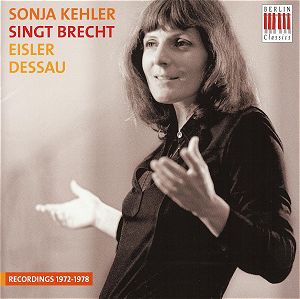
Sonja Kehler - Singt Brecht, Eisler, Dessau (Recordings 1972 - 1978)

"Sonja Kehler grew up in the German Democratic Republic and started her career as an actress who also landed roles that required singing. She played Eliza Doolittle in "My Fair Lady" for a long time and was also selected for Brecht roles. Towards the end of the 1960s she gradually left the theatre to concentrate on a career as a solo artist – also internationally. Hers was a typical Brechtian voice: flexible, unsentimental, excellent enunciation, a bit distanced in approach. The ageing Lotte Lenya’s ‘speak-song’ had become a kind of norm and Sonja Kehler belongs to that school, as does the roughly ten years older Gisela May. This disc with recordings from the 1970s was issued to coincide with her 75th birthday in 2008 as a tribute to a great artist.

Bertold Brecht and Kurt Weill are for many, I suppose, the inseparable radar couple in German music theatre. In fact their collaboration was short-lived. On the other hand, Dessau and especially Eisler worked with Brecht for many years. Eisler chalked up nearly thirty years collaboration with Brecht. There is, no doubt, a kinship between the three composers: in the straightforward approach, a kind of aggression, the rhythmic patterns, the often blunt ends, the adaptation of elements from jazz and popular music. But whereas Weill has a melodic directness that he was to hone and develop when he moved to the USA to fit into mainstream popular songs and Broadway musical theatre, both Eisler and Dessau are bolder, more experimental, drawing on sometimes harsh harmonies and melodic material based on speech. In particular Paul Dessau was quite avant-garde. The differences can generally be heard both in the theatre songs and the Lieder, where Eisler is sometimes ingratiatingly catchy, Dessau is more evasive. What they have in common is the gift to let Brecht’s lyrics speak – the melodies are not ends in themselves. They fit Brecht’s aesthetics: the epic theatre, the Verfremdungseffekt. This doesn’t imply that there is any kind of monotony. Within the concept there is variation aplenty. Among my personal favourites I would single out the melodically inventive songs from Herr Puntila … (Eisler) and Dessau’s Lied der Mutter Courage, where we hear soldiers marching relentlessly.

The Lieder, many of them quite short, are charmingly jazzy (tr. 17), catchy Schlager-melodies (tr. 18) or intimate ballads (tr. 24). Not all of them are Brecht settings. Dessau’s Tierverse are amusing miniatures and each of them starts like a fairy-tale: Es war einmal … One of them, Das Pferd (The Horse), was composed specifically for Sonja Kehler.

The accompaniments are varied, spanning from simple guitar-chords to full ensemble with winds and percussion, often with witty or illustrative instrumental solos. The arrangements are by Manfred Grabs and Helge Jung. The sound quality is excellent with wide stereo spread. The booklet has an interview with Sonja Kehler but unfortunately no sung texts. The message is central and even though Kehler’s articulation is spotless non-German natives at least would have been greatly helped by the printed words.

Whether this is a disc with universal appeal is debatable. The texts are political, even controversially so to some listeners, but provided one accepts Brecht’s point of view it is hard to imagine a better advocate for these songs than Sonja Kehler. A timely issue. Many Happy Returns of the Day! "

Göran Forsling


Tracklist:

Hanns EISLER (1898–1962): Die Rundköpfe und die Spitzköpfe

1. Das Lied von der Tünche [1:45]

2. Die Ballade vom Knopfwurf [4:44]

3. Das “Vielleicht”-Lied [1:53]

Paul DESSAU (1894–1979): Der Gute Mensch von Sezuan

4. Das Lied vom achten Elefanten [2:44]

5. Arioso der Shen Te [1:42]

Hanns EISLER: Herr Puntila und sein Knecht Matti

6. Das Puntila-Lied [4:23]

7. Ala die Pflaumen reif geworden [1:19]

8. Die Gräfin und der Förster [1:44]

Paul DESSAU: Mutter Courage und ihre Kinder

9. Lied der Mutter Courage [5:58]

10. Lied von der Bleibe [1:50]

11. Lied vom Fraternisieren [3:35]

Der Kaukasische Kreidekreis

12. Lied der Grusche (Vier Generäle) [1:35]

13. Liebster mein [1:26]

Hanns EISLER: Die Tage der Commune

14. Margot ging auf den Markt heut früh [1:21]

15. Resolution [3:27]

16. Ostern ist Bal sur Seine [1:03]

Lieder von Hanns Eisler / Lieder von Paul Dessau

Hanns EISLER

17. Considering everything [2:34]

18. Der Butterräuber von Halberstadt [2:24]

Paul DESSAU

19. Das Zukunftslied [3:05]

20. Der Pflaumenbaum [1:19]

21. Vom Kind, das sich nicht waschen wollte [1:28]

Hanns EISLER

22. Willem hat ein Schloss [0:54]

23. Lied vom kriegrischen Lehrer [0:45]

Paul DESSAU

24. Bitten der Kinder [1:06]

25. Kriegslied [3:12]

26. Sieben Rosen hat der Strauch [0:47]

27. Als ich nachher von dir ging [0:56]

Hanns EISLER

28. Hast am Feldrain geblüht, lieber Birnbaum [1:07]

Paul DESSAU

Tierverse (Brecht)

29. Das Schwein [0:22]

30. Die Ziege [0:51]

31. Der Hund [0:33]

32. Der Elefant [0:33]

33. Das Kamel [0:26]

34. Die Kellerassel [1:06]

35. Der Rabe [0:44]

36. Das Pferd [0:39]


Artists: Sonja Kehler (vocals), Helge Jung with instrumental ensemble (1, 5-9, 11-19, 22-24, 28-36); Bernd Wefelmeyer with instrumental ensemble (2-4); Werner Pauli (guitar) (10, 20, 21, 26, 27); Ernst Rentner (accordion) (12, 14-16, 28); Gundula Sonsalla (guitar) (6-8); Gerald Schleicher (clarinet)(6-8); Bernd Wefelmeyer (piano) (25)

rec. 1972 (26, 27); 1973 (1, 6-8, 14-18, 22, 23, 28); 1976 (5, 9-13, 19-21, 24, 29-36); 1978 (25, 2-4)

Sonja Kehler singt Brecht, Eisler, Dessau (Recordings 1972 - 1978)
(192 kbps, front cover included)

Montag, 30. Oktober 2023

Donny Hathaway - Same (1971)

"With just one exception, Donny Hathaway's second full-length is a covers album, featuring one of the most pop-averse artists in soul music surprisingly offering interpretations of contemporary hit material like "A Song for You," "He Ain't Heavy, He's My Brother," "Magnificent Sanctuary Band," and (most effectively) "Put Your Hand in the Hand," a laidback yet rolling, gospel-choir version of the song he was born to sing. 

In striking contrast to his debut, Donny Hathaway is a very dark record, and it opens on a particularly low note, with "Giving Up" (a 1964 R&B hit for Gladys Knight & the Pips). Most of Hathaway's performances are slow, piano-led laments, powerfully delivered but with little melodic sway to convert listeners. It's no coincedence then, that the only up-tempo song, "Magnificent Sanctuary Band," is the standout. "Little Girl" is a nice piece of gospel testifying with great male harmonizing on the chorus, and "He Ain't Heavy, He's My Brother" is a solid rendering of a song usually drenched in pathos.

Still, whereas `Everything Is Everything´ saw him leading the choir up in the front of church, Donny Hathaway sounds like the lament of a man alone in the sanctuary after services are finished." (- allmusic.com)


Tracklist:

1 Giving Up 6:17
2 A Song For You 5:24
3 Little Girl 4:43
4 He Ain't Heavy, He's My Brother 5:51
51 Magnificent Sanctuary Band 4:18
6 She Is My Lady 5:28
7 I Believe In Music 3:34
8 Take A Love Song 4:47
9 Put Your Hand In The Hand 3:42

Bonus Tracks
10 Be There
11 This Christmas


(192 kbps, cover art included)

Paul Clayton - Unholy Matrimony (1957)

Paul Clayton is one of the unsung heroes of the '60s folk revival. He was an avid collector of folk songs and an early companion of Bob Dylan, who may have been influenced by Clayton's low-key, half-sung, half-spoken delivery. He's remembered today, if at all, because it's been said that Dylan wrote "It's All Over Now, Baby Blue" and "It Ain't Me, Babe" about their relationship. 

It's widely known that Clayton's song "Who's Gonna Buy You Ribbons When I'm Gone" was the template for "Don't Think Twice," although the melody was a traditional one Clayton collected during his travels as a folklorist. All that said, this is one of Clayton's most exuberant albums, full of songs about the pitfalls of marriage and the wicked ways of women. (Clayton was gay, so maybe he was playfully venting some of his anger at heterosexual hegemony.) Clayton is accompanied here by future Greenbriar Boy Bob Yellin on banjo and cittern, a medieval stringed instrument that sounds like a harpsichord. 

The arrangements are simple -- old-time music meets bluegrass -- but Clayton's sly vocals bring these tales of misfortune and cuckoldry to life. "Stay Away from the Girls" delineates the horrors of married life; Yellin's banjo gives the tune an extra kick. "I Wish I Was Single Again" is one of the best-known songs about the hazards of marriage, again benefiting from Yellin's sprightly banjo. "The Old Wife Who Wanted Spruncin'" is slightly more feminist, the story of a widow who still enjoys sex, but her children conspire against her, embarrassed by her carrying on. "Life on the Installment Plan" became a folk hit under the title "A Dollar Down and a Dollar a Week," a warning about living beyond your means. "The Farmer's Servant" is a variation of a bawdy British song, and with a slight rewrite, it became a big pop hit called "The Thing" for comedy singer Phil Harris. "A Quick Way to Be Rid of a Wife" is a brief, gleeful tale of murder, set to the tune of the sea shanty "Early in the Morning." "The Husband with No Courage in Him" has the album's prettiest melody, probably from Scotland originally, the lament of a maid who has married a man with no interest in sex. It's the only tune that tells the story from the viewpoint of a woman, and the doleful minor-key melody gives the tune a poignant air that's missing from the rest of the album.


Tracklist:

A1 Stay Away From The Girls
A2 The Wooden Legged Parson
A3 Will The Weaver
A4 Mother-In-Law Song
A5 I Wish I Was Single Again
A6 The Old Wife Who Wanted Sprincin'
A7 The Charleston Merchant
A8 Life On The Installment Plan
A9 The Dumb Wife
B1 Jack The Sailor
B2 Farmer's Nagging Wife
B3 Dirty Wife
B4 The Farmer's Servant
B5 A Quick Way To Be Rid Of A Wife
B6 The Butcher And The Tailor's Wife
B7 The Husband With No Courage In Him
B8 I Can't Change It
B9 Home, Sad Home

(192 kbps, cover art included)

VA - Township Jazz 'N' Jive

In the second quarter of the 20th century, American jazz records began making their way to South Africa and exerting a huge impact upon the country's culturally besieged black community. As fascinated by the tight, hot jazz sounds as by the celebrity of the African-American stars playing them, urban musicians began appropriating the look, the sound, and, most courageously, the style of Louis Armstrong and the zoot-suited gangsters they saw in American films.

The township jazz, or marabi, that came to fruition in the '50s is some of the sweetest summertime jazz you'll ever hear. The main sound is the driving hot sound Armstrong perfected in the late '20s, but elements of Cuban rumba, American doo-wop, and South African a cappella singing slip into the mix. Groups like the Manhattan Brothers, the Jazz Dazzlers, and the Four Yanks provide gorgeous ensemble work, while legendary girl groups like the Skylarks and Nancy Jacobs & Her Sisters sing glowing soul tunes that would have made Phil Spector weak in the knees. This is the sound of people using music to transcend their own reality, and it's as redemptive as Jimmy Cliff's THE HARDER THEY COME or the best Sam Cooke singles.
"Before mbaqanga's stomping bumpkin intensity swept the townships, small jazz-style ensembles played indigenous tunes with a South African beat you could jitterbug to. This is that music, the same urbane mode cherry-picked so infectiously on the Mandela soundtrack: the swinging jive of the '50s, when social dancing was a passion in every slapped-together apartheid ghetto. Far suaver than mbaqanga or kwela yet no less African, far simpler than Count Basie or the Mills Brothers yet no less artful, it implied an indoor space even if it couldn't always find one big enough for its spiritual ambitions. Its matchless buoyancy is mostly a matter of two learned rhythms coming together. But it evinces an unsinkability nobody would ever puncture." - Robert Christgau


Tracklist:

1. Ubuhlungu - The Four Yanks
2. Clarinet Kwela - Kippie Moeketsi & The Marabi Kings
3. Banana Ba Rustenburg - Spokess Mashiyane
4. De Makebam - Jazz Dazzlers
5. Omnyakane - Royal Players
6. Something New In Africa - Solven Whistlers
7. Holilili - Skylarks
8. Ndenzeni Na? - Father Huddlestone Band
9. Baby Are Yeng - Nancy Jacobs & Her Sisters
10. Dudu Wam - Four Yanks
11. Tihapi Ke Noga - Dolly Rathebe
12. Loafers Corner - Orlando Seven
13. Ishumelosheleni - Manhattan Brothers
14. Kwela Blues - Lemmy 'Special' Mabuse
15. Ngi Hamba Ngedwa - Dorothy Masuka
16. Thaba Tseu - Manhattan Brothers
17. Mbube - Solomon Linda's Original Evening Birds
18. Midnight Ska - Reggie Msomi's Hollywood Jazz Band

(320 kbps, cover art included)

Sonntag, 29. Oktober 2023

Mississippi John Hurt – Make Me A Pallet - Live!

John Smith Hurt, commonly known as Mississippi John Hurt was born in the early 1890's and is one of those legendary blues singers of the same generation at Son House, Big Bill Broonzy, Blind Lemon Jefferson and Charlie Patton. He started playing guitar at age 9 and worked on and off as a sharecropper, recording for Okeh and Vanguard Records but the resurgence of his career came when he was invited to play at the 1963 Newport Folk Festival.

Mississippi John Hurt did a live 21-song set on April 15, 1965, at Oberlin College in Ohio, a scant two years after his rediscovery in 1963, and a year before his death in 1966. Hurt was remarkably consistent as a performer, whether you listen to his famous 1920s Okeh tracks, his rediscovery studio work for Vanguard Records, or the handful of live shows like this one: the skill and delivery is always steady, professional, and charming. Among the highlights in this set is his intricate and atmospheric slide guitar work on "Talking Casey," one of the few times Hurt abandoned his trademark three-finger guitar picking style. This concert has been issued in various configurations and sequences by several labels under different titles and with different cover art over the years.


Tracklist:

Nobody's Business But Mine
The Angels Laid Him Away
Baby What's Wrong With You
Casey Jones
Candy Man
Lonesome Blues
My Creole Belle
Make Me A Pallet On Your Floor
Trouble I Had All My Days
C-H-I-C-K-E-N Blues
Coffee Blues
Shake That Thing
Monday Morning Blues
Frankie And Albert
Salty Dog
Spike Drivers Blues
Here I Am, Lord, Send Me
Talking Casey
Hot Time In The Old Town Tonight
I'm Satisfied
Richland Women Blues

(320 kbps, cover art included)