Sonntag, 26. Oktober 2025

Richard Hell & The Voidoids – Blank Generation (1977/1990)

Richard Hell was one of the first men on the scene when punk rock emerged in New York City as an early member of both Television and the Heartbreakers (he left both groups before they could record). 
But his own version of punk wasn't much like anyone else's, and while Hell's debut album, "Blank Generation", remains one of the most powerful to come from punk's first wave, those anticipating a Ramones/Dead Boys-style frontal assault from this set had better readjust their expectations. 

"Love Comes in Spurts" and "Liars Beware" proved the Voidoids could play fast and loud when they wanted to, but for the most part this group's formula was much more complicated than that. Guitarists Robert Quine and Ivan Julian bounced sharp, edgy patterns off each other that were more about psychological tension than brute force (though Quine's solos suggest a fragile grace beneath the surface of their neo-Beefheart chaos). And while most punk nihilism was of the simplistic "Everything Sucks" variety, Hell was (with the exception of Patti Smith) the most literate and consciously poetic figure in the New York punk scene. 

While there's little on the album that's friendly or life-affirming, there's a crackling intelligence to songs like "New Pleasure," "Betrayal Takes Two," and "Another World" that confirmed Hell had a truly unique lyrical voice, at once supremely self-confident and dismissive of nearly everything around him (sometimes including himself). Brittle and troubling but brimming with ideas and musical intelligence, "Blank Generation" was groundbreaking punk rock that followed no one's template, and today it sounds just as fresh - and nearly as abrasive - as it did when it first hit the racks.


Tracklist:

Love Comes In Spurts 1:59
Liars Beware 2:50
New Pleasure 1:52
Betrayal Takes Two 3:33
Down At The Rock And Roll Club 3:37
Who Says? 2:07
Blank Generation 2:41
Walking On The Water 2:14
The Plan 3:53
Another World 8:10

plus 1990 CD reissue bonus tracks:
I´m Your Man
All The Way


Richard Hell & The Voidoids – Blank Generation (1977/1990)
(320 kbps, cover art included)

Samstag, 25. Oktober 2025

Karol Rathaus - Der letzte Pierrot - Sinfonie Nr. 1 (Decca Entartete Musik)

Karol Rathaus was one of those indirect victims of Nazism that Decca’s Entartete Musik series has been so indispensable in rediscovering. Polish-born, he was briefly very successful in pre-war Germany (an opera was premiered by Bruno Walter; Furtwangler and Horenstein also took him up). Seeing the way the wind was blowing he left Germany the year before Hitler came to power, wrote film music and a ballet in Paris and London but found few openings and fewer performances in America, where he eventually settled.

The First Symphony (there are two others) was roundly abused at its premiere in 1926; this recording is its first performance since then, and the composer – not yet 60 – went to his early grave believing the score to be
lost. It is a prodigiously inventive work, 40 minutes long though in only two movements, in a frowning, sinewy post-romantic style that might remind you just a little of the symphonies of Honegger or of the more austere pages of Martinu. The thematic language, though, is much closer to the Viennese tradition and its roots in Mahler, Reger and (Rathaus’s teacher) Schreker are clearly perceptible. But it has an individual emotional vein, often grim, sombre or shadowed, rising at times to a bitter eloquence that is very striking; orchestrally, too, it is highly accomplished. According to an accompanying note Rathaus was frightened by the reaction to the work and by the anti-Semitism of some of his critics; it is hard not to hear some such prejudice in dismissals of the symphony as ‘atonal’. It is no such thing, and although many of its melodies are angular and some of its dissonances harsh, it is by no means especially innovative for its period.

Even so, Rathaus apparently changed his style soon afterwards. Not radically, if his ballet The last Pierrot is anything to go by. Its melodies are sometimes smoother; no doubt association with dance added an element of grace to his manner, but the music is evidently by the same composer as the symphony. Jazz elements are introduced (and adroitly used to convey real menace at one point) and there is a violent forcefulness that aptly reflects the plot – this is a Pierrot in modern times, seeking his Columbine among factories and dance halls. It is effective and was for a while very popular. But it is the Symphony that whets one’s appetite for more of this impressively gifted composer’s music, especially in such eloquent performances as these. The Symphony is a tough piece to bring off – it had to wait five years for its premiere, because conductors were scared of it – but Israel Yinon has its full measure. I look forward to future recordings by him as eagerly as I do to more music by Karol Rathaus.

-- Michael Oliver, Gramophone [9/1998]

Tracklist:

Sinfonie Nr. 1
01. Erster Satz
02. Zweiter Satz

Der letzte Pierrot
03. Erster Akt
04. Zweiter Akt
05. Dritter Akt

Karol Rathaus - Der letzte Pierrot - Sinfonie Nr. 1 (Decca Entartete Musik)
(256 kbps, front cover included)

Freitag, 24. Oktober 2025

The Celibate Rifles – The Celibate Rifles (1984)

Playing stripped-down, loud, and fast Ramones-inspired guitar rock, the Celibate Rifles were one of the earliest Australian punk bands to emerge during the post-Radio Birdman/Saints era. 

Taking their cues from these Aussie bands, along with the American hard rock of the Stooges, MC5, and Blue Öyster Cult, the Rifles were led by the twin-guitar attack of Kent Steedman and Dave Morris and the deadpan baritone of vocalist Damien Lovelock. 

They exploded out of the gates in 1982 with a series of records (released in Australia only) fueled by high-speed guitars, wah-wah-strangulated solos, and cartoonish, tongue-in-cheek lyrics


Tracklist:

Wild Desire
Kiss Me Deadly
Pretty Colours
Back In The Red
Darlinghurst Confidential
Thank You America
Rainforest
Netherworld
Electric Snake River


The Celibate Rifles – The Celibate Rifles (1984)
(320 kbps, cover art included)


Mittwoch, 22. Oktober 2025

Hein & Oss - Singen Volkslieder (1976)

Hein & Oss were born identical twins on September 17th 1927 in Pirmasens, Germany. Through the influence of their mother and their grandfather they found a very early interest in singing and in music.

They belong to the small band of German folksingers who are internationally famous through their various concerts, broadcasting and television appearances.

Through their extensive travels they got to know the world and its music; their repertoire is extremely varied and interesting and is drawn from nearly every part of the folk word. Shanties or chansons, soldier´s songs, protest songs or spirituals - the congenial twins from Pirmasens enthrall their audience in Berlin and Calcutta, Paris and Rome, Athens, Teheran, Munich, Bagdad,Hamburg and London.

Hein & Oss belongend to the founders of the "Chanson Folklore International", whose annual festival was held at Castle Waldeck, Germany and was considered as a meeting point of well known folksingers from various countries.

This double album was recored in Munich, August 1976.

Hein & Oss - Singen Volkslieder - Auf den Plätzen, auf, in den Straßen (1976)
(192 kbps, front cover included)

Dienstag, 21. Oktober 2025

Hugh Masekela - Grrr (1966)

The South Afican-born trumpeter Hugh Masekela was playing world music before it had a name. On this album, recorded shortly after he moved to the United States and shortly before he became a worldwide star, he seamlessly fuses jazz ideas with the emotionally direct, rhythmically complex South African music known as Mbaqanga.

Masekela as a young trumpeter from the mid-'60s. Rare, but clearly his best format and playing.  - allmusic.com               

Tracklist:

01. U, Dwi (Masekela) (3:14)
02. Zuul and the Mexican (Masekela) (3:22)
03. Emavungweni (Xaba) (3:08)
04. Ntjilo-Ntjilo (Makeba) (4:12)
05. Sharpville (Masekela) (3:29)
06. Umaningi Bona (Nkabinde) (3:17)
07. Sipho (Mrwebi) (3:44)
08. Kwa-Blaney (Gwangwa) (2:12)
09. Mra (Christopher) (3:08)
10. Phatsha-Phatsha (Mabaso) (2:55)

Hugh Masekela - Grrr (1966)
(320 kbps, cover art included)
Sonntag, 19. Oktober 2025

Kalyi Jag - Lungoj O Drom Angla Mande - Gipsy Folk Songs From Hungary


Kalyi Jag (Black Fire) is a group formed in Budapest in 1978 by young Gypsies from Szatmár county. They play authentic Gypsy music, sung in Romany and Hungarian. Kalyi Jag consists of: Gusztáv Varga - voice, guitar Ágnes Künstler - voice József Balogh - voice, tambura, guitar, spoon József Nagy - water can, oral bass.
They are recognised as one of the foremost Gypsy folk ensembles in Eastern Europe today.

This is one of their early LPs released on Hungaroton Records in 1989 and features guitar, jug, whistle, oral bass, water can etc..


Tracklist:

1. Parne gada szi pe late (2:07)
2. Lungoj o drom angla mande (2:42)
3. Muri klaca kocsakenca (2:14)
4. Lina (5:09)
5. Aj, Dévale Koj Odi (3:53)
6. Pánzs kolompiri ande tigalya (2:26)
7. Ustyen Opre, Romále (3:05)
8. Le csurara mol na pena (3:26)
9. Kerkoj aba muro jilo (2:50)
10. Anta, romnyej, mure roulya (3:07)
11. Szájbőgő improvizáció (2:04)
12. Szar Csiriklyi (4:37)
13. Beng hhuklyasz ande roulyi (1:38)
14. Sápä szärátä ás mänká (3:01)
15. Kutyka téle, ko lahhikao kopácsi (2:13)
16. Csorro Joka (2:43)
17. Könyörgés (3:10)

01 She has a white dress on
02 I have still a long way to go
03 My trousers are buttoned all along
04 Lina
05 Oh, my God, who is there
06 There are five potatoes in the pot
07 Get up, Gypsies
08 Shieve-makers do not drink wine
09 My Heart Is Heavy
10 Give, woman, my stick to me
11 Oral bass improvisations
12 Like birds
13 The devil has hidden in my stick
14 I would eat salten onions
15 Over there under a little tree
16 Poor Joska
17 Song for Mercy

Kalyi Jag - Lungoj O Drom Angla Mande
(192 kbps, front cover included)

Freitag, 17. Oktober 2025

VA - 1962 - Chants De La Revolution Cubaine

Fidel Castro, Cuba's leader of revolution, died today at 90. More than half a century ago, his guerrilla army of “bearded ones” replaced Fulgencio Batista’s corrupt dictatorship with communist rule which challenged the US and turned the island into a cold-war crucible.
He fended off a CIA-backed invasion at the Bay of Pigs in 1961 as well as many assassination attempts. His alliance with Moscow helped trigger the Cuban missile crisis in 1962, a 13-day showdown with the US that brought the world closer to the brink of nuclear war than it has ever been.

He first tried to overthrow General Batista in 1953, was imprisoned, exiled to Mexico, and then returned in 1956. He succeeded on January 1, 1959 and has dominated Cuba ever since – surviving 638 documented attempts by the CIA to kill him, and living through ten US presidencies.

Resigning due to ill health in February 2008, Castro handed over to his brother Raul and is now rarely seen in public. But he continues to loom large in Cuba - writing regular columns for Granma, the Communist Party newspaper, and meet visiting dignitaries.


"Chants De La Revolution Cubaine" collects some historic recordings relatetd to the revolution in Cuba in 1959.

Tracklist:

  • 1. - Fidel Est Arrivé [Rolando La Serie Y Et Son Orchestre] - 2:57"
  • 2. - Partisans [Choeurs De Révolutionnaires Cubains] - 2:10"
  • 3. - Vive La Revolution [Raúl Luzardo Et Le Trio Los Titanes] - 3:11"
  • 4. - Sierra Maestra [Daniel Santos Et Son Ensemble] - 3:37"
  • 5. - Parlons De La Revolution [Celina Et Reutillo] - 3:08"
  • 6. - Les "Barbudos" [Orchestre Fajardos] - 2:30"
  • 7. - Au Commandant Camacho [Los Yayaberos] - 3:07"
  • 8. - Hymne De La Milice [Fanfarre De L'armée Rebelle] - 2:30"

VA - 1962 - Chants De La Revolution Cubaine
(192 kbps, cover art included)

Mittwoch, 15. Oktober 2025

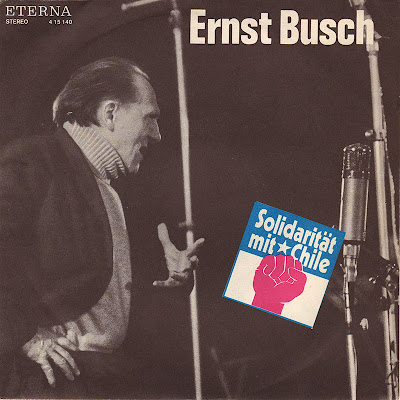
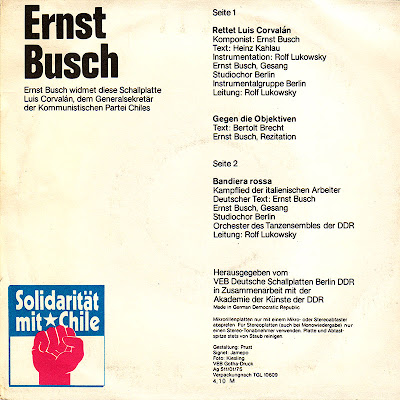
Ernst Busch - Solidarität mit Chile (Eterna, 1975)

This single was released in 1975 in the German Democratic Republic (GDR) as a special production to support the chilean communist leader Luis Corvalán.

Luis Alberto Corvalán Lepe (September 14, 1916, – July 21, 2010) was a Chilean politician. He served as the general secretary of the Communist Party of Chile (PCCh).
Corvalán joined the Communist Party of Chile at the age of fifteen in the city of Chillán shortly after the fall of the repressive dictatorship of Carlos Ibáñez del Campo in 1932. Trained as a teacher, after 1952 he became an elected member of the PCCh's Central Committee, and after 1958 served as the Secretary-General. The party was outlawed from 1948 until 1958. In this period Corvalán was interned in the concentration camps of Pitrufquén and later in Pisagua.

On September 11, 1973, General Augusto Pinochet lead a military coup and Corvalán was among the many arrested. After the murder of Victor Jara, he was the most prominent political prisoner in Chile. While in prison, Luis Corvalán was awarded the Lenin Peace Prize (for 1973-74). The Soviet Union launched an international campaign for his release and on December 18, 1976 Corvalán was exchanged for a notable Soviet political prisoner, dissident Vladimir Bukovsky, and received asylum in the USSR.

Corvalán headed the Communist Party of Chile - both within Chile and whilst in exile - for over three decades, which covered the whole period of the Pinochet military dictatorship. Corvalán returned to Chile in 1988.

Tracklist:
A1. Rettet Luis Corvalán 1:54 
A2. Gegen Die Objektiven 1:23 
B1. Bandiera Rossa 1:42 


Ernst Busch - Solidarität mit Chile (Eterna, 1960)
(160 kbps, cover art included, vinyl rip)


Gegen die Objektiven


Wenn die Bekämpfer des Unrechts
Ihre verwundeten Gesichter zeigen
Ist die Ungeduld derer, die in Sicherheit waren
Groß.


Warum beschwert ihr euch, fragen sie
Ihr habt das Unrecht bekämpft! Jetzt
Hat es euch besiegt: schweigt also!


Wer kämpft, sagen sie, muß verlieren können
Wer Streit sucht, begibt sich in Gefahr
Wer mit Gewalt vorgeht
Darf die Gewalt nicht beschuldigen.


Ach, Freunde, die ihr gesichert seid
Warum so feindlich? Sind wir
Eure Feinde, die wir Feinde des Unrechts sind?
Wenn die Kämpfer gegen das Unrecht besiegt sind
Hat das Unrecht doch nicht recht!


Unsere Niederlagen nämlich
Beweisen nichts, als daß wir zu
Wenige sind
Die gegen die Gemeinheit kämpfen
Und von den Zuschauern erwarten wir
Daß sie wenigstens beschämt sind!

(Bertolt Brecht)

Sonntag, 12. Oktober 2025

Theodore Bikel - Sings Jewish Folk Songs (1958)

A talented folksinger and actor, Theodore Bikel carved out his place in the modern entertainment industry as a renaissance man. For over 50 years, Bikel left his mark on film, the stage, and the arts, from his supporting role in The African Queen in 1951 to his appearance at the 1960 Newport Folk Festival to his appointment to the National Council for the Arts in 1977. Although he was born in Austria, he lived in Israel, England, and the United States and spoke five languages. Bikel recorded for Elektra, Columbia, and Reprise, published Folksongs & Footnotes, and served as a vice president of the American Jewish Congress.               

Bikel was born in Vienna, Austria, in 1924, but his family fled to Palestine in 1938, where they became British subjects. Bikel wanted to study language and become a teacher, so he worked at a communal farm to help pay expenses. Drawn to the theater, however, he left the farm in 1943 to study at the Hamimah Theater in Tel Aviv. Later, Bikel and four other actors formed the Tel Aviv Chamber Theater. In 1946, he left Israel to study at the Royal Academy of Dramatic Art in London. While in England, he also began to take a serious interest in folk music and learn the guitar. In 1947, Bikel's acting skills were noticed by Sir Laurence Olivier, leading to a part in the London production of A Streetcar Named Desire.
By the early '50s, Bikel began to play Russian officers and German sailors in English and American films and in 1955, he moved to New York City. The move also coincided with the beginning of a career in folk music. He signed with Elektra Records in the mid-'50s and recorded Israeli Folk Songs in 1955. He became a co-founder of the Newport Folk Festival and performed at the event in 1960. Bikel's repertoire proved uniquely eclectic, including songs from Russia, Eastern Europe, and Israel. He played hundreds of dates in United States, from the Rainbow & Stars in New York to the Boarding House in San Francisco, and traveled broadly, performing in New Zealand, Australia, and throughout Europe.
  Over the next 40 years, Bikel continued his dual career in film and folk music. He received parts in The Russians Are Coming in 1966, See You in the Morning in 1989, and Shadow Conspiracy in 1997. He recorded "Songs of the Earth" for Elektra in 1967, "A New Day" on Reprise in 1970, and "A Taste of Passover" for Rounder in 1998. Bikel also involved himself in a number of political activities. In 1977, President Jimmy Carter appointed Bikel to the National Council for the Arts, a position he retained until 1982. He also served with the Associated Actors and Artistes of America, Americans for the Arts, and the American Jewish Congress. In 1992, Bikel received an honorary Doctor of Fine Arts degree from the University of Hartford.

Tracklist:
                           
A1Der Rebe Elimelech
A2De Yontevdike Teyg
A3Sha Shtil
A4Di Ban
A5Kum AherDo Filozof
A6Di Mezinke
A7A Sundenyu
A8Achtsig Er Un Zibetsik Zi
B1Di Name Iz Gegangen
B2Margaritkelech
B3Mu Asapru
B4Lomir Zich Iberbeten
B5Homentashn
B6A Chazn Oyf Shabes
B7Reyzl
B8Tumbalalayka


Theodore Bikel - Sings Jewish Folk Songs (1958)
(256 kbps, cover art included)

Poesie & Musik - Francois Villon (1976)

"Poesie und Musik" was a trio ensemble consisting of Orlando Valentini, Andreas Vollenweider and René Bardet. Between 1974 and 1983 this ensemble was publishing inspiring records that combined poetry and music based on texts by Francois Villon, Heinrich Heine, the indian Chief Seattle and Pablo Neruada.

François Villon, pseudonym of François de Montcorbier or François des Loges, (born 1431, Paris—died after 1463), was one of the greatest French lyric poets. He was known for his life of criminal excess, spending much time in prison or in banishment from medieval Paris. His chief works include Le Lais (Le Petit Testament), Le Grand Testament, and various ballades, chansons, and rondeaux.

Perhaps the most deeply moving of French lyric poets, Villon ranges in his verse from themes of drunkenness and prostitution to the unsentimental humility of a ballade-prayer to “Our Lady,” “Pour prier Nostre-Dame,” written at the request of his mother. He speaks, with marvelous directness, of love and death, reveals a deep compassion for all suffering humanity, and tells unforgettably of regret for the wasted past.

His work marks the end of an epoch, the waning of the Middle Ages, and it has commonly been read as the inspiration of a “lost child.” But as more becomes known about the poetic traditions and disciplines of his day, this interpretation seems inadequate. It is probably either too early or too late fully to understand Villon’s work, as one critic has suggested; but although the scholar must still face a variety of critical problems, enough is known about Villon’s life and times to mark him as a poet of genius, whose work is charged with meaning and great emotional force.


Tracklist:

A1 Waldschratt (1:25)
A2 Ballade für den Hausgebrauch im Winter (3:45)
A3 Bettelballade für meinen armen Bruder Jean Cotard (3:35)
A4 Ballade von der treulosen Cylaea (4:55)
A5 Ballade von den Vogelfreien (2:40)
A6 Liebesballade für ein Zigeunermadchen (7:45)

B1 Ballade, mit der Meister Villon seine Mitmenschen um Verzeihung bittet (4:10)
B2 Sommerballade von der armen Louise (4:40)
B3 Neue Ballade, gedichtet für Mira L´Ydolle (4:40)
B4 Notwendige Nachschrift, mein Begräbnis betreffend (5:15)
B5 Kleine Ballade von Ddem Mäuslein, das in Villons Zelle Junge bekam (6:45)


Poesie & Musik - Francois Villon (1976)
(320 kbps, cover art included)
Freitag, 10. Oktober 2025

The Voices of the Civil Rights Movement - Black American Freedom Songs 1960-1966

This double-CD reissue documents a central aspect of the cultural environment of the Civil Rights Movement, acknowledging songs as the language that focused people's energy. These 43 tracks are a series of musical images, of a people in coversation about their determination to be free. Many of the songs were recorded live in mass meetings held in churches, where people from different life experiences, predominantly black, with a few white supporters, came together in a common struggle. These freedom songs draw from spirituals, gospel, rhythm and blues, football chants, blues and calypso forms.

"The Voices of the Civil Rights Movement: Black American Freedom Songs 1960-1966" documents the importance of songs in the Civil Rights Movement. The first disc features songs from mass meetings, where a singer or core of singers leads the people in the singing of the songs, while the second focuses on ensemble works by the SNCC Freedom Singers and other groups.

Chances are that unless you were involved in the Civil Rights Movement you will not especially recognize many of these songs, with "This Little Light of Mine," "Go Tell It On the Mountain," and "We Shall Overcome" being the obvious exceptions. But you will be surprised at some of the popular songs that were appropriate for the cause, such as "Calypso Freedom," based on Harry Belafonte's "The Banana Boat Song," and "Get Your Rights, Jack," based on the Ray Charles hit "Hit the Road, Jack." For me the song that stood out was "In the Mississippi River," written by Marshall Jones after the disappearance of three Civil Rights workers in Mississippi during the summer of 1964. As local rivers were dragged in search of the men, many other bodies were discovered, a chilling fact that certainly needs to be more than a historic footnote to that tragic event. There is also a lengthy segment from a sermon by Rev. Lawrence Campbell, which illustrates the song-sermons that were an integral part of the movement and its traditions. The result is a historical document of immense value.

Folkways Records was founded by Moses Asch and Marian Distler in 1948 to document music and spoken word from around the world. The Smithsonian Institution acquired Folkways from the Asch estate and has succeeded in preserving the best of the label's 2,200 albums. Smithsonian Folkways Recordings has continued this grand tradition. Their releases are superb, especially in terms of providing the historical context by which we can best appreciate these songs from another place and another time.
.

Mittwoch, 8. Oktober 2025

Egon Erwin Kisch - Erinnerungen an den rasenden Reporter

PhotobucketOn March 31, 1948, Egon Erwin Kisch, a german-speaking Czech journalist and novelist, died in Prague, Czech Republic.

Egon Erwin Kisch was "der rasende Reporter" ("the raging reporter"), a journalist whose interest in marginalized parts of society and the world outside Europe endeared him to a large number of readers. He became a figurehead in the fight against fascism. Later generations of journalists regarded his documentaries as exemplary and pioneering. He is admired to this day for the high literary quality of his journalitic work.

Kisch was born into a German-speaking Jewish family in Prague, at that time part of the Austro-Hungarian Empire, and began his journalistic career as a reporter for a local German language newspaper in 1906. His early work is characterised by an interest in crime and the lives of the poor of Prague, taking Jan Neruda, Emile Zola and Charles Dickens's Sketches by Boz as his models. He deserted from the army in World War I in October 1918 as the war came to an end and played a leading role in the left-wing revolution in Vienna in November of that year. Although the revolution failed, in 1919, Kisch joined the Communist party, a political allegiance he maintained for the rest of his life.
Between 1921 and 1930 Kisch, though a citizen of Czechoslovakia, lived primarily in Berlin, where his work found a new and appreciative audience. In books of collected journalism such as "Der rasende Reporter" (1924), he cultivated the image of a witty, gritty, daring reporter always on the move, a cigarette clamped doggedly between his lips. His work and his public persona found an echo in the artistic movement of "Neue Sachlichkeit", a major strand in the culture of the Weimar Republic.
On February 28 1933, the day after the Reichstag Fire, Kisch was one of many prominent opponents of Nazism to be arrested. He was briefly imprisoned in Spandau, but as a Czechoslovakian citizen, was expelled from Germany. His works were banned and burnt in Germany, but he continued to write for the Czech and émigré German press, bearing witness to the horrors of the Nazi takeover.
In 1937 and 1938, Kisch took part in Spanish Civil War. He travelled across the country speaking in the Republican cause and his reports from the front line were widely published.

Following the "Munich Agreement" of 1938 and the subsequent Nazi occupation of Bohemia six months later, Kisch was unable to return to the country of his birth. Once war broke out, Paris, which he had made his main home since 1933, also became too dangerous for an outspoken Jewish communist whose native land no longer existed. In late 1939, Kisch and his wife Gisela, sailed for New York where, once again, he was initially denied entry. He eventually landed at Ellis Island on December 28, but as he only had a transit visa moved onto Mexico in 1940.
He remained in Mexico for the next five years, one of a circle of European communist refugees, notable among them Anna Seghers and Ludwig Renn.

Kisch died two years after his return to Prague, shortly after the Communist party seized complete power. There are contradictory reports of his attitude - as a German-speaking Jew - to the party in this period as it began to develop the anti-semitism which culminated in the "Prague Trials" of 1952 and supported the expulsion of most of Czechoslovakia's ethnic Germans.
To remember his great work, here is "Erinnerungen an den rasenden Reporter", a wonderful feature in german language about Egon Erwin Kisch.

Egon Erwin Kisch - Erinnerungen an den rasenden Reporter
(192 kbps, front cover included)

Montag, 6. Oktober 2025

VA - Songs For Desert Refugees - A Compilation In Aid Of The Refugees From Northern Mali

Mali is one of the musical power-houses of Africa, but today it's a country in chaos, and its ancient culture is under threat. In the desert north, the rebels of the MNLA have been ousted by Islamist groups, adding to the crisis in which hundreds of thousands of refugees have fled to neighbouring states, at a time of acute food shortage across the region. This benefit album aims to raise money for refugee projects, but also provides a rousing new compilation of desert blues, with unreleased or rare tracks from Tuareg musicians from Mali, Niger and Algeria. It starts, appropriately, with a slinky, rhythmic and previous unreleased song from Saharan superstars Tinariwen, and there are contributions from younger Malian bands Tamikrest, Amanar and the hypnotic Tartit. But many of the best tracks are from across the border in Niger, with an engaging, rhythmic contribution from Etran Finatawa, and a remarkable 13-minute live work-out from Bombino, proving why he is the desert's new guitar hero.

For beginners, this album can serve as an introduction to the incredible music of northern Mali, the cultural center of the Tuareg people. For people who already know this music, it's an introduction to new artists you may not have heard of before.

All proceeds from the sale of this album will be donated to TAMOUDR´R and ETAR, two NGOs working with refugees in northern Mali. If you want to support them, please make a donation to the associations via www.tamoudre.org/desertrefugees .

Tracklist:

1.
Tinariwen - Amous Idraout Assouf d'Alwa   04:27
2.
Tamikrest - Warktifed   03:50
3.
Ibrahim Djo experience - Blues du Désert [part 1]   04:32
4.
Faris & Terakaft - Derhan Alkher   04:13
5.
Nabil Baly Othmani - Teswa Ténéré [desert version]   05:52
6.
Amanar - Ténéré   05:39
7.
Tadalat - Taghdart   04:55
8.
Etran Finatawa - Gourma   06:35
9.
Terakaft - Nak Essanagh   04:34
10.
Toumast - Aïtma   04:14
11.
Bombino - Tigrawahi Tikma [live version]   13:01
12.
Tartit - Tihou Beyatene   05:02

VA - Songs For Desert Refugees - A Compilation In Aid Of The Refugees From Northern Mali
(256 kbps, cover art included)

Samstag, 4. Oktober 2025

Charly Garcia - Parte de la Religión

Charly Garcia is one of the most talented and influential figures of Argentine and Latin rock. He composed many generational hymns and was always obsessed with expanding the boundaries of pop music and the musician's role itself.               

"Parte de la Religión", released in 1987, was an album recorded almost entirely by García himself. An exception can be found in "Rap de las Hormigas," on which the Brazilian group Os Paralams do Succeso took part. The record was clearly a masterpiece and showed Prince's influence. Songs like "No Voy en Tren," "Buscando un Símbolo de Paz," and "En la Ruta del Tentempié" became Top Ten hits.    


Charly Garcia - Parte de la Religión     
(320 kbps, cover art included)

Donnerstag, 2. Oktober 2025

Sun Ra - Featuring Pharoah Sanders & Black Harold (1964)

In 1964, Sun Ra asked the young tenor saxophonist Pharoah Sanders to join him, while Arkestra mainstay John Gilmore was busy working with Paul Bley, Andrew Hill, and Art Blakey. Before the recording's original release in 1976, Sun Ra stated: "It should be very interesting to the world to show what the pre-Coltrane Pharoah Sanders was like." Also appearing on "Featuring Pharoah Sanders & Black Harold" is the little-heard flautist, Black Harold (Harold Murray), who takes the lead on the track "The Voice of Pan," continuing into "Dawn over Israel." Bassist Alan Silva (ESP 1091) also does some fine bass work on the release.

"Featuring Pharoah Sanders & Black Harold" is notable not only for its unique lineup, but also for the first known recording of the composition "The Shadow World," here titled "The World Shadow," which was featured on later Arkestra albums.

The music is vital, as much a testament to the times, as it is to Sun Ra's approach. An innovator who was not constricted by form, the music flowed as he and the band saw fit. He not only assimilated various musical genres, he juxtaposed composition and invention to add impact to the development of the music.

Tracks:
Gods on a Safari (Ra)
The World Shadow (Ra)
Rocket Number 9(Ra)
The Voice of Pan (Ra)
Dawn over Israel  (Ra)
Space Mates (Ra)


Sun Ra - Featuring Pharoah Sanders &  Black Harold (1964)
(192 kbps, front cover included)

Dienstag, 30. September 2025

Harry Belafonte - Calypso (1956)

This is the album that made Harry Belafonte's career. Up to this point, calypso had only been a part of Belafonte's focus in his recordings of folk music styles. But with this landmark album, calypso not only became tattooed to Belafonte permanently; it had a revolutionary effect on folk music in the 1950s and '60s.

The album consists of songs from Trinidad, mostly written by West Indian songwriter Irving Burgie
(aka Lord Burgess). Burgie´s two most successful songs are included -- "Day O" and "Jamaica Farewell" (which were both hit singles for Belafonte) -- as are the evocative ballads "I Do Adore Her" and "Come Back Liza" and what could be the first feminist folk song, "Man Smart (Woman Smarter)."

"Calypso" became the first million-selling album by a single artist, spending an incredible 31 weeks at the top of the Billboard album charts, remaining on the charts for 99 weeks. It triggered a veritable tidal wave of imitators, parodists, and artists wishing to capitalize on its success. Years later, it remains a record of inestimable influence, inspiring many folksingers and groups to perform, most notably the Kingston Trio, which was named for the Jamaican capital. For a decade, just about every folksinger and folk group featured in their repertoire at least one song that was of West Indian origin or one that had a calypso beat. They all can be attributed to this one remarkable album. Despite the success of "Calypso", Belafonte refused to be typecast. Resisting the impulse to record an immediate follow-up album, Belafonte instead spaced his calypso albums apart, releasing them at five-year intervals in 1961, 1966, and 1971.                

Harry Belafonte - Calypso (1956)
(256 kbps, cover art included)

Sonntag, 28. September 2025

Georges Brassens - La Chasse Aux Papillons

George Brassens, (born October 22, 1921, Sète, France - died October 30, 1981, Sète) was a French singer and songwriter. One of the most-celebrated French chansonniers (cabaret singers) of the 20th century, Brassens held a unique place in the affections of the French public and, during a career of nearly 30 years, sold more than 20 million records.
Brassens’s songs, which won the poetry prize of the Académie Française in 1967, belonged to a tradition reaching back to the medieval jongleurs (professional storytellers and entertainers). They combined bawdy humour, tenderness, and contempt for the self-importance of bigots and authority figures.
 
 After arriving in Paris in 1940, Brassens worked in the Renault car factory and was conscripted for war work in Germany. While off duty back in France, Brassens deserted and was given refuge by his aunt’s neighbour, Jeanne Planche, to whom he dedicated many of his songs. In 1952 Brassens was discovered by Jacques Grello and made his debut in a nightclub owned by the singer Patachou. His warm voice and emphatic guitar accompaniment were heard at the Olympia, the Alhambra, and the Palais de Chaillot, but he was at his best in his regular appearances in the unpretentious surroundings of the Bobino music hall.
 
Brassens’s only motion picture role was in René Clair’s Porte des lilas (1957; also released as Gates of Paris). He also published poems and a novel, La Tour des miracles (1953; “The Tower of Miracles”).


This album was first published in 1954 as an EP with the title "N° 1 - Georges Brassens Chante Les Chansons Poétiques (... Et Souvent Gaillardes) De... Georges Brassens" and re-released on cd several times in the last years.

Tracklist:

1La Chasse Aux Papillons2:01
2La Mauvaise Reputation2:13
3Le Parapluie2:30
4Le Gorille3:18
5Corne D'Auroch2:52
6Hecatombe1:58
7Le Fossoyeur2:06
8Le Petit Cheval2:17


Georges Brassens - La Chasse Aux Papillons
(256 kbps, cover art included)

Freitag, 26. September 2025

Heinrich Heine - Lyrik und Jazz (Gerd Westphal)

The German student movement of 1968 gave rise to a colorful flock of songsmiths, who early on discovered Heinrich Heine for their purposes. Looking at pieces critical of times past or present, a few verses from "Deutschland. Ein Wintermärchen" became part of the scenery.

Many listeners were introduced to an entirely new Heine at the legendary song festivals at Burg Waldeck. Accompanied by guitar, folk duos sang musically rather unassuming "Erinnerungen aus Kräwinkels Schreckentagen" or songs of the "Wanderratten". "Die schlesischen Weber" without tears in their desperate eyes have been part and parcel of political folklore ever since. It seems as if the new embracing of Heine in this genre follows other societal trends, from agitation to spirituality. Of all the many groups who did so, the Swiss group "Poesie und Musik" (with members Rene Bardet, Andreas Vollenweider, Orlando Valentini) had the greatest success in 1974 with their recorded Heine program "Ich kann nicht mehr die Augen schliessen".
This music and poetry concept, however, was not a novel one; under the title "Lyrik und Jazz", the Attilla Zoller Quartet with Gert Westphal, the famous speaker who died in 2002, had already introduced a jazzed-up Heine.

Heinrich Heine - Lyrik und Jazz (Gerd Westphal)
(192 kbps, ca. 55 MB, front cover included)

Mittwoch, 24. September 2025

Gil Scott-Heron - Real Eyes (1980)

In 1980, Gil Scott-Heron had a nice opportunity to promote his "Real Eyes" album when he became the opening act on Stevie Wonder's "Hotter Than July" tour. On his own, Scott-Heron usually played small clubs, but opening for Wonder gave him the chance to perform in front of thousands of Wonder fans in major stadiums and sports arenas. Many of Wonder's white fans seemed to be unfamiliar with Scott-Heron (who had never had a major pop hit), while a lot of Wonder's black fans at least knew him for "The Bottle" and "Angel Dust" even if they hadn't bought a lot of his albums. Opening for all those Wonder fans certainly didn't hurt Scott-Heron's career, but it didn't make him a superstar either.

While it's possible that some Wonder fans enjoyed Scott-Heron's opening sets enough to go out and purchase "Real Eyes", most of the people who acquired this LP were already confirmed Scott-Heron fans. Unfortunately, "Real Eyes" lacked a hit single, although the material is excellent nonetheless. As usual, Scott-Heron has a lot of sociopolitical things on his mind - "The Train From Washington" concludes that the working class can't depend on the U.S. government for anything, while "Not Needed" angrily points the finger at companies who consider longtime employees expendable.

And the album's less sociopolitical songs are equally memorable. "Your Daddy Loves You" is a touching ode to Scott-Heron's daughter Gia Louise (who was only a child in 1980), and the jazz-oriented "A Legend in His Own Mind" is a humorous, clever put-down of a wannabe "Casanova" who isn't nearly the ladies' man he brags about being. Scott-Heron's love of jazz serves him well on "A Legend in His Own Mind" and the smoky "Combinations," but make no mistake: "Real Eyes" is an R&B album more than anything.

(320 kbps, front cover included)

Montag, 22. September 2025

Bad Brains – Attitude • The ROIR Sessions (1982)

More than one writer has called the Bad Brains' incendiary 1982 debut the definitive hardcore album, which certainly testifies to its strengths while also overlooking how different the group was from the other bands on the nascent hardcore punk scene, as well as those who followed. 

As powerful and exciting as hardcore could be, many of the key groups in its first wave were made up of young players who embraced speed and impact because they lacked the experience or skill to give their performances nuance. Bad Brains, on the other hand, were mature musicians who had the chops and the imagination to play whatever they wanted; fast and loud wasn't the only option open to them, which is why they could use it as a tool rather than a blunt instrument. Dr. Know's guitar work showed a deep knowledge of hard rock riffage when he dropped a concise solo into the maelstrom of one of their songs, while bassist Darryl Jennifer and drummer Earl Hudson could actually groove in fifth gear, lacking the stiffness that was the curse of too many punk bands trying to break the sound barrier. 

Like most hardcore acts, Bad Brains sang at length about the injustices and frustrations they saw in their daily lives, but as African-Americans and Rastafarians, their outlook on oppression and a broken society came from a place the white suburban teenagers who were the backbone of most hardcore bands had never experienced. Their rage was more purposeful, and their embrace of "Positive Mental Attitude" was emblematic of a survival instinct and a desire for a larger justice rather than simply shouting for its own sake, and the depth of H.R.'s fevered howl was the right instrument to articulate this. Bad Brains had the gift to write anthems rather than just rants, and though their detours into reggae weren't always as immediately satisfying as their punk rock, their ability to shift from one rhythmic extreme to another with confidence and ease demonstrated the depth of their relationship with time. Bad Brains' only real flaw is the low-budget production and engineering, which documents the deep-focus ferocity of the performances but doesn't make it easy to focus on the details (an advantage their second LP, the Ric Ocasek-produced Rock for Light, has over the debut), which was even more of a problem in its original cassette-only release. Still, if the audio is not all it could be, the songs and the performances are dazzling and inspiring in their fury, and Bad Brains remains the gold standard of American hardcore, a warp-speed cry of rage and hope.


Tracklist:

1 Sailin' On 1:56
2 Don't Need It 1:07
3 Attitude 1:19
4 The Regulator 1:08
5 Banned In D.C. 2:10
6 Jah Calling 2:33
7 Supertouch / !!!!Fit 2:31
8 Leaving Babylon 4:12
9 Fearless Vampire Killers 1:07
10 I 2:05
11 Big Take Over 2:57
12 Pay To Cum 1:25
13 Right Brigade 2:26
14 I Luv I Jah 6:23
15 Intro 0:17

(320 kbps, cover art included)