Freitag, 14. August 2020

Odetta - Sings Ballads And Blues (1956)


One of the strongest voices in the folk revival and the civil rights movement, Odetta was born on New Year's Eve 1930 in Birmingham, AL.

Odetta's debut album was a strong, confident effort featuring just her and her guitar on 16 tracks, most of which were traditional in origin.
In its day, it was quite an influential recording; Bob Dylan, in fact, once cited this record in particular as the one that made him decide to trade in his electric guitar and amplifier for an acoustic guitar. Several of the songs would find their ways into the repertoires of subsequent folkies, and even some folk-rock bands. There's no way of knowing whether they heard the tunes first on this release, but it's entirely possible, as it was one of the first strong traditional folk LPs.
This is the initial vinyl release which has tracks 1-8 as side A, then tracks 9-16 as side B (the "Spiritual Trilogy" being counted as one track, a medley).

Tracklist:
Side One:
Santy Anno
If I Had A Ribbon Bow
Muleskinner Blues
Another Man Done Gone
Shame And Scandal
Jack 0' Diamonds
'Buked And Scorned
Easy Rider

Side Two:Joshua
Hound Dog
Glory, Glory
Alabama Bound
Been In The Pen
Deep Blue Sea
God's Gonna Cut You Down
Spiritual Trilogy:
Oh Freedom
Come And Go With Me
I'm On My Way

(256 kbps, no cover art included)


Original sleeve notes:
"A magnificent new voice is here to sing the old songs. It belongs to a woman whom we believe to be the queen of American folksingers. the latest descendent of the line which gave birth to Ma Rainey and Bessie Smith, the rightful heiress to Leadbelly's Legacy. Her name is Odetta. and like everything else about this remarkable personality it is unusual. When one first sees her. her size and height give rise to the uneasy feeling that she belongs to a race a out above our own: but in her strong, haunting face there is a reassuring beauty and charm. In her normal speech her voice is quiet and delicate, but when she sings she can unleash a force that is startling. In her rendition of a number like Joshua she displays a power and intensity that could well have tumbled the walls of Jericho, while a few minutes later her voice in Glory, Glory is more like the shuffling of angels' feet.
This album is an important milestone in the history of folk-recording. For the first time devotees of traditional music may hear a truly great folk-artist in her prime—though it would be foolhardy to assume that Odetta has yet reached the height of her musical powers. She is now in her twenty-fifth year and comes to the public at a time when the recording industry is approaching the borders of perfect fidelity. Sound reproduction was in its infancy when Ma Rainey and Blind Lemon Jefferson had already reached old age. From the faint, scratchy sounds left to us from those days we can only guess at the youthful magnificence of Bessie Smith or the unrestrained exuberance of the young Leadbelly; such recordings give us a disquieting sense of loss. But this brilliant album will only whet our appetites, and we will look forward with impatience to the many Odetta performances to follow.
The foregoing is not meant to suggest that Odetta will delight only the devotees of folk-music any more than Marlene Dietrich's appeal is limited to fans of popular music or Tchaikovsky's to enthusiasts of the classics. On the contrary, the emotions of folk music, so faithfully presented by Odetta, have a universal attraction—whether it's in the lonely cry of her blues, the exultance of her work songs, the poignancy of her love ballads, or the quiet faith of her spirituals.
Though Odetta was born in Birmingham, Alabama—deep in the heartland of American traditional music—she has spent most of her life in California. Folk music was hardly her first love; she has had several years of operatic training and made her professional stage debut—as did Sonny Terry—in the hit musical, "Finian's Rainbow". She was on the road with this show when she fell in with a group of enthusiastic young balladeers in San Francisco, and for the past five years she has concentrated on folksinging. Her nightclub appearances have included the Blue Angel in New York City, the Hungry i, and The Tin Angel in San Francisco, a monumental run of two years at the Turnabout Theatre in Los Angeles, and a triumphant return to the East which began at The Gate of Horn in Chicago.
This album has entertained more people in the month before its release than most albums do in the month after they are released. This is easily explained: we at TRADITION have been too excited about it to wait patiently through the long weeks of production before introducing Odetta to our friends. At least a half-dozen acetate copies of the original tapes have been worn to a nubbin through incessant replays, and with each hearing our own delight and admiration for her power and artistry has increased. It is our sincere belief that the listening public will echo our enthusiasm. It is therefore with a pride which borders on hybris that TRADITION RECORDS presents in her first album one of the most electrifying performers of our time—ODETTA!
—DEAN GITTER"

Hanns Dieter Hüsch - Nachtvorstellung (1975)

Hanns Dieter Hüsch grew up in the Niederrhein-Area near the Netherlands and had to suffer of 'pes adductus' until he was 11 years old. Because he could not play with other children, he became a loner and began to write. When he was 22, Hüsch began to study in Mainz, "but I did not study, I wrote cabaret pieces". In 1949 Hüsch married Marianne and they had a daughter named Anna. At the time, they did not earn enough money to feed the young family, and Hüsch moved to Stuttgart, where he obtained employment at the local radio station. He worked under the direction of Guy Walter as author, songwriter and radio commentator. In 1955 Hanns Dieter Hüsch started his first cabaret ensemble, 'Arche nova', which became famous in southern Germany and Switzerland.

From 1965 on, Hüsch released phonograph records with literary cabaret pieces, chansons and poems - he sold more than 50 albums until his death. In 1967 he joined the left-wing German student movement and performed in Berlin on Burg Waldeck. But some elements of the student movement did not like Hüsch's non-violent attitude. They heckled his performances from June 1968 until August 1969 and "it was just as if your comrades told you that you are not good enough for the fight and that you have to give it up", said Hüsch. He was disappointed and hurt by their actions against his art, decided not to perform in Germany for years, and moved to Switzerland.

In 1972 he returned to German cabaret stages and subsequently became one of the most productive and successful representatives of literary cabaret in Germany, with more than 200 performances every year. In 1985 his wife died, and Hüsch wrote his most successful programme ever: "Und sie bewegt mich doch"/"And yet she moves me". In 1988 Hüsch left Mainz and went to Cologne, where he met his second wife Christiane. In 1996 Hüsch contracted lung cancer, caused by his cigarette smoking, but survived. Until the end of 2000, he toured with his farewell programme "Wir sehen uns wieder" ("We will meet again") in Germany, Austria and Switzerland. In 2001, a stroke ended his plan to play King Lear at the Staatstheater Dresden. Complications resulting from the stroke and cancer confined him to his home in Windeck near Cologne, where he was nursed by Christiane. Hanns Dieter Hüsch died 6 months after his 80th birthday.

It is said that more than 3.5 million people have seen Hanns Dieter Hüsch's live performances from 1947 to 2000. He received the Bundesverdienstkreuz and, twice, the German Cabaret award "Deutscher Kleinkunstpreis"; he also received honorary citizenship of Moers and Mainz, the North Rhine-Westphalia culture prize, the 1995 Kassel Literary Prize, and the culture prize of Rhineland-Palatinate, as well as other honors.


Tracklist:

A1 Heiterkeit 4:35
A2 Obduktion 2:16
A3 Ich Möchte Mir 4:40
A4 Nachrichten 5:24
A5 Knoblauch 3:31
B1 Befund 3:02
B2 An-Liegen 2:20
B3 "Nicht Kindskopf, Sondern Kunstkopf!" 1:24
B4 Suite 5:39
B5 Lothar Trappmann 6:41
C1 Das Wort Zum Montag 3:31
C2 Requiem 3:21
C3 Abendlied 3:29
C4 Szenenwechsel 0:33
C5 Vortrag 6:54
D1 Nünkteplein 4:28
D2 Das Wort Zum Sonntag 5:24
D3 Liedermacher 6:02
D4 Weltende 5:00
D5 Liedermacher 1:00

Hanns Dieter Hüsch - Nachtvorstellung (1975)
(128 kbps, cover art included)

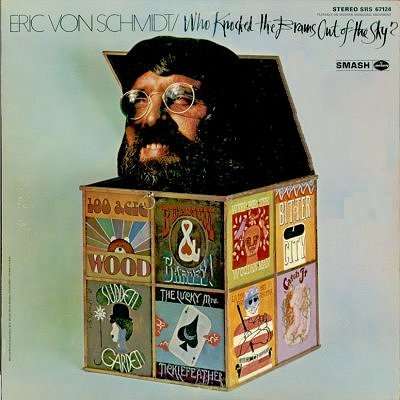
Eric Von Schmidt - Who Knocked the Brains Out Of the Sky (1969)


Painter, illustrator, singer/songwriter, and folksinger Eric Von Schmidt was a spearhead of the folk revival that swept through Cambridge, Massachusett's Harvard Square in the early '60s. When he wasn't hosting late-night jam sessions at his apartment/studio, Von Schmidt was performing Leadbelly-influenced songs in coffeehouses and inspiring several generations of folk-rooted singer/songwriters.


As the third generation of painters in his family, Von Schmidt was the son of famed illustrator Harold Von Schmidt, best known for his serial Tugboat Annie. Von Schmidt was the first in his family to become involved with music. Although his mother read music and played piano at Christmas, his father and brother were unable to carry a tune. Determined that their children be given a grounding in music, Von Schmidt's parents purchased a collection of records including tunes by Johnny Noble & His Royal Hawaiians, Burl Ives, Segovia, Fred Waring & His Pennsylvanians, Hoagy Carmichael, and Duke Ellington.

Von Schmidt stumbled onto folk music by chance when he heard a live broadcast by Leadbelly on radio station WNYC. The theme song was "Goodnight Irene." "I was going out with a girl called Irene, " Von Schmidt explained in 1992. "I thought, 'Boy, there's a song that I've got to learn.'"
Leadbelly's performance inspired Von Schmidt to teach himself to play guitar. In addition to learning songs from the records that he bought at a local store, he learned songs from the few music books that he could find. Much to his surprise, Von Schmidt found other high-school students in awe of folk music. Together they would travel to New York, where they would sit around playing their guitars and banjos in taverns. Among the first New York-based folksingers who Von Schmidt befriended were Ramblin' Jack Elliott and Tom Paley. At Elliott's invitation, Von Schmidt made his radio debut on a program hosted by Oscar Brand, playing "Pretty Polly" on a banjo.

Von Schmidt continued his musical education while serving in the Army. During the two years that he was stationed in Washington D.C., he searched for songs in the archives of the Folklore Department of the Library of Congress. After being discharged and spending two years studying art in Italy via a Fulbright Scholarship, Von Schmidt went to Harvard Square. Around the corner from his apartment and studio was Tulla's Coffee Grinder, a coffeehouse that served as the center of the early folk music movement.

Although the folk scene was initially relaxed and strictly amateur, things began to change around 1958 when Joan Baez made her debut appearances. The folk music craze spread quickly and new clubs opened, including Club 47 in Harvard Square and the Unicorn in Boston. One of the first folk artists to be recorded, Von Schmidt released his debut album in 1962.


An early friend and supporter of Bob Dylan, Von Schmidt was mentioned on Dylan's debut album as the source of the song "Baby, Let Me Follow You Down",  which Von Schmidt had recorded as "Baby, Let Me Lay It on You". In 1963, Von Schmidt traveled to England with Dylan and Rolf Cohn, recording an album with Dylan appearing as "Blind Boy Grunt." Von Schmidt's debut album, "Folk Blues", rests on the floor in the cover photograph of Dylan's 1965 "Bringing It All Back Home" album. Von Schmidt's original song "Joshua Gone Barbados" was recorded by Dylan and the Band during their Basement Tapes sessions and was included on the bootleg album "The Genuine Basement Tapes, Vol. 5".              

The folk scene was still going strong when Von Schmidt, who had been divorced from his first wife, left for Florida in 1970. After meeting the woman who would become his second wife, he relocated to Henniker, New Hampshire. He continued to record albums until the late '70s. Although he released an album with the Cruel Family on Philo in 1977, the label was experiencing severe problems and failed to promote the recording. The album was never included in the label's catalog. "Baby, Let Me Lay It on You", a book about the Boston/Cambridge folk years that Von Schmidt co-wrote with folksinger and record producer Jim Rooney, was originally published in 1979; the book was later reissued by the University of Massachusetts. For much of the 1980s and early '90s, Von Schmidt concentrated on his artwork. His illustrations were featured on numerous record albums and exhibited in several galleries and museums.


After meeting guitarist and vocalist Linda Clifford, Von Schmidt began performing again. In 1995, he recorded "Baby, Let Me Lay It on You" -- his first album in 18 years. In addition to 15 new songs, the album featured reworkings of "Joshua Gone Barbados" and the title track. Eric Von Schmidt died at age 75 on February 2, 2007 in Fairfield, Connecticut, after having suffered a stroke in August of the preceding year.              


Tracklist:

A1Who Knocked The Brains Out Of The Sky?4:04
A2Beanum & Barley4:55
A3Three Mules0:46
A4Living On The Corner3:46
A5Sudden Garden4:39
B1Catch It3:27
B2Bitter City3:25
B3Lucky Mrs. Ticklefeather4:45
B4Hundred Acre Wood2:56
B5Weep For The Wooden Man4:38


Notes by Bob Dylan on rear cover:
"Of course we had heard about Eric von Schmidt for many years. The name itself had become a password. Eventually, after standing in line to meet him, there it was — his doorstep, a rainy day, and he greeted his visitors, inviting them in. He was told how much they liked GRIZZLY BEAR and he then invited the whole bunch to the Club where he was about to perform the thing live, "C'mon down to the Club," he said— "I'm about to perform it live." We accepted the invitation. And that's what this record is. An invitation. An invitation to the glad, mad, fad, biting, exciting, frightening, crabby, happy, enlightening, hugging, chugging world of Eric von Schmidt. For here is a man who can sing the bird off the wire and the rubber off the tire. He can separate the men from the boys and the note from the noise; the bridle from the saddle and the cow from the cattle. He can play the tune of the moon, the why of the sky, and the commotion of the ocean. Yes he can — and he is also a hell of a guy."          

Eric Von Schmidt - Who Knocked the Brains Out Of the Sky (1969)
(ca. 210 kbps, front cover included)

Vom Lachen über die Welt zum Leben mit der Welt - Lieder und Gedichte von Bertolt Brecht mit Ekkehard Schall (LITERA 1984)


"When you see Schall at work during his two-hour performance, it's as if you were watching Brecht himself on stage.Schall's technical skills embody all of Brechtian dramatic theory and practice, just as Brecht's thoughts and opinions infuse his performances. " - New York City Tribune

Ekkehard Schall was Bertolt Brecht's son-in-law and one of the most important Brechtian actors in Germany.

A member of the Berliner Ensemble established by Bertolt Brecht and his wife Helene Weigel in 1949, Ekkehard Schall worked on numerous productions of Brecht's plays and others with the Ensemble between 1952 and 1995. In the 1970s and 80s he combined the roles of leading actor and deputy director of the Ensemble. In all he played over sixty roles and achieved greatest success in the role as Arturo Ui, a role he played over 500 times.

He was married to Brecht's daughter Barbara Brecht-Schall and is the father of actress Johanna Schall.

Here´s the first of three programms by Ekkehard Schall at the Berliner Ensemble with material by Bertolt Brecht.

Tracklist:
A1 Ballade von den Abenteurern
A2 Wenn ich auf den zauberischen Karussellen
A3 Sie sagt, sie ist die treueste Frau der Welt
A4 Victoria-Song
A5 Und wenn wir's überlegen
A6 Salomon-Song
A7 Bilbao-Song
A8 Legende vom toten Soldaten
A9 Von Der Kindesmörderin Marie Farrar
A10 Lied einer deutschen Mutter
A11 Kinderkreuzzug
B1 Keiner oder alle
B2 Das Lied vom Extra
B3 Die neuen Zeitalter
B4 Ballade von der Billigung der Welt
B5 Kälbermarsch
B6 Ballade von der Judenhure Marie Sanders
B7 An meine Landsleute
B8 Lied der Ströme
B9 Liebeslieder III (Sieben Rosen hat der Strauch)
B10 Das Lied vom kleinen Wind
B11 Fröhlich vom Fleisch zu essen
B12 Vom Glück des Gebens
B13 Vom Glück
B14 Solidaritätslied
B15 Der Kommunismus ist das Mittlere
B16 Erinnerung an die Marie A.

Ekkehard Schall - Vom Lachen über die Welt
(192 kbps, cover art included)

VA - Chile no se rinde, Chile vencerá (1975)


In the 1970s, the demonstrations of solidarity with the Chilean people roamed throughout Latin America and Europe. An interesting example for this broad solidarity is the "Festival Latinoamericano De La Cancion En Solidaridad Con Chile".
This live album features recordings from the concerts that took place in San José de Costa Rica in solidarity with Chile, in the late seventies. Several Central and South American artists performed at this event.

Tracklist:

01. Canto indoamericano – Arnulfo Briceño (Colombia)
02. Pelea, hombre, pelea – Conjunto Mahu Cutah (El Salvador)
03. La enfermedad del dollar – Santos Díaz (Panamá)
04. Uno, dos … – Dionisio Cabal (Costa Rica)
05. Rodolfo Aguilar Delgado – Taller sonoro Víctor Jara (Panamá)
06. Cuando tenga la tierra – Julio Lacarra (Argentina)
07. Cuba, qué linda es Cuba (Carlos Puebla) – Los Cañas (Cuba)
08. A Chile – Gerardo Guzmán (El Salvador)
09. Chile no se rinde – Rubén Pagura (Costa Rica)
10. Chile vencerá (Luis Enrique Mejía Godoy) – Grupo Tayacán (Costa Rica)
11. El pueblo unido jamás será vencito – Todos los artistas y público

VA - Chile no se rinde, Chile vencerá (1975)
(320 kbps, cover art included)

Creation Rebel - Psychotic Junkanoo (1981)

Creation Rebel was one of Adrian Sherwood’s first endeavours as a producer. Originally the backing group for the late reggae great Prince Far-I, Creation Rebel worked with Sherwood from 1977-1980, recording some of the best reggae dub music this side of Lee Perry during the early English punk era. Languorous, funky, spacey, and totally intoxicating, it’s exciting to hear the awesome production/mixing talents of Sherwood in their early days. Similarly, the band (drummers Style Scott and Fish Clarke, bassist Clinton Jack, keyboardist Bigga Morrison, guitarist Crucial Tony, and percussionist Slicker) play with a grace, effortlessness, and power that most studio bands would kill to achieve. With the band’s talents so wonderfully used by Sherwood, this is without a doubt some of the best and most important non-rock music to be made in England in the late ’70s.

Creation Rebel's penultimate album, "Psychotic Junkanoo" might not be the most revolutionary collection in the band's catalog, but it is one of the most enjoyable. Indeed, if it demands any comparisons, it is period Black Uhuru that comes fastest to mind, with Crucial Tony's militant vocals riding on a bed of delicious harmonies and, on the opening "The Dope," a guest appearance from sax legend Deadly Headley. Anthem by anthem, the album takes shape. Reworking Jah Woosh's "Woodpecker Sound" rhythm, "Chatti Mouth" is a frenetic singsong toast laid over a haunted, effects-riven rhythm. With backing vocals from John Lydon, "Mother Don't Cry" echoes Black Uhuru's "Abortion" in its stark delivery, and "African Space" is propelled by so startlingly evocative a wah-wah guitar that one doesn't even realize it's an instrumental till it's over. Across the board, Adrian Sherwood's production and mix are as crisply clean as any "mainstream" roots album -- cleaner, in fact, as the rhythms float in a space all of their own, and the echoes simply ricochet off one another.

Anybody searching Sherwood's catalog for an easy point of entry would do well to start here, and everyone else can simply applaud "Psychotic Junkanoo" as the last truly great roots reggae album of the 1980s.


Tracklist:

A1 The Dope
A2 African Space
A3 Chatti Mouth
A4 Threat To Creation
B1 Highest Degree
B2 Mother Don't Cry
B3 Yuk Up
B4 Drum Talk

Creation Rebel - Psychotic Junkanoo (1981)
(256 kbps, cover art included)

Montag, 27. Juli 2020

Franz Josef Degenhardt - Junge Paare auf Bänken - Franz Josef Degenhardt singt Georges Brassens (1986)


The songs on Degenhardt's 1986 album "Junge Paare Auf Den Bänken" ("Young Couples on the Benches") are his translations into German of chansons by the French singer-songwriter Georges Brassens, spiritually perhaps one of Degenhardts closest musical allies.

Georges Brassens ( 22 October 1921 – 29 October 1981), was a French singer-songwriter and poet.
Brassens was born in Sète, a town in southern France near Montpellier.
Now an iconic figure in France, he achieved fame through his elegant songs with their harmonically complex music for voice and guitar and articulate, diverse lyrics; indeed, he is considered one of France's most accomplished postwar poets.
He has also set to music poems by both well-known and relatively obscure poets, including Louis Aragon (Il n'y a pas d'amour heureux), Victor Hugo (La Légende de la Nonne, Gastibelza), Jean Richepin, François Villon (La Ballade des Dames du Temps Jadis), and Guillaume Apollinaire, Antoine Pol (Les Passantes).

During World War II, he was forced by the Germans to work in a labor camp at a BMW aircraft engine plant in Basdorf near Berlin in Germany (March 1943). Here Brassens met some of his future friends, such as Pierre Onténiente, whom he called Gibraltar because he was "steady as a rock." They would later become close friends.
After being given ten days' leave in France, he decided not to return to the labour camp. Brassens took refuge in a slum called "Impasse Florimont," in the 14th arrondissement of Paris, where he lived for several years with Jeanne Planche, a friend of his aunt. Planche lived with her husband Marcel in relative poverty: without gas, running water, or electricity. Brassens remained hidden there until the end of the war five months later, but ended up staying for 22 years.

This album was recorded january 1986 in 'Musikstudio M 1, Studio Hamburg', Germany, with
Franz Josef Degenhardt (translation of the George Brassens lyrics, lyrics track 10, vocals,guitar), Lech Wieleba (bass), Jan Reimer (guitar), Steve Baker (harp), produced by Jimmy Bowien, engineered by Gert Hauke.

Tracklisting:

1. Junge Paare auf Bänken (Les amoureux des bancs publics)
2. Marinette
3. Ich mach mich ganz klein (Je me suis fait tout petit)
4. Mit einer Hacke auf der Schulter (Pauvre Martin)
5. Das Testament (Le Testament)
6. Margot (Brave Margot)
7. Vorsicht Gorilla (Le Gorille)
8. König Großkotz (Le Roi)
9. Weltkrieg Nr. 1 (La guerre de 14 - 18)
10. Au pere eternel (für George Brassens)

Franz Josef Degenhardt - Paar auf Bänken  
(320 kbps, cover art included)

Ernst Busch - The Moscow Recordings - Four Shellacs (1936, Gramplasttrest)


Originally posted in July 2014:

Today we had a very informative event: Jürgen Schebera, who wrote wonderful biographies about Hanns Eisler and Kurt Weill, gave a lecture about Ernst Busch´s exile in Moscow, his cooperation with Hans Hauska and the German exile music scene in these days. He played these recordings which will be officially released in 2015 together with other Ernst Busch recordings from his exile years.

The following text is from April, 2012:

A few weeks ago a friendly reader of this blog shared some rare Ernst Busch recordings with us. He saved the recordings from some russian sites and put them together in one file. Thanks a lot for your work!!!

Ernst Busch recorded these songs between 1935 and 1936 during his exile in Moscow. They were released on four shellac singles on the Gramplasttrest label.

Tracklist:

1. Einheitsfrontlied - Die Moorsoldaten

2. Kominternlied - Thälmann-Lied (Für den Kameraden Thälmann: Hoch die Faust!) (1934)

3. Bandera roja - UHP

4. Alabama-Song - Ballade von den Säckeschmeißern


Ernst Busch - Four Shellacs (1936, Gramplasttrest)
(320 kbps, scans of the labels included)

Sonntag, 26. Juli 2020

Max Romeo - Let The Power Fall (1971)

The singer who put the rude in rude boy, Max Romeo was responsible for launching an entirely new sub-genre of reggae, whose overtly suggestive lyrics caused an outcry but took a massive hold of the music scene regardless. Yet innuendo was the least of the singer's stylings, previous to the release of his infamous "Wet Dream," Romeo had garnered a string of sweet hits with the vocal trio the Emotions. And once the nocturnal naughtiness faded, the singer established himself as one of the most important figures in the roots scene.

Romeo was born Max Smith on November 22, 1947, in St D'Acre, Jamaica. His prospects initially seemed dim; at 14 he left home and found a menial job cleaning out irrigation ditches on a sugar plantation. And there he might have stayed, if he hadn't won a local talent contest. With all the wide-eyed optimism of youth, the 18-year-old now made his way to Kingston, determined to become a star. Once in the capital, he hooked up with two other hopefuls, Kenneth Knight and Lloyd Shakespeare, and the Emotions were born. Their 1966 debut, "(Buy You) A Rainbow," produced by Ken Lack, was an immediate hit and over the next two years, the trio amassed an impressive list of successful singles.

In 1968, the singer, now dubbed Max Romeo, was confident enough to launch a solo career. Working with producer Bunny Lee, the young star recorded a number of love ballads and sweet singles, but none made much of an impression on the charts. The singer admitted defeat and returned to the Emotions. Simultaneously, he formed the Hippy Boys, with whom he did some recording (the band eventually evolved into the Upsetters), while also working as a sales rep for Lee Perry. Later that year, Romeo penned new lyrics to the rhythm track of Derrick Morgan's "Hold You Jack" and handed them over to Lee Perry. Morgan was penciled in for the recording but opted to give it a miss, as did a couple of other vocalists, until finally the exasperated producer bullied Romeo into taking the mic.

The result was "Wet Dream," an instant smash in Jamaica, although it was far from the first island single to feature suggestive lyrics. It was, however, a bit more obvious than most, so much so that even the British had no difficulty discerning its real meaning. Across the Atlantic, the single was heating up the charts, although not the airwaves. The British censors, not known for their stupidity, gave short shrift to Romeo's rather lame explanation that the song was actually about a leaky roof and immediately banned it. This had the reverse effect and helped push the single up the chart into the Top Ten.
A bucketload of less-than-furtive follow-up singles now ran rampant across the chart, both from Romeo himself and other equally lasciviously minded artists, with 1970's "A Dream" boasting an entire album's worth of Romeo's own offerings. In the U.K., this mini-movement took on a life of its own, culminating with the phenomenal success of the homegrown talent Judge Dread and his string of naughty nursery rhyme hits. Back in Jamaica, Romeo attempted to launch his own label (Romax) and sound system in 1970, but unfortunately the venture was a failure. The following year, he hooked back up with Bunny Lee and began recording a clutch of singles based on the producer's own rocksteady classic rhythms. One of the most intriguing was "Watch This Sound," which combined a rocksteady backing with the lyrics to the Buffalo Springfield classic "For What It's Worth." Branching out, Romeo also cut numerous singles with a number of other producers, including Winston Riley, Sonia Pottinger, and Alvin Ranglin. Many of these releases were culturally themed, as the singer shifted into a more roots-fired mode. Some of the most striking were recorded with the young Niney Holness, including "Beardman Feast," "The Coming of Jah," and the apocalyptic "Babylon Burning," which was co-written by Lee Perry.
                                        
A sense of an impending apocalypse was inherent to Rastafarianism as all of Jamaica was caught in its grip in the run-up to the 1972 election. Democracy has always carried a price tag of political violence on the island, but this year was particularly expensive. The conservative JLP party, which had run the country since independence a decade earlier, now for the first time faced serious opposition from the socialist PNP party. The result was an outbreak of violence across the island, as the opposing party supporters squared off on the streets. Both the urban poor and Rastafarians flocked to the PNP banner, while artists, too, made their preferences plain, although it may not seem that way to the uninitiated. Virtually all Old Testament references alluded to politics, with PNP leader Michael Manley personified by biblical heroes (normally Joshua, the nickname he was given by supporters), while JLP Prime Minister Harry Shearer was consigned to the role of villain.               

Let the Power Fall is the second studio album by Max Romeo, released in 1971. The album, in contrast to Romeo's debut A Dream, included politically charged material. It was engineered by Carlton Lee and Sid Bucknor.

Tracklist:


Side A

  1. "Let the Power Fall"
  2. "Bachelor Boy"
  3. "Cracklin' Rosie"
  4. "Chatter Box "
  5. "Missing You"
Side B
  1. "Puppet on a String"
  2. "My Special Prayer"
  3. "Fowl Thief"
  4. "Hola Zion"
  5. "Macabee Version"

Max Romeo - Let The Power Fall (1971)
(192 kbps, cover art included)

Sonntag, 19. Juli 2020

Eddie Gale ‎– Eddie Gale's Ghetto Music (1968) - Rest in peace!

Eddie Gale died July 10, 2020 - rest in peace!
The aesthetic and cultural merits of Eddie Gale's "Ghetto Music" cannot be overstated. That it is one of the most obscure recordings in Blue Note's catalog - paid for out of label co-founder Francis Wolff's own pocket - should tell us something.

This is an apocryphal album, one that seamlessly blends the new jazz of the '60s - Gale was a member of the Sun Ra Arkestra before and after these sides, and played on Cecil Taylor's Blue Note debut, "Unit Structures" - with gospel, soul, and the blues. Gale's sextet included two bass players and two drummers - in 1968 - as well as a chorus of 11 voices, male and female. Sound like a mess? Far from it. This is some of the most spiritually engaged, forward-thinking, and finely wrought music of 1968.

What's more is that, unlike lots of post-Coltrane free jazz, it's ultimately very listenable. Soloists come and go, but modes, melodies, and harmonies remain firmly intact. The beautiful strains of African folk music and Latin jazz sounds in "Fulton Street," for example, create a veritable chromatic rainbow. "A Walk with Thee" is a spiritual written to a march tempo with drummers playing counterpoint to one another and the front line creating elongated melodic lines via an Eastern harmonic sensibility. The final cut, "The Coming of Gwilu," moves from the tribal to the urban and everywhere in between using Jamaican thumb piano's, soaring vocals à la the Arkestra, polyrhythmic invention, and good, old-fashioned groove jazz, making something entirely new in the process. While Albert Ayler's "New Grass" was a failure for all its adventurousness, Eddie Gale's "Ghetto Music", while a bit narrower in scope, succeeds because it concentrates on creating a space for the myriad voices of an emerging African-American cultural force to be heard in a single architecture. This is militant music posessed by soul and spirit.     

Tracklist:
  1. "The Rain" - 6:30
  2. "Fulton Street" - 6:51
  3. "A Understanding" - 7:41
  4. "A Walk With Thee" - 6:09
  5. "The Coming of Gwilu" - 13:37


Eddie Gale ‎– Eddie Gale's Ghetto Music  (1968)
(192 kbps, cover art included)   

Freitag, 17. Juli 2020

Nico - Live Heroes (1986)

This album is a compilation of live recordings by Nico with the Blue Orchids partially at the København Saltlagertet, Rotterdam, Netherlands, on October 5, 1982. Nico & The Invisible Girls "Procession / All Tomorrow Parties" 1982 single.

Originally released as an LP on yellow vinyl, "(Live) Heroes" is one of many collections of live and studio tracks by Nico released in her last years and after her death. She begins her cover of David Bowie's "Heroes" by asking the crowd, "Why do you give me so much gratitude?" Her own "Procession" and a cover of the Velvet Underground's "All Tomorrow's Parties" are arranged by and performed with "the Invisible Girls," while the version of another Velvet Underground & Nico number, "Femme Fatale," features the Blue Orchids. "My Funny Valentine" proves to be an excellent choice for a cover song, as it was on Camera Obscura, and Nico has long since made the Doors' "The End" her own. This is a relatively brief, not particularly outstanding collection of familiar songs that will be of interest largely to confirmed Nico fans. One of the highlight is her version of 'My Funny Valentine' which is the most heartbreakingly beautiful rendition of that song I've ever heard


Tracklist:

"Heroes" – 8:19 (David Bowie, Brian Eno)
"Procession" – 4:45 (Nico)
"My Funny Valentine" – 4:07 (Richard Rodgers, Lorenz Hart)
"All Tomorrow's Parties" – 5:28 (Lou Reed)
"Valley of the Kings" – 3:10 (Nico)
"Femme Fatale" – 3:07 (Lou Reed)
"The End" – 9:51 (The Doors)

(320 kbps, cover art included)

Donnerstag, 16. Juli 2020

Yusef Lateef ‎– The Three Faces Of Yusef Lateef (1960)

On "The Three Faces of Yusef Lateef", Riverside seems eager to present Yusef Lateef, technical virtuoso, on a series of songs that step closer to jazz tradition than any of his work in the recent past. Largely absent are Lateef's experiments with Eastern modes, rhythms, and instrumentation, and in their place is a collection of largely upbeat, accessible songs, with a balanced mix of standards and originals. 

Much of the introspective, personal quality of his previo us albums seems lost in the effort, but Lateef's playing still remains stellar, especially on oboe. That instrument, which is by nature soft and muted, is given enough power by Lateef to lead on several songs, most beautifully on "Salt Water Blues," where its naturally melancholy sound seems perfectly matched with the low, rounded tones of Lateef's rhythm section, especially Ron Carter's bowed cello. The quintet also shines on the following track, Joe Zawinul's "Lateef Minor 7th," where they provide a gentle counterpoint to Lateef's sweet flute line. Not quite as expansive or daring as much of Lateef's other recordings, "The Three Faces of Yusef Lateef" still documents a fine musician at work during the peak of his career.


Tracklist:

Goin' Home 4:59
I'm Just A Lucky So And So 4:33
Quarantine 6:56
From Within 4:07
Salt Water Blues 6:44
Lateef Minor 7th 4:56
Adoration 4:28
Ma - He's Makin' Eyes At Me 5:50


Yusef Lateef ‎– The Three Faces Of Yusef Lateef (1960)
(320 kbps, cover art included)

Mittwoch, 15. Juli 2020

Gary Bartz ‎– Libra / Another Earth

Altoist Gary Bartz's first two recordings as a leader are reissued in full (except for one selection, "Disjunction," left off due to lack of space) on this 1998 CD. 

1967's "Libra" matches Bartz (then 26) with trumpeter Jimmy Owens, pianist Albert Dailey, bassist Richard Davis, and drummer Billy Higgins for four diverse originals including "Eastern Blues," a lyrical "Cabin in the Sky," the old hymn "Deep River," and Charlie Parker's "Bloomdido." 

"Another Earth" features Bartz dueting with bassist Reggie Workmanon "Lost in the Stars," performing three trio quartet numbers with Workman, pianist Stanley Cowell, and drummer Freddie Waits, and welcoming trumpeter Charles Tolliver and tenor saxophonist Pharoah Sanders (who is a little more restrained than usual) to the 23-and-a-half-minute, three-part "Another Earth." 

The music is advanced but not avant-garde, essentially falling into the genre of modern mainstream for the period. Even at this early stage, Bartz had a fairly distinctive sound and a strong musical style. Recommended.


Tracklist:

1 Eastern Blues 3:59
2 Cabin In The Sky 3:59
3 Air And Fire 5:33
4 Libra 6:22
5 Bloomdido 4:46
6 Deep River 4:51
7 Freedom One Day 5:08
8 Another Earth 23:46
9 Dark Nebula 5:04
10 Ufo 4:49
11 Lost In The Stars 4:04
12 Perihelion And Aphelion 3:47


Gary Bartz ‎– Libra / Another Earth
(320 kbps, cover art included)

Dienstag, 14. Juli 2020

Mythen in Tüten - Die neue Kollektion! (1981)

Mythen in Tüten came from Hannover, where the band around the charismatic singer Emilio Winschetti was established in 1979. Also Lutz Worat (keyboards), Ingo Erlhoff (saxophone) and Rüdiger Klose (drums) formed the core of the band. 

The group operated music with the term Meta-Schlager and thus became one of the pioneers of commercial NDW. The debut single "Lady Di" was released on NO FUN Records in 1981. A short time later followed the debut album "DIE NEUE KOLLEKTION" (released on No Fun Records, too). A collection of fine popsongs, the group plays carefree at great ease and offers some amazing arrangements.


Tracklist:

A1 Die Neue Kollektion 2:02
A2 Hochkant 4:39
A3 Südstadt-Spatz 2:17
A4 Fotoapparat 2:39
A5 Schöne Schuhe 3:17
A6 Mäzen 3:12
A7 Sansibar 2:17
B1 Herbst 3:43
B2 Tortellini 3:10
B3 Geruchssinn 1:50
B4 12 Finger 2:08
B5 Doppelgänger 2:46
B6 Digital 1:11
B7 Zeitsprung 3:05
B8 Ich Glaub' Dir Alles 1:49


Mythen in Tüten - Die neue Kollektion! (1981)(320 kbps, cover art included)

Sonntag, 12. Juli 2020

Bhundu Boys ‎– Muchiyedza (Out Of The Dark)

The most commercially and creatively successful act ever to emerge from Zimbabwe, the Bhundu Boys embodied the world music zeitgeist of the mid-'80s. Creators of a frenetic, guitar-dominated style they dubbed "jit," they fused airy melodies, shimmering harmonies, and pulsating rhythms drawn from across the African continent to make music that was both alien and accessible. Taking their name from the guerrillas who backed Robert Mugabe in his successful war to win Zimbabwe's independence from Britain, the Bhundu Boys formed in April 1980 in the city of Harare, which translates literally (and, sadly, prophetically) as "death everywhere."

Lead guitarist Rise Kagona assembled the original lineup, which also included singer/guitarist Biggie Tembo, bassist David Mankaba, keyboardist Shakie Kangwena, and drummer Kenny Chitsvatsva. Making do with homemade instruments, the Bhundu Boys cut their teeth playing Western pop covers in township beer halls, and were a local phenomenon by the time they were discovered by erstwhile property developer Steve Roskilly, who cut their earliest sessions in his home studio, Shed. Their 1981 debut single, "Hatisitose," topped the Zimbabwean charts for three months straight, and in the years to follow the band scored three more national number ones with "Baba Munini Francis," "Wenhamo Haaneti," and "Ndimboze."


Tracklist:

1 Kachembere
2 Hazviskanwe
3 Dorica
4 Mhunza Musha
5 Satan Ngaaparadzwe
6 Mumhanzi We Jit
7 Tamba Wega
8 Pafunge
9 Misodzi Pamatama


Bhundu Boys ‎– Muchiyedza (Out Of The Dark)
(320 kbps, cover art included)

Samstag, 11. Juli 2020

Sun Ra And His Arkestra - Jazz In Silhouette (1959)

Throughout their mid-to-late-'50s stay in Chicago, Sun Ra (piano) and his Arkestra established themselves as formidable purveyors of a new strain or sub-genre of jazz. Having evolved from elaborate reworkings of familiar standards, "Jazz in Silhouette" (1959) presents a collection of originals, building upon Ra's abilities as a consummate multi-tasker - writing, arranging, scoring parts for his band, in addition to performing.

He stretches the boundaries of the music to suit the Arkestra, simultaneously progressing his distinct sound. Seminal readings of the quick and complex "Saturn" and "Velvet" are offered with unmatchable dexterity and precision. The latter title comes off like a confused version of "Jeepers Creepers" as Hobart Dotson (trumpet) prominently displays his unquestionable tonality. "Ancient Aiethopia" is one of the more involved works, both in terms of length - running over nine minutes - and the Arkestra's capacity for Ra's compositions. "Blues at Midnight" is another expansive (nearly 12 minutes) outing that, by contrast, is for the soloists rather than full ensemble. John Gilmore (tenor sax), Ronnie Boykins (bass), Pat Patrick (baritone sax), and Marshall Allen (alto sax) all shine behind William Cochran's (drums) solid contributions.

Equally significant is the running dialogue Ra maintains during other musicians' leads, directing the ebb and flow with an uncanny fusion of melody and rhythm. Undoubtedly, this is a factor in the freshness the material retains. It is also a prime example of Ra and company in a transitional phase, prior to their full-fledged explorations into the avant-garde.


Recorded in 1959 at El Saturn Studio, Chicago, the album is one of three records that the Arkestra released in the 1950s - the other two being Jazz by Sun Ra and Super-Sonic Jazz. Originally released in a simple silk-screened cover credited to HP Corbissero, the album had gained its sci-fi cover, 'of half-naked women teleporting themselves over one of the moons of Saturn', credited to 'Evans'  by the early 1960s. The album was reissued by Impulse in 1974, and released on CD by Evidence in 1992.

When originally released, the album's sides were reversed, starting with Hours After at the beginning of side one, and ending side two with Ancient Aiethopia. Enlightenment in particular was to become a staple of the Arkestra's concerts, often featuring chanted lyrics. 

Tracklist:

Enlightenment
Saturn
Velvet
Ancient Aiethopia
Hours After
Horoscope
Images
Blues at Midnight

Sun Ra And His Arkestra - Jazz In Silhouette (1959)
(256 kbps, cover art included)

Janis Joplin & Full Tilt Boogie ‎– Honolulu 1970

Spinning in the 'rock room' today is a true original. Released after Joplin's death in 1970 by legendary bootleg producers Trademark of Quality, a yellow colored vinyl Get It While You Can immortalized Janis Joplin and the Full Tilt Boogie Band's 1970 performance at the Honolulu International Center Arena for an assembled crowd of 7,000+. The direct and very raw soundboard recording captures the entirety of Joplin's hour long set in surprisingly good sonic quality. The recording also captures a crazed crowd and much of the onstage discussions and song choice decisions that are called out by Joplin.

The recording I am enjoying is a transfer from the aforementioned original LP release. There are a few minor mix issues and anomalies but nothing that detracts from this special capture. Janis is feeling no pain and is obviously a bit fuzzy around the edges but performs admirably and is laid way back and not looking at the clock in any way. She chats with the crowd, kids with band members and puts on a wonderful late era performance. This recording a classic in every way, from the performance to pirated production.

The concert begins after the MC's introduction with a typical for the era, which means an excitable and sensual reading of 'Tell Mama'. The 'Full Tilt Boogie Band' which Janis referred to as her band opens it up with a mid song John Till guitar solo that pours out of the PA like molten lava racing for the sea. Janis brings down the groove and while squinting through the steam enters into her 'rap'. Beginning a sweet call and response section Janis reminds the 'rock room' of Presley during the same era. She is in complete control of the band and acts as a baton swinging R and B princess directing the groove.

After the conclusion of 'Tell Mama' some banging from the stage can be heard on the tape as Joplin tells the crowd that she and the band came for one reason and that is to rock. Joplin calls out for 'Half Moon' a song that would appear on Joplin's posthumous release, Pearl. A musical hero of the performance, Richard Bell on piano is stunning during this rendition. Bell, for those not aware was a the 'Revols' from Stratford, Ontario which also featured Richard Manuel of 'The Band'. The quivering guitar now gets funky and follows the big splashing cymbals in to the song proper. Classic big band Joplin. Janis pushes off from the safety of shore and gets it on. Till's first solo flies low almost banging tree tops setting the stage for the plethora of string acrobatics to follow. Joplin responds with hearty wines that syncopate with the high tempo rim shots. The song starts to dissolve into dusk with Joplin wailing to the sky before reaching a starry silence and concluding in a big way.

The concert continues in this breathless fashion as the Joplin penned 'Move Over' follows. The track would later appear on Janis's last album Pearl as the opening song. Beginning a gunshot snare from drummer Clark Pierson with a Joplin cry of 'Get it on' the song slams into the venue's shared seating bumping anyone close by to the floor. Till's steel wool guitar duets with Joplin through the verses. Joplin encourages the increasingly rowdy crowd to singalong. Relentlessly 'Move Over' churns from the stage while Joplin plaintively pleads for her man to stop playing with her and to just move on with it. The band shifts for the solo segment and digs in for the most intense musical movement of the evening thus far. While not breaking down the barriers of the song Janis shows great control, patience and presence while touching the edges of orgasm. She howls with eyes closed ecstasy' while still keeping the tension from breaching the musical framework. Stunning.

Following the accelerated R and B and euphoric vibe that has just occurred since the opener, the band takes some time to deal with some guitar issues and technical problems. The tape revels some classic stage banter that I will leave for you my treasured listener to discover. The band tosses out various tuning quotes including 'Tequila' before the thick breaking into the gooey sweet center of the concert.

The 'soul' set of the concert begins here.The band enters into a cover of 'Maybe' originally performed by the 'Chantels' in 1958. Highlighted by dramatic organ flourishes by Ken Pearson the song is stamped with stuttering drums and well times caesura's. Joplin's vocals are sweet Southern Comfort and swirl around the arrangement like the last thick swig in a bar glass.

'Summertime' starts in the same tractor tracks of 'Maybe', except its arrangement is floral and as vibrant as diffused sunlight. The song though only two years removed seems like ages because of Joplin's brisk maturity and constant artistic flux. Full Tilt channels Big Brother but in a tighter wrapping here as 'Summertime' plays from a psychedelic music box. Joplin is again in fine form directing the band up and over and under and around as 'Summertime' gets a heavy response from the crowd.

Joplin then takes the opportunity to introduce her band of 'Canadians'. The only American in the band being drummer Clark Pierson.There again follows some prime dialog from the stage here as Janis invites someone in the crowd to 'Pearl's House' for drinks if they can make it. Again, I'll leave it to the listener to enjoy these audio verite' moments of Joplin. There is no doubt that Joplin is nipping good as the show continues into the evening.

Introduced as a 'kind of a new song', One of Joplin's signature cuts, 'Get It While You Can' becomes the centerpiece of the elegant place setting of music developed by the performance. The track illustrates Joplin's range and soul in a sympathetic arrangement. While not an 'all time' reading, this version stays true to the good time, easy vibe of the show. Bell's saloon piano and the slow steady rhythmic sway support Joplin's breathy verses. Prime Janis.

Closing the main set is a dynamic version of 'Kozmic Blues', a song from the 1969 LP I Got Dem Ol' Kozmic Blues Again Mama!. The song starts low and ends high becoming a triumphant detonation of sound by its conclusion. The band corners with Joplin for every tight turn. Janis initiates a sing along throughout her series of falsetto exclamations, the whips the crowd into a frenzy documented by the recording. Perfectly placed and paced the performance ends confidently and stunningly.

The MC returns and tries to contain the crowd while controlling his own excitement. You can tell that something is going down in the auditorium from the audio evidence, but I cannot confirm what. Joplin and the band return in response to the crowds calls and unidentified chaos to which Janis says, 'Figure out what it costs and I'll pay for it'. She then calls for 'Piece of My Heart' which is played in a uptempo but somewhat tired fashion. I think Janis is feeling really good at this point of the show. The oft played but mega popular song gives the crowd even greater reason to celebrate and at its conclusion the response is tangible. The MC explains Janis and the band have left as the crowd screams for more.

Janis Joplin's classic performance and bootleg recording from Honolulu 1970 has made the rounds for years and rightfully so. While arguably not the 'best' Joplin performance available, its charm is in the edgy vibe, the honest unadorned soundboard mix, the insane crowd and Janis's awesome vocals and raps. The recording is a rock time capsule trapped in the grooves of the original yellow vinyl release, released by enterprising collectors and passed on for eternity for rock fans like all of us. Janis would not be long for the earth after these Summer 1970 concerts, throw this recording on to find her performing like there is no tomorrow. - https://www.talkfromtherockroom.com

Tracklist:

1 Tell Mama
2 Half Moon
3 Mover Over
4 Stage Problems
5 Maybe
6 Summertime
7 Band Introduction
8 Get It While You Can
9 Kozmic Blues
10 Encore Break
11 Piece Of My Heart


Janis Joplin & Full Tilt Boogie ‎– Honolulu 1970
(320 kbps, cover art included)

Donnerstag, 9. Juli 2020

Sun Ra - Nuits De La Fondation Maeght, Vol. 2 (1971)

This is the second of two 7" EPs derived from Sun Ra and his Arkestra's August 1970 run at the Nuits de la Fondation Maeght (1970). Historically noteworthy is that the Saint Paul de Vence, Côte d'Azur, France, shows marked the first time the extended aggregate would play for a European audience.

Their excitement translates into what is unquestionably one of the strongest live documents to exist from this period. Many potential listeners may be initially dismayed at the seeming discord that is inherent in the free and avant-garde subgenres. For them, Nuits de la Fondation Maeght, Vol. 2 might be a good starting place as it offers up a variety of styles from within the open-ended framework.

"Friendly Galaxy Number 2" is a brooding and edgy mid-tempo affair, highlighted by the rhythm section's smouldering restraint beneath the alternately plaintive and sinuous wails from Alan Silva (violin). This segues into the entire Arkestra as it joins in on a carefree and buoyant "Spontaneous Simplicity." Once again, Silva shines, albeit this time on electric bass guitar. His syncopated pulsations are viscous enough to ably swaddle the aggressive percussive ensemble. On this piece, Ra's electric piano runs are among his most melodic, as he gently weaves around the well-placed chord progressions. The brass section also reasserts itself for some stellar interaction at the song's conclusion. "The World of Lightning" may have been the Arkestra's encore, judging by the rhythmic applause from the audience at the beginning of the song. After preliminary disjointed inflections from Ra's Mini Moog and John Goldsmith's percussive gong and tympani interjections, Marshall Allen (sax) provides blistering leads atop of what evolves into a full-blown and substantial Arkestra assault. This somewhat abruptly resolves into a profound, if not definitive reading of the epic "Black Myth," commencing with June Tyson's spoken "The Shadows Took Shape" and "The Strange World" recitations. The band counters with incisive precision, which trails into a ferocious bout of the Moog from Ra during the "Journey Through the Outer Darkness" movement. "Sky" is a brief concluding solo from Allen on haubois -- a predecessor to the modern-day oboe -- that cuts off mid-stream.


Tracklist:

Friendly Galaxy Number 2 8:46
Spontaneous Simplicity 10:50
The World Of The Lightening 5:54
Black Myth 8:32
  a) The Shadows Took Shape
  b) This Strange World
  c) Journey Through The Outer Darkness
Sky 2:01

Sun Ra - Nuits De La Fondation Maeght, Vol. 2
(320 kbps, cover art included)

Mittwoch, 8. Juli 2020

Sun Ra - Nuits de la Fondation Maeght, Vol. 1 (1970)

Nuits de la Fondation Maeght, Vol. 1 (1970) is the first of two releases capturing Sun Ra and the Arkestra at Saint Paul de Vence, Côte d'Azur, France, in August of 1970, on what was their first European excursion. As a rule, free and avant-garde jazz are a decidedly acquired taste. However, for discerning palettes, these installments present the aggregate at their absolute pinnacle in terms of performance and inspiration. 

The four works included here offer a wide variety of styles and approaches, proving that the combo were far more multifaceted and involved than often given credit for. "Enlightenment" is a suitable opener, featuring a vocal duet between June Tyson (vocals) and John Gilmore (tenor sax/drums/vocals). This ambles subtly into another brief lyric on "The Star Gazers," followed by an inventive and elaborate piano solo from Ra. The bandleader is clearly enthused throughout, translating in what is perceived as even quicker and more potent inflections. These continue during a full-ensemble reading of "Shadow World," which is given a worthy workout. The flurry and fury in Marshall Allen's alto sax are countered with more of Ra's highly intricate assertions. 

One of the most inspired keyboard performances from Ra is the appropriately titled "Cosmic Explorer." There are moments that vacillate from terrifying to sublime as the artist methodically investigates the sounds, carefully constructing his progressive arrangements. Much like the Arkestra presentation, Ra's solos are complex, more than making up for any lack of structure with a motivated performance. Enthusiasts should note that both volumes of Nuits de la Fondation Maeght were issued on CD from an excellent quality tape (read: non-vinyl) source on Comet Records in 2003.


Tracklist:

Enlightment 2:56
The Star Gazers 3:08
Shadow World 13:20
The Cosmic Explorer 19:45

(320 kbps, cover art included)

Freitag, 3. Juli 2020

Eric Dolphy - Outward Bound (1960)

The late multi-reed player/composer Eric Dolphy, one of the most pivotal figures in jazz, was a fiercely lyrical, imaginative musician at the forefront of the changes the music underwent in the 1960s. Dolphy, unlike some of his contemporaries, never totally abandoned the bebop approach of soloing over chord changes, but instead took his solos to fresh, expressive heights. 

"Outward Bound", a quintet session from 1960, shows Dolphy in a somewhat transitional phase, his music closer to the hard bop of the late '50s than the free jazz of the '60s. "245" is a late-night blues on which Dolphy, on alto, testifies his feeling and loyalty to the form. The standard "Glad to Be Unhappy" is given a lovely, lively reading on flute, with the band providing appropriately spare, sympathetic accompaniment. "Miss Ann" features Dolphy swinging the bass clarinet with joyous abandon, as well as some crackling Freddie Hubbard trumpet. A highlight of this session is the imaginative, tasteful drumming of Roy Haynes, who has played with everyone from Charlie Parker to Pat Metheny.

Jazz critic Martin Williams wrote the following about the album: "From the first selection on Dolphy's first album under his own name... it was obvious that fresh and important talent had arrived."

Reviewer J. Hunter wrote the following about "G.W.": "While the rest of the band lays down beats and fills that would not be out of place on any bop date, Dolphy steps out of the head to blister us with a mind-boggling, lightning-fingered alto solo that threatens to go over a cliff at any moment. Dolphy and his partners maintain this unorthodox balancing act throughout the 1960 session."


Tracklist:

A1 G.W.  8:00
A2 Green Dolphin Street  5:51
A3 Les  5:13
B1 245  6:56
B2 Glad To Be Unhappy  5:27
B3 Miss Toni  5:47


(320 kbps, cover art included)