Mittwoch, 8. März 2023

Pharoah Sanders - Pharoah's First (1965)

Pharoah's First is the debut album by American free jazz saxophonist Pharoah Sanders, recorded in New York City at the loft of audio engineer Jerry Newman on September 10, 1964, and first released in 1965 on the ESP-Disk label. The album was originally issued with the title Pharaoh and was later re-released with the titles "Pharoah", "Pharaoh Sanders Quintet", "Pharaoh's First", and was also included in its entirety in the 2012 4-CD compilation "In The Beginning 1963-1964".

Reviews of the recording have been mixed, with a number of writers expressing puzzlement over the juxtaposition of Sanders, who "wastes no time blowing his horn apart,", playing "some trademark wail and spasmodic multiphonic roar,"[ with the competent but relatively conservative side musicians selected for the session. Al Campbell, writing for AllMusic, stated that Sanders' sidemen "play bebop, Sanders doesn't. You can hear that Sanders is ready to go out, but restrains himself due to this mismatching of musicians... It sounds as if this date was set up for someone like Dexter Gordon, who didn't show up, so they got Sanders at the last minute. Sanders really has no purpose on this conventional date besides initial name exposure as a leader. What a shame." AllAboutJazz reviewer Trevor MacLaren wrote: "This record has always been a thorn in the discography of saxophonist Pharoah Sanders. The playing is solid, but his legendary ripping chops are extremely subdued, making this disc seem out of place. Not to mention the fact that the musicians that Sanders is playing with are bebop players, slapping out bop riffs. At no other time did Sanders ever seek out that sound. Nowhere during his Coltrane apprenticeship did he even hint at bop." JazzTimes reviewer Scott Verrastro stated: "This album truly protrudes in the tenor's early catalogue... The overall demeanor of the two sidelong cuts... is purely hard bop, energetic but largely nondescript... There's an undeniably palpable sensation that this session was a result of an open date on the studio calendar and Sanders just happened to be the most recognizable name, thusly earning the 'leader' title. Overall, it's not a particularly memorable debut but nevertheless an intriguing document."

Other writers were more positive. AllAboutJazz reviewer Clifford Allen wrote that the disc "though somewhat of an aesthetic anomaly in the ESP catalog and, at the time, given more 'could-have-been' status than it probably deserved, is a crucial workshop puzzle-piece that gives historians of improvised music one very important look at Pharoah Sanders and his young, big ideas." A Forced Exposure review stated: "With one foot in mainstream jazz... and the other, tentatively at times, in the avant-garde, this is a fascinating glimpse of Sanders's style before he wielded the unremitting fierceness of his playing with Coltrane and the modal mysticism of his later solo albums on Impulse."

Regardless of its reception, the album is historically important in that it "caught the ear of John Coltrane" (one writer stated that "the steaming intensity of Pharoah drew Coltrane to Sanders"), who had also heard Sanders' group perform at the Village Gate. In late 1964, Coltrane invited Sanders to sit in with his band,[ and Sanders became a member of the group in September 1965.


Tracklist:

"Seven By Seven" (Sanders) - 26:25
"Bethera" (Sanders) - 23:44


(256 kbps, cover art included)

Antoni und Schall - Bertolt Brecht gesungen von Antoni und Schall


Johanna Schall, the granddaughter of Bert Brecht, and Carmen-Maja Antoni are famous for her work on theater stages and in films. Besides that they did outstanding interpretations of Bertolt Brecht´s work.
This album presents a selection of ballads, songs and poems by Brecht, interpreted by Johanna Schall and Carmen-Maja Antoni, accompanied by Karl-Heinz Nehring from the Berliner Ensemble on piano.


Tracks:

1 Der große Bert Brecht
2 Die Zuhälterballade
3 Sehet die Jungfrau
4 Der Barbara-Song
5 Die Seeräuber-Jenny
6 Und das Lächeln, das mir galt
7 Das Eifersuchtsduett
8 Der Kanonen-Song
9 Jetzt ist alles Gras aufgefressen
10 Paragraph 1
11 Paragraph 111
12 Ballade zum § 218
13 Mein Sohn, was immer auch aus dir werde
14 Auch der Himmel bricht manchmal ein, indem Sterne auf die Erde fallen
15 Das Lied vom SA-Mann
16 Ballade von der "Judenhure" Marie Sanders
17 Kälbermarsch
18 Die protestiert haben sind erschlagen worden
19 Vom kriegerischen Lehrer
20 Vom Kind, das sich nicht waschen wollte
21 Kleines Lied
22 Ihre Worte waren bitter
23 In dem zarten Alter
24 Mutter Beimelein hat ein Holzbein
25 Mit den Gesetzestafeln
26 Nannas Lied
27 Allem, was du empfindest, gib die kleinste Größe
28 Ballade von der Höllenlili
29 Der Song von Mandeley
30 Als ich einst im Flügelkleide in den Himmel gangen bin
31 Über die Verführung von Engeln
32 Ich habe gehört, daß man vom Leben einen dicken hals kriegt
33 Gegen Verführung
34 Ach, nur der flüchtige Blick
35 Sieben Rosen hat der Strauch
36 Das Lied vom kleinen Wind
37 Erinnerung an Marie K.
38 Ballade von der Hanna Cash
39 Und ich dachte immer: die allereinfachsten Worte müssen genügen
40 Ballade von den Seeräubern
41 Das Lied von Surabaya-Johnny
42 Der Lernende
43 Denn wie man sich bettet
 
Antoni und Schall - Bertolt Brecht gesungen von Antoni und Schall
(192 kbps)

Billie Holiday - No Greater Love

The first popular jazz singer to move audiences with the intense, personal feeling of classic blues, Billie Holiday changed the art of American pop vocals forever. More than a half-century after her death, it's difficult to believe that prior to her emergence, jazz and pop singers were tied to the Tin Pan Alley tradition and rarely personalized their songs; only blues singers like Bessie Smith and Ma Rainey actually gave the impression they had lived through what they were singing. Billie Holiday's highly stylized reading of this blues tradition revolutionized traditional pop, ripping the decades-long tradition of song plugging in two by refusing to compromise her artistry for either the song or the band. She made clear her debts to Bessie Smith and Louis Armstrong (in her autobiography she admitted, "I always wanted Bessie's big sound and Pops' feeling"), but in truth her style was virtually her own, quite a shock in an age of interchangeable crooners and band singers.

With her spirit shining through on every recording, Holiday's technical expertise also excelled in comparison to the great majority of her contemporaries. Often bored by the tired old Tin Pan Alley songs she was forced to record early in her career, Holiday fooled around with the beat and the melody, phrasing behind the beat and often rejuvenating the standard melody with harmonies borrowed from her favorite horn players, Armstrong and Lester Young. (She often said she tried to sing like a horn.) Her notorious private life - a series of abusive relationships, substance addictions, and periods of depression - undoubtedly assisted her legendary status, but Holiday's best performances ("Lover Man," "Don't Explain," "Strange Fruit," her own composition "God Bless the Child") remain among the most sensitive and accomplished vocal performances ever recorded. More than technical ability, more than purity of voice, what made Billie Holiday one of the best vocalists of the century - easily the equal of Ella Fitzgerald or Frank Sinatra - was her relentlessly individualist temperament, a quality that colored every one of her endlessly nuanced performances.

Billie Holiday - No Greater Love
(192 kbps, small front cover included)


Ella Fitzgerald ‎– Ella Fitzgerald Sings Songs From "Let No Man Write My Epitaph" (1960)

Recognized worldwide as "The First Lady of Song," Ella Fitzgerald is arguably the finest female jazz vocalist of all time. Blessed with a highly resonant voice, wide range, and near-perfect elocution, Fitzgerald also possessed a deft sense of swing, and with her brilliant scat technique, could hold her own against any of her instrumental contemporaries. She came to initial popularity as a member of drummer Chick Webb's band in the 1930s, scoring a hit with a "A-Tisket, A-Tasket," before ascending to wide acclaim in the 1940s with Jazz at the Philharmonic and Dizzy Gillespie's Big Band, and issuing landmark performances like "Flying Home" and "How High the Moon." Working with producer/manager Norman Granz, she gained even more acclaim with her series of albums on Verve, recording definitive versions of the music of the Great American Songbook composers, including 1956's "Sings the Cole Porter Songbook". Over her 50-year career, she earned 13 Grammy Awards, sold over 40 million albums, and picked up numerous accolades including a National Medal of Arts and the Presidential Medal of Freedom. A hugely important cultural figure, Fitzgerald made an immeasurable impact on the development of jazz and popular music, and remains a touchstone for fans and artists decades after her passing.

"Ella Fitzgerald Sings Songs from the Soundtrack of `Let No Man Write My Epitaph´" is a 1960 album, accompanied by the pianist Paul Smith. "Let No Man Write My Epitaph" was a 1960 Hollywood movie featuring Fitzgerald.

This is a most unusual Ella Fitzgerald recording. Recorded around the time when she performed some of these songs for the film "Let No Man Write My Epitaph", the masterful singer is heard in duets with pianist Paul Smith interpreting 13 songs (even "I Cried for You," "I Can't Give You Anything But Love," and "Who's Sorry Now?") at slow expressive tempos. Listeners who feel that Ella Fitzgerald was mostly a scat singer who had trouble giving the proper emotional intensity to lyrics will be surprised by this sensitive and often-haunting set.


Tracklist:

A1 Black Coffee 3:24
A2 Angel Eyes 3:18
A3 I Cried For You 3:21
A4 I Can't Give You Anything But Love 3:23
A5 Then You've Never Been Blue 3:06
A6 I Hadn't Anyone Till You 2:47
A7 My Melancholy Baby 2:55
B1 Misty 2:54
B2 September Song 3:33
B3 One For My Baby (And One More For The Road) 4:10
B4 Who's Sorry Now 3:23
B5 I'm Getting Sentimental Over You 2:32

Loudon Wainwright III ‎– A Live One (1979)

"A Live One" is a live album by American singer-songwriter Loudon Wainwright III. The live performances included on the album were recorded on a tour of the British Isles in 1976 and at McCabe's in Los Angeles in 1978. It was released in 1979 on Rounder Records.

His first completely live album, it was released during the longest hiatus between studio albums so far in his career (five years): his farewell to the 1970s (1978's "Final Exam") and his self-reinvention on 1983's "Fame and Wealth". Furthermore, since the track list relies on early LPs such as "Attempted Mustache", the gap between his adjacent studio albums seems all the wider.

Wainwright is well served by this collection of samples of his live work, which also doubles as the best of his 70s material, with songs like "Whatever Happened to Us," "Nocturnal Stumblebutt," and "Clockwork Chartreuse."
                 
Tracklist:

  1. "Motel Blues" – 3:28
  2. "Hollywood Hopeful" – 1:25
  3. "Whatever Happened to Us" – 1:35
  4. "Natural Disaster" – 2:03
  5. "Suicide Song" – 2:22
  6. "School Days" – 3:16
  7. "Kings and Queens" (Loudon Wainwright III, George Gerdes) – 2:37
  8. "Down Drinking at the Bar" – 3:57
  9. "B-Side" – 2:08
  10. "Nocturnal Stumblebutt" – 4:19
  11. "Red Guitar" – 1:54
  12. "Clockwork Chartreuse" – 4:10
  13. "Lullaby" – 2:44
Track 1 was recorded at Birmingham Town Hall, England; Autumn 1976.
Tracks 2, 7, 8, 9, 10 and 13 were recorded at McCabes Guitar Shop, Los Angeles, California during weekend engagement October 1978.
Tracks 3, 4, 5, and 12 were recorded at The New Vic, London, England; Autumn 1976.
Track 6 was recorded at The Apollo, Glasgow, Scotland; Autumn 1976.
Track 11 was recorded at Manchester Opera House, England; Autumn 1976.

Loudon Wainwright III ‎– A Live One (1979)
(320 kbps, cover art included)


Kurt Weill - American Songbook Series (Smithsonian Collection)

The Smithsonian American Songbook Series traces the legacy of American songwriters with individual volumes devoted to a number of artists. This one featurs music by Kurt Weill in interpretationts by artist like Louis Armstong, Benny Goodman, Lotte Lenya, Bing Crosby, Lee Wiley, Sarah Vaughan and many others.
Kurt Julian Weill (March 2, 1900 – April 3, 1950) was a prominent and popular German-Jewish composer, active from the 1920s, and in his later years in the United States. He left nazi Germany in 1933 for Paris, London and then the USA in 1936. He was a leading composer for the stage who was most well known for his fruitful collaborations with Bertolt Brecht. With Brecht, he developed productions such as his most well known work "The Threepenny Opera", a Marxist critique of capitalism, which included the ballad "Mack the Knife". Weill was a socialist who held the ideal of writing music that serveda socially useful purpose. He also wrote a number of works for the concert hall, as well as several Judaism themed pieces.

Tracklist:


1. Mack the Knife -- Louis Armstrong, Louis Armstrong
2. Jenny -- Helen Forrest, Benny Goodman & His Orchestra
3. That's Him -- Mary Martin
4. September Song -- Bing Crosby
5. This Is New -- Lee Wiley
6. Green-Up Time -- Buddy Clark
7. One Life to Live -- Portia Nelson
8. Susan's Dream -- Kaye Ballard
9. One Touch of Venus -- Greta Keller
10. Moon-faced, Starry-eyed -- The Hi-Lo's
11. Speak Low -- Sarah Vaughan
12. Pirate Jenny -- Lotte Lenya
13. Lonely House -- June Christy
14. Lost in the Stars -- Tony Bennett
15. It Never Was You -- Judy Garland
16. Alabama Song -- Georgia Brown
17. Mr. Right -- Dorothy Loudon
18. There's Nowhere to Go but up -- William Roy, Julie Wilson
19. Surabaya Johnny -- Lotte Lenya
20. My Ship -- Lena Horne

Sonntag, 5. März 2023

Lee "Scratch"Perry & The Upsetters - Scratch and Company - The Upsetters, Chapter 1 (1982)

Making sense of the Lee "Scratch" Perry oeuvre has long been a troubling affair. Though the advent of reissued material and printed retrospectives in The Wire and Grand Royal answered many questions, the occasional release still slips through the cracks. Enter "Scratch & Company: The Upsetters, Chapter One", a 1982 collection from Jam Clockwork. Both the origins of the music and its place in Perry's catalog are something of a mystery.

It matches a handful of the producer's known collaborators and a series of more obscure figures, creating an assemblage of pulsating organs, distorted guitar scratches, and deep bass. Vocals come in the form of the standard dub production fragments ("Curly Dub") and occasional Rasta philosophizing ("Who You Gonna Run To," "When Jah Come").

The most striking moment is "Tighten Up." Here, an infectious tune with banal lyrics and fine groove is transformed through Perry's absurd production methods. Warped beyond belief (and anything resembling conventional logic), it's as if Perry placed the entire track underwater just to see what it sounded like, then sat back, satisfied with his creation. Only the saxophone escapes. The vocalists sound like alien versions of Alvin & the Chipmunks have landed on the island of Jamaica. Nothing else on "Scratch & Company" quite matches it. The rest of the collection, while inconsistent, has its merits. "A Serious Joke," with its deceptive aural balance, takes second place. "Scratch the Dub Organizer" offers little surprise, but it's a fine dub moment nonetheless with great horn harmony, smooth soloing, and chest-rattling bass. The cool and calm instrumental "Scratch Walking" would indeed be the perfect soundtrack for Perry himself, strolling through town. Though it's not of the caliber of the Upsetters' finest releases, "Scratch & Company" contains some fine music for those looking deeper into the producer's catalog.

Tracklist:

A1 –The Upsetters  - Scratch The Dub Organizer
A2 –Johnny Lover & The Towerchanters - Who You Gonna Run To
A3 –Lee Perry & The Blue Bell - Tighten Up
A4 –Val Bennett & The Upsetters - Serious Joke
A5 –Brad Osbourne & The Towerchanters - Little Flute Chant
B1 –Devon Irons When - Jah Comes
B2 –The Upsetters - Stratch Walking
B3 –Lee Perry & The Black Arks - Come Along
B4 –Bunny & Ricky - Bush Weed Corn Trash
B5 –The Upsetters - Curly Dub


Freitag, 3. März 2023

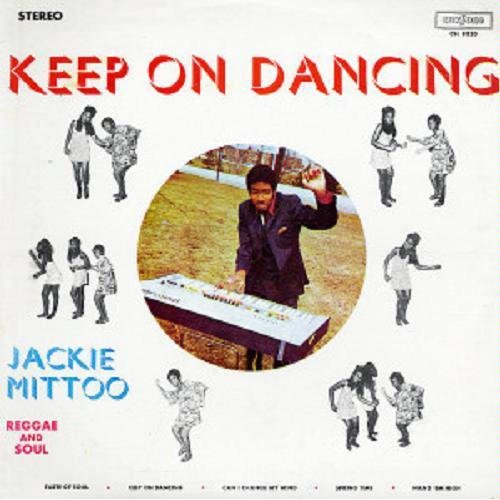
Jackie Mittoo - Keep On Dancing (1969)


By the time this 1969 solo record was released, organist/arranger Jackie Mittoo had already established his reputation as an important contributor to the Skatalites' catalog and Clement "Coxsone" Dodd's Studio One label. Under Dodd, Mittoo wrote a large chunk of the famous Brentford Road rhythms that would light up the charts, both in their original rocksteady form and as reworked gems for the dancehall crowd of the early '80s.

Like many of his fellow session players, Mittoo channeled U.S. soul and funk influences to help concoct a unique Jamaican musical style in the '60s and '70s. And while recent retrospectives, like Hearbeat's admirable "Tribute to Jackie Mittoo" two-disc set, make a first-choice selection easy, this and other of the organists many solo releases on the Studio One imprint beg a listen. One soon discovers Mittoo and Dodd's various house bands (the Soul Vendors, Sound Dimension, and the Soul Brothers) produced more than enough prime shots to fill several roundups. A fine slice of rocksteady and reggae-soul instrumentals from one of reggae's brightest lights.

Tracklist:
Clean Up
Taste Of Soul
This Scorcher
Water Hole
Blue Lou
Taste Of Living
Juice Box
Keep On Dancing
Mellow Fellow
Can I Change My Mind
Spring Time
Hang ´em High
Lazy Bones
Hello Studio One

Jackie Mittoo - Keep On Dancing (1969)
(192 kbps, front cover included)

Tighten Up - Volume 5 & 6

PhotobucketTrojan's Tighten Up series had always gone for variety, but Volume 5, released in 1971, hot on the heels of its predecessor, was positively anarchic.

From the sublime, "In Paradise", to the surreal, "Hello Mother", the sweet, "It's You", to the savage, "Rod of Correction", this compilation careened madly through the reggae landscape.

For the uninitiated, reggae may appear a monolithic musical style, defined merely by its emphasis on the offbeat, but like any other generic label, the term sheltered myriad sub-styles under its umbrella. And all of them feature on this set.

Jamaicans always had a penchant for reggae-fied pop covers, and a pair appear hear. Instrumental versions of chart hits were equally popular, and once again three were included, although this time only one, "Ripe Cherry", boasts a DJ on top. Medleys were also all the rage, normally melding three of an artist's hits together, thus the proliferation of singles simply titled "Three in One".
Here it's a hat trick of sweet hits from young singing star Errol Dunkley. There's also a trio of cultural numbers, including Delroy Wilson's masterful "Better Must Come".
And in a broad hint of what was to come, The Wailers's make their sole appearance in the series with their classic "Duppy Conqueror".
Volume 6 was to be the final album in the series, with vocal groups once again coming to the fore, alongside solo singers and DJs. The Maytals's "Redemption Song" bears no relationship to Bob Marley's own similarly titled masterpiece, bar Toots Hibbert's equally heartfelt delivery. The Chosen Few showcase their soulful side, while The Maytones are all sweet ache.

Elsewhere Ernie Smith herded reggae out on the range, Clancy Eccles was submerged under strings, Mikey Chung took his guitar surfing, The Cimarons's (sic) organist headed for outer space, while Dandy Livingstone shot up the UK chart with his hit "Suzanne Beware of the Devil". Representing the DJs, Shortie suavely mashed up The Uniques's sublime "My Conversation", and I-Roy exploded across The Jumpers's "The Bomb". They were the future, as toasters ran rampart across the Jamaican scene. But Jackie Edwards's offered an escape, at least for Britain, with his fabulous performance on "Who Told You So", which tells one everything they need to know about lover's rock.

It was a wild ride, and across it this seminal series defined the reggae age, bringing hits and misses to the masses, and leaving its mark on a host of future British artists and bands.

Tighten Up - Volume 5 & 6

Mittwoch, 1. März 2023

Hanns Eisler – Kleine Sinfonie, Kammer-Sinfonie, Orchesterstücke - Magedeburgische Philharmonie, Mathias Husmann


Hanns Eisler´s life and work as a composer had the character of a fundamental aesthetic confrontation with tradition and the world. Even at the age of sixteen, at the outbreak of World War I, Eisler belonged to a student group of antiwar activists - such membership being completely contrary to the trend of the times.

The Small Symphony op. 29 was composed in 1932. For short movements form a sequence of ten minutes in duration. Twelve-tone techniques are employed along with variation forms, contrapuntal elements, and rhytmical-metrical motivic shifts, and all of this creates the impression of a model exhibition.

The other orchestral works recorded here draw on extramusical sources. Eisler teamed up with the revolutionary filmmaker Joris Ivens in 1938. He composed the music for Ivens film about the legendary Long March of the Chinese communists ("Four Hundred Million"). The film music yielded his Five Pieces For Orchestra.

The Chamber Symphony of 1940 is also based on experiments in the area of film music.
The Overture to a Comedy (Nestroy´s "Höllenangst") of 1948 is much more relaxed than the Chamber Symphony. Eisler convices himself, so to speak, of his sovereign command of the light tone animated by ironic usage in the style of quotations.

The recordings on this album feature the Magdeburg Philharmonic Orchestra conducted by Mathias Husmann.

Tracks:

Kleine Sinfonie, op.29
Drei Stücke für Orchester
Fünf Orchesterstücke
Kammer-Sinfonie, op.69
Ouverture zu einem Lustspiel

Hanns Eisler – Kleine Sinfonie, Kammer-Sinfonie, etc. - Magedeburgische Philharmonie, Mathias Husmann
(256 kbps, cover art included)

VA - Tighten Up Vol. 3 & 4


Obviously onto a good thing, the Trojan label continued the "Tighten Up" series of budget compilations rounding up recent hits continued, with Volume 3 and 4 arriving in 1970 and 1971 respectively.

The Maytals "Monkey Man" kicked off the former set, which once again is notable for its eclectic nature. There's another trio of instrumentals, with "Shocks of Mighty" boasting the exuberant DJ skills of Dave Barker, while veteran toaster King Stitt indulges the "Herbsman". Jimmy Cliff was "Suffering", but not for long, by the time this album hit the streets he'd already hit the big time. Ken Boothe was still a few years away from that, but his "Freedom Street" was a popular number, and in Jamaica the riddim would be versioned for years to come. Jamaican born, but British based Dandy Livingston would also eventually crack the UK charts, and here delivers a sublime cover of "Raining in My Heart". Former Gaylad Delano Stewart's offering is just as sweet and emotive.

With the dawn of a new decade, culture began taking hold in Jamaica, a phenomenon reflected across a clutch of Volume 4's cuts. Niney Holness's apocalyptic "Blood and Fire", The Ethiopians's plea for repatriation "The Selah", The Pioneers's harmonic cry of "Starvation" and Merlene Webber's toasting "Hard Life" all spoke of serious matters, as did The Slickers's sublime rude boy warning "Johnny Too Bad". But amongst these heavy hitters were an equal number of lighter songs. Hopeton Lewis, for one, was "Grooving Out on Life", Jean & the Gaytones found comfort in music, and adamantly declaring "I Shall Sing", while Webber found the solution for her difficulties, advising all women to "Stand by Your Man". The Ethiopians also return for a second helping with the love-laced "Good Ambition". Reissuing these two excellent compilation albums together on one CD emphasizes the stylistic shift underway, one from which roots would emerge.


Tighten Up - Volume 3 & 4 (192 kbps)

Donnerstag, 16. Februar 2023

VA - Tighten Up, Vol. 1 & 2 (Trojan Records)


It was the phenomenal success of the Inspirations' "Tighten Up" single, that launched Trojan's legendary reggae series. Quickly cashing in with the astutely titled "Tighten Up" compilation, the rest is history.

That's the accepted version of the story, the actual one is more mundane, and much more calculating. Trojan had so far failed to interest the British public with its albums, and three excellent single-artist compilations released in 1968 excited little attention. In desperation, a market research study was conducted; the results were a wake-up call, for what reggae fans really wanted was a cheap sound system experience in their front rooms. Trojan responded in 1969 with a budget-priced album featuring an eclectic mix of recent tracks, kicking off with "Tighten Up" itself. The reaction was phenomenal, so much so that a follow-up set was released before the year was out.

"Tighten Up, Vol. 1-2" brings these two seminal sets together on a single CD. The first volume was surprisingly the weakest, and weighed down with reggae-fied pop covers. David Isaacs' "Place in the Sun" is the best of the batch, the two instrumentals the most fun, and the Uniques' "Watch This Squad" the oddest. Of the original numbers, "Tighten Up" itself (now inexplicably credited to producer Lee Perry) is the obvious draw, but equally crucial are Derrick Morgan's soulful, skinhead fave "Fat Man," and Brother Dan All--Stars' sweet "Donkey Returns."

In contrast to this shaky start, the second volume was stuffed with smash hits and acknowledged classics. The trio of instrumentals are absolutely lethal, with the biggest, the Upsetters' "Return of Django" having moonstomped its way into the U.K. Top Five. It's obvious this set held pride of place in many future 2-Toners record collections, with the Pioneers' "Longshot Kick de Bucket," Clancy Eccles' "Fattie Fattie," and the Upsetters' exuberant "Live Injection" all providing inspiration. From calculating Casanovas to the outright rude, from sufferers to celebrators of the new sound, in Britain "Them a Laugh and a Ki Ki" when presented with reggae in all its wonder. Great music never goes out of fashion, which is why this series' popularity has never faded.            

VA - Tighten Up Vol. 1 & 2 (Trojan)
(192 kbps, front cover included)

Mittwoch, 15. Februar 2023

The Fugs - Be Free - The Fugs Final CD (Part 2)

It's hard to say what seems more remarkable - that the Fugs have somehow survived well into the 21st century, or that they've finally threatened to throw in the towel in the year 2010, 46 years after a handful of poets, beats, and activists became America's first great underground rock band.

"Be Free!" is subtitled "Final CD, Pt. 2", and given Tuli Kupferberg's death in 2010, this is the group's final recorded gesture. The Fugs that recorded this album between 2005 and 2009 are a different kettle of fish from the gleefully rude troublemakers who emerged in the '60s, but if guitarist Steve Taylor, bassist Scott Petito, and percussionist Coby Batty make this music sound almost professional (something they periodically managed in their heyday, truth be told), Kupferberg and Ed Sanders thankfully seem to have scarcely changed a bit. Sanders is a man who knows how to celebrate joy and isn't afraid to deliver his songs with the brio they deserve, and his celebrations of laughter ("The Laughing Song"), purposeful sloth ("Goofitude"), and throwing off the burden of white collar culture (a song adapted from Herman Melville's Bartelby the Scrivener) ring clear and true, as does a witty but forceful attack on the CIA. Taylor's "Hungry Blues" isn't as ambitiously poetic as the other tunes here, but it's impassioned and all too timely. And if Kupferberg mostly sounds like a cranky old man on Be Free, he's a hilarious, inspired, and eloquent cranky old man, and the playful snark of "This Is a Hit Song" and "I Am an Artist for Art's Sake" is vital, beautiful stuff. But Kupferberg saves his best moments for the album's closing track, "Greenwich Village of My Dreams," a reverie in which many of the great bohemian heroes of the 20th century come together in a string of fantastic moments both real and imagined; it's also a tribute to the time and place that brought the Fugs together in the first place, and it's an ideal way to bring this group's story to a close.


Tracklist:

1 Bee Free
2 Backward Jewish Soldiers
3 My Darling Magnolia Tree
4 Goofitude
5 This Is A Hit Song
6 The Laughing Song
7 Hungry Blues
8 Loose Peach Gown
9 Bartleby The Scrivener
10 Imgrat
11 The CIA Made Me Sing Off-Key
12 The British Journalist
13 I Am An Artist For Art´s Sake
14 Greenwich Village Of My Dreams

The Fugs - Be Free - The Fugs Final CD (Part 2)
(320 kbps, cover art included)
           

VA - Vanguard Newport Folk Festival Sampler

Founded in 1959 by Theodore Bikel, Oscar Brand, Pete Seeger, George Wein, and Albert Grossman, and modeled after the already established and successful Newport Jazz Festival, the Newport Folk Festival ran in its original configuration throughout the '60s before running out of gas in 1971 (the festival was revived in 1985 and has run annually ever since, although it has little more than its name in common with the festival's original run). Vanguard Records was on hand to record several of the mid-'60s lineups and as this sampler shows, there was a lot of vitality in the performances. Highlights here include Johnny Cash's spry version of his "Big River," a powerful, ominous, and spooky acoustic rendition by John Lee Hooker (complete with foot stomping) of "Hobo Blues," and a delightful duet between Joan Baez and Donovan on the latter's "Colours."

Any sampler worth its salt should leave the listener wanting to investigate further, and this introduction to the riches of Vanguard’s “Newport Folk Festival” set of albums does the job admirably. With one 13-track selection, it shows the quality and diversity of the music as it was presented at Newport from the first festival in 1959. The festival was founded under the guidance of a board of directors that originally included Theodore Bikel, Pete Seeger, Oscar Brand, Albert Grossman and George Wein, the latter having been the driving force of the well-established Newport Jazz Festival. The new festival arrived at a time when folk music was achieving mainstream popularity and much political relevance during the Cold War. It was a time when folk was seen as a very accessible musical form to play, sing along to or simply as a social unifier. The Newport Folk Festival was an annual event from 1959 through most of the 60s until it took a break from 1971 to 1985, when it successfully revived in a broader musical format. This sampler features music from the years up to the mid-60s, when it was at its most influential.


Tracklist:
1 Johnny Cash – Big River
2 The Kingston Trio – When The Saints Go Marching In
3 The Staples Singers – Pray On My Child
4 Judy Collins – Turn Turn Turn
5 The Stanley Brothers – How Mountain Girls Can Love
6 John Lee Hooker – Hobo Blues
7 Pete Seeger – It Takes A Worried Man
8 The New Lost City Ramblers – Gold Watch And Chain
9 Muddy Waters – I Can't Be Satisfied
10 Joan Baez & Donovan – Colours
11 Roy Acuff & His Smokey Mountain Boys – Steel Guitar Chimes
12 The Kentucky Colonels – Get Down On Your Knees And Pray
13 Doc Watson – Beaumont Rag

VA - Vanguard Newport Folk Festival Sampler
(320 kbps, cover art included)

Montag, 13. Februar 2023

The Fugs - The Real Woodstock Festival (Live 1994)

Given the American social and political climate during the mid '80s, the semi-permanent reunion of founding Fugs Tuli Kupferberg and Ed Saunders could not have been more culturally apropos. "The Real Woodstock Festival" is a live two-disc set featuring Kupferberg and Saunders accompanied by Steve Taylor on guitar and backing vocals, Coby Batty on percussion and backing vocals, and Scott Petito on bass.
Also joining the festivities are two counter-cultural icons: beat poet Allen Ginsberg and "Country" Joe McDonald -- the only artist to have performed at the original event in 1969 and the Fugs "Real Woodstock Festival" in 1994.
Ironically, unlike any of the other events bearing the 'Woodstock' albatross, "The Real Woodstock Festival" was actually held in the town of Woodstock, New York -- where Ed Saunders has maintained a permanent residency since the early '70s. Likewise the two performances were held on the true anniversary of the original event -- August 13 & 14.

The loose camaraderie and rag tag frenetic madness that defined the Fugs 'high art' of blending music with socially conscious poetry is certainly alive and well on this collection. In addition to performing a handful of new compositions, Kupferberg and Saunders revived some of their most treasured works from every phase of their career. From their days on the uncompromising ESP label, "Frenzy," "CIA Man," "Morning, Morning," "How Sweet I Roamed From Field To Field" and "The Post-modern Nothing" have been modernized with new arrangements, yet remain as poetic and arguably even more relevant in this context. Likewise, there are a few rarities from the Fugs tenure on Reprise Records in the late '60s: "Crystal Liaison," "I Want To Know" and the rarely performed "When The Mode Of The Music Changes." The latter undoubtedly contains further portents as less than an hour away from this celebration, Woodstock '94 was co-opting an entire generation.


The Fugs - The Real Woodstock Festival 1
The Fugs - The Real Woodstock Festival 2

(192 kbps, front cover included)

Pete Seeger - Live At Newport (1963)


As one of the main folk labels of the 1960s folk revival, Vanguard Records extensively recorded performances at the Newport Folk Festivals of 1963, 1964, and 1965, but released the results only sparingly on a series of various-artists LPs at the time, in part because many of the performers captured on tape had exclusive recording contracts with other companies.

One of those artists was Pete Seeger, and 30 years later Vanguard is able to issue an album assembled from Seeger's 1963-1965 Newport appearances, all of it previously unreleased. In some ways, it's a fairly typical Seeger live album, on which he covers then-contemporary material by other folksingers (Matt McGinn's humorous "Manyura Manyah"); sings in a foreign language ("Malaika"); tells a children's story ("The Foolish Frog"); plays banjo tunes ("Old Joe Clark"); revives the work of his influences (Leadbelly's "Midnight Special," performed with Lafayette Leake and Willie Dixon); and includes his own originals ("Oh Had I a Golden Thread," "Where Have All the Flowers Gone"), all the while instructing and encouraging his audiences to sing along.

One unusual aspect of the Newport performances, however, is the inclusion of an excerpt from a "workshop" appearance, at which Seeger is questioned about his banjo style and explains some of his techniques. Another one-time occurrence is the group closer on "Down by the Riverside," in which he leads a stage full of fellow performers including Joan Baez and Peter, Paul and Mary. Those are moments that make this a special Pete Seeger recording, not just another one of his many live albums.    

Tracklist:

1 Introduction 0:51
2 Manyura Manyah 5:38
3 Malaika 2:06
4 Oh Mary Don't You Weep 4:34
5 The Foolish Frog 7:43
6 Deep Blue Sea 4:04
7 Never Wed An Old Man 2:31
8 Old Joe Clark / Oh Had I A Golden Thread 3:52
9 Holy Ground 3:52
10 Darlin' Corey / Skip To My Lou / Going Across The Mountains 10:47
11 Midnight Special 2:52
12 It Takes A Worried Man 5:28
13 Coal Creek March 2:13
14 Where Have All The Flowers Gone 2:17
15 Down By The Riverside 5:02

Pete Seeger - Live At Newport
(256 kbps, front cover included)       

Sonntag, 12. Februar 2023

Sarah Vaughan - No Count Sarah (1958)

Sarah Vaughan recorded in a variety of settings while with Mercury and EmArcy in the 1950s, but this particular matchup with the Count Basie Orchestra (pianist Ronnell Bright substitutes for Count, thus the title) is pure jazz.

During the classic encounter, Vaughan fits in comfortably with the band, whether singing lyrics (such as "Darn That Dream," "Cheek to Cheek," or "Doodlin'") or scatting sensuously on "No Count Blues." The wit and constant swing (in addition to the spontaneous creativity), makes this one of the best of all Sarah Vaughan recordings. Highly recommended.


Tracklist:

  1. "Smoke Gets in Your Eyes" (Otto Harbach, Jerome Kern) – 3:58
  2. "Doodlin'" (Horace Silver) – 4:34
  3. "Darn That Dream" (Eddie DeLange, Jimmy Van Heusen) – 3:43
  4. "Just One of Those Things" (Cole Porter) – 2:31
  5. "Moonlight in Vermont" (John Blackburn, Karl Suessdorf) – 3:19
  6. "No 'Count Blues" (Thad Jones, Sarah Vaughan) – 5:27
  7. "Cheek to Cheek" (Irving Berlin) – 5:09
  8. "Stardust" (Hoagy Carmichael, Mitchell Parish) – 3:17
  9. "Missing You" (Ronnell Bright) – 3:28


Sarah Vaughan - No Count Sarah (1958)
(256 kbps, cover art included)         

Bob Dylan - Studs Terkel´s Wax Museum (1963)

On the morning of April 25 1963, directly after the conclusion of his final Freewheelin’ Bob Dylan album session, Bob journeyed to Chicago for a live club appearance and a radio interview. The gig, on the evening of the same day, was at a newly opened club called The Bear, in which manager Albert Grossman was a partner. But the primary reason for the 700-mile excursion west was for Dylan to appear on a radio show the following evening, hosted by the extraordinary Studs Terkel.
Capturing the entire broadcast, during which Dylan is questioned and discusses with Studs his thoughts and ideas behind both the songs he performs and others he had written by this juncture, this CD contains a legendary event during which a 21 year old Bob Dylan also performs full acoustic versions of 7 self penned numbers.
Across just over an hour of airtime, Studs and Bob chat like old friends as Dylan is prompted towards playing certain tracks from his then fairly slim body of work, but comes up trumps by pulling songs not just from his imminent second record, but including one from the album after that and showcasing 3 songs that wouldn’t see the light of day on record until the 1990s.
Serving both as a historic document of a little known event in the career of a true musical icon, but also as a wholly enjoyable listening experience that stands up to numerous repeat listens.

The 1963 Terkel performance and interview is a must have for any serious collector. Bob has come into his own as a performer even at this early date. The songs are well done, and Bob's wit shines through on the interview.

Bob Dylan - Studs Terkel´s Wax Museum (1963)
(192 kbps, cover art incuded)

Ian & Sylvia - So Much For Dreaming (1967)

From 1967, “So Much For Dreaming” was the sixth of seven albums that Ian and Sylvia issued on Vanguard Records during the sixties, and came a year or so after they had established their position as key folk-rock artists with their oft-covered songs like ‘Four Strong Winds’ and ‘Early Morning Rain’. The Canadian pair were married by this point, but had started as a singing duo on the Toronto folk club circuit in 1959. After some help and prompting from Pete Seeger, in 1962 they relocated to New York where they were spotted at Gerde's Folk City by Albert Grossman who pointed them towards Vanguard. After an initial album of mostly traditional folk songs, the pair hit their stride with their own songs, and gradually began to add extra instrumentation that helped then define the New York folk-rock sound that became so influential around the world. On this album they are augmented by drummer Alvin Rogers, Fender bassist Robert Bushnell and guitarist David Rae, the latter being briefly a member of Fairport Convention during 1972.

This album opens with the lilting Joni Mitchell song ‘The Circle Game’, that they had recorded even before Joni had. Continuing the contemporary approach, Ian's title track comes next and helps to set the tone and feel for the album, with the pair's floaty vocals overlapping each other as the track builds with additional orchestration from Trade Martin. More of Ian's songs follow, including ‘Wild Geese’ and ‘Summer Wages’ with the latter cautionary tale being one that he sang many times over the years. Sylvia's own songs here are the rhythmic ‘Hold Tight’ and the more reflective album closer ‘Grey Morning’. They come together with their co-arrangement of ‘Come All Ye Fair And Tender Ladies’ making it one of the best and most attractive examples of their ability to re-mould a song and make it their own. Another traditional song that they rearrange is ‘Cutty Wren’ that shows that they hadn't forgotten their roots and how they could bring a new twist to such a song, in this case with their interchanging vocal lines against some tinkling percussion. ‘Si Les Bateaux’ from Gilles Vignault and Robert Petway's ‘Catfish Blues’ are two more 'outside' songs, with Vignault's being a gentle French song constructed with differing sections, while Petway's is a funky blues sung effectively and commandingly by Sylvia on her own.

The album sold reasonably well, reaching #130 on Billboard, though their earlier albums “Northern Journey” and “Early Morning Rain” had fared better reaching up into the 70s. They were soon to make a move to MGM Records, but were not to really replicate the quality and accessibility of the Vanguard albums where they forged their most memorable work and cut their very best songs.  


Tracklist:
A1Circle Game2:58
A2So Much For Dreaming3:00
A3Wild Geese3:54
A4Child Apart3:26
A5Summer Wages4:01
A6Hold Tight2:38
B1Cutty Wren2:55
B2Si Les Bateaux3:40
B3Catfish Blues3:33
B4Come All Ye Fair And Tender Ladies3:23
B5January Morning3:03
B6Grey Morning2:48


Ian & Sylvia - So Much For Dreaming (1967)
(192 kbps, cover art included)

Joseph Spence - The Complete Folkway Recordings 1958


Born on the island of Andrus in the Bahamas, Joseph Spence created an idiosyncratic (and inimitable) guitar style rife with percussive and improvisatory vamps around staid hymns and such "square" standards as "Coming in on a Wing and a Prayer." He was a folk guitarist's Thelonious Monk, and his growling vocal counterpoint and surprising inventions are one of folk music's great delights.                

These recordings of Joseph Spence, made by Samuel Charters in 1958, display one of the most inventive guitar styles ever put to tape. Spence improvised on traditional tunes in a manner comparable to African-Americans Elizabeth Cotten and Mississippi Fred McDowell, like them adding rhythmic and melodic accents and changes in unexpected ways. In addition to his guitar work, he possessed an unparalleled vocal style. The closest match is the deep-voiced blues singer Howlin' Wolf.

Charters met Joseph Spence, who was well-known to people on the island of Andros in the Bahamas, somewhat unintentionally while looking for Bahamian folk music. The recordings were made with field equipment, and the sound quality reflects this. As with all field recordings, this is a blessing and a curse. The lack of a studio preserves the "authenticity" of the folk sound, while the vocals on some tracks end up too low in the mix, thus de-emphasizing one of the most interesting aspects of the music.

Nonetheless, the songs on this collection are intriguing and novel, even to the seasoned folk music listener. Spence's complexity of guitar work and uniqueness of vocal style are an unmatched combination.       
   
Joseph Spence - The Complete Folkway Recordings 1958
(256 kbps, cover art included)