Samstag, 1. Juli 2023

Dave Van Ronk And The Hudson Dusters - Same (1967)

The Hudson Dusters was a band put together by legendary folksinger Dave Van Ronk in a short-lived attempt to buy into the folk-rock craze that hit the States in the mid-sixties. Though Van Ronk was one of the founding fathers of the original Greenwich Village revival, he had never really conformed to any of the stereotypes which were so quick to develop among his contemporaries. Thus, the music which developed out his “going electric” was far more eccentric than most people’s. This was no attempt to simply copycat (and thus capitalize on) Dylan’s new aesthetics, this was an artist expanding his sonic palate on his own terms.

"Dave Van Ronk and the Hudson Dusters", like any Van Ronk record, is an eclectic experience. Not only does the band draw from folk, blues, jazz and rock and roll traditions, but Van Ronk’s unique sense of humor and unmistakable whiskey-and-tobacco voice lend the music a surreal edge. In fact, I’d argue that the convoluted middle-class satire of “Mister Middle” almost lands the proceedings in Mothers of Invention territory. Though neither it nor “Keep Off The Grass” should be considered the era’s sharpest attempts at social commentary, the tongue-in-cheek approach and adventurous musical arrangements make them more entertaining than most such material.

I have to admit that I’ve never been wild about Joni Mitchell, but Dave Van Ronk’s back-to-back takes on “Chelsea Morning” and “Both Sides Now” are surprisingly successful. This is one of those instances where you wouldn’t expect the artist and the material to click, but somehow the deadpan earthiness of the interpreter lends new angles to what are otherwise rather spacey and introverted lyrics. Apparently Mitchell herself praised Van Ronk’s recording of “Both Sides Now” as being definitive, but I’ll leave that one up to the reader to decide.

The Hudson Dusters also run through a few numbers previously recorded by Van Ronk on his acoustic records, such as the Reverend Gary Davis’ “Cocaine Blues” – which has always been something of a signature song for the singer – and “Dink’s Song,” in which subtle strings underscore Van Ronk’s rough-yet-tender vocal performance. The goofy show tune “Swinging On A Star” would also become a Van Ronk standard in the years to come, though my own reaction to this one is lukewarm at best. I much prefer their psychedelic garage take on Dallas Frazier’s old rock and roll chestnut “Alley Oop” with it’s odd, echoplexed vocal chorus.

With a few notable exceptions, the majority of Van Ronk’s 1960s recordings remain unreleased or out-of-print on compact disc, and unfortunately this is one of the former. Don’t let this unfortunate detail deter you, though; "Hudson Dusters" may not be the definitive statement from Dave Van Ronk (he tended to stick to the acoustic guitar for a reason), but as a rare electric anomaly in his catalog, it is definitely worth checking out.  (from: http://therisingstorm.net)

The sound on this album is reminiscent of the New York folk-rock band The Blues Project. It begins with a ragged rendition of The Hollywood Argyles' "Alley Oop" and ranges from that doo wop chestnut to Joni Mitchell's "Chelsea Morning and Clouds" to "Romping Through the Swamp." More familiar Van Ronk territory is covered, also with reprise performances of "Dink's Song" and "Cocaine." Dave Van Ronk always brings his enthusiastic roar to his material and makes it his own. His rendition of "Swing on a Star" is but one example. The Hudson Dusters seem to be a combination electric jugband, folk orchestra and bubblegum band, as on "Mr. Middle." A strange collection.


Tracklist:

A1 Alley Oop 3:38
A2 Head Inspector 2:06
A3 Swing On A Star 2:37
A4 Mr. Middle 3:02
A5 Chelsea Morning 2:33
A6 Clouds (From Both Sides Now) 4:37
B1 Keep Off The Grass 2:08
B2 Dink's Song 3:34
B3 New Dreams 2:22
B4 Cocaine 4:58
B5 Romping Through The Swamp 1:58

Dave Van Ronk And The Hudson Dusters - Same (1967)
(320 kbps, cover art included)

X-Ray Spex‎– Live At The Roxy Club

Say what you like about X Ray Spex, but they never let their audience off easily. Even at the peak of their shortlived success, London's Hammersmith Odeon just two years after scratching a living at the nearby Man In The Moon, the band blistered through a set of such intensity that its absolute brevity really didn't sink in until you tried to remember where the rest of the evening went. Track back to the band's infancy, and they made the Ramones sound like a tortoise race.

"Live At The Roxy" is as brutal as the band's reputation suggests. Recorded at the same show as the band's contribution to the 1977 Live At The Roxy various artists album, it opens and closes with hideously discordant versions of the intent-laden "Oh Bondage! Up Yours", a cacophonic saxophone defying the punk wisdom that the instrument had no place in the new discipline, while the remainder of the band alternately staggers and swaggers through a riff so monotonal that Poly Styrene herself sounds tuneful.

Not once does the energy level dip, with versions of "Identity" and "Let's Submerge" already hinting at the shrieking magnificence of their eventual studio incarnations. And hindsight, battered by two decades worth of noise bands that make X Ray Spex sound symphonic, readily adjusts to the crunchy caterwauling that was the infant group's stock in trade. But the audience response - bothered, bewildered and bemused - reminds you just how far off the beaten track X Ray Spex once marched, and 25 minutes seems to stretch out to an eternity. What a wonderful record this is!

Tracklist:

Oh Bondage! Up Yours! 2:42
Identity 2:25
Let's Submerge 3:05
Plastic Bag 4:10
I Live Off You 2:18
I Am A Cliche 1:48
I Can't Do Anything 2:59
Oh Bondage! Up Yours! 2:52


X-Ray Spex‎–
Live At The Roxy Club                                   
(256 kbps, cover art included)

Rip Rig + Panic ‎– I Am Cold (1982)

Named after a terrific '60s jazz album by Rahsaan Roland Kirk, "Rip Rig + Panic" answered the question: what happens when avant-garde post-punks collide head-long with a pop/soul singer and play a mutated form of jazz? A loosely knit collection of ex-Pop Group members (Gareth Sager and Bruce Smith) and young stars-to-be (Neneh Cherry), Rip, Rig & Panic formed in 1980 as quintessential avant-garde bohemians. They eschewed pop for a more primal, percussive foundation (slightly reggae, slightly Afro-pop) upon which was layered free jazz blowing and honking, soulful singing, and Cecil Taylor-inspired piano mania. But, as intense as this music was, it wasn't played with a dry academic seriousness; quite the contrary, Rip Rig + Panic were all about fun and playfulness. Even the song titles ("Constant Drudgery Is Harmful to Soul, Spirit & Health" and "Those Eskimo Women Speak Frankly") sounded more like surreal announcements than they did traditional, catchy song titles.

Arguably the most likable bunch of avant-garde types ever to record music, Rip Rig + Panic called it a day after three mostly wonderful, if somewhat inconsistent records. If your taste in music, even fringe music, is such that a strong melodic focus is necessary, than perhaps this won't be your cup of tea. However, if you don't mind a little chaos with your funk, then give this heady mix a chance; it will work its way into your heart, head, and feet. As for the members, Bruce Smith joined Public Image Ltd. for a spell, and Neneh Cherry became a huge pop star (deservedly so) with her first solo record.       

"I Am Cold" is the second studio album by Rip Rig + Panic, released in 18 June 1982. With additional help from ex-Slits singer Ari Upp and Cherry's stepfather, noted jazz trumpeter Don Cherry, "I Am Cold" is a slightly more mature work, but the exuberance and all-out craziness that marked their debut is here in full force. A little rambling, but an approach to music unlike one you've heard before.

Tracklist:
North Side:
Hunger (The Ocean Roars It Bites)3:00
Epi Epi Arp Woosh!4:00
Another Tampon Up The Arse Of Humanity4:00
Misa Luba Lone Wolf3:06
East Side:
Storm The Reality Asylum4:00
Here Gathers Nameless Energy (Volcanoes Covered By Snow)4:20
A Dog's Secret1:30
Liars Shape Up Or Ship Out2:00
South Side:
Warm; To The If In Life4:30
Nurse Increase The Sedatives (The Torment's No Better)4:15
Take A Don Key To Mystery4:00
West Side:
Tax Sex5:00
Subversive Wisdom5:00
Fire Eyes Joyful Silent Tears4:10

Rip Rig + Panic ‎– I Am Cold (1982)
(192 kbps, cover art included)
     

Keith Hudson - The Black Morphologist Of Reggae (1983)

Ominously known as "The Dark Prince of Reggae," Keith Hudson was born into a musical family in Kingston, Jamaica in 1946. His musical education began as Hudson worked as a sort of roadie for Skatalite and Jamaican trombone king Don Drummond.

By age 21, Hudson, who had been trained as a dentist, sunk his earnings into his own record label, Inbidimts, and had a hit with Ken Boothe's recording of "Old Fashioned Way." Not long after this chart success, the suddenly hot Hudson was producing some of the biggest names (and soon-to-be biggest names) in reggae - John Holt, Delroy Wilson, Alton Ellis, and the great toasters U-Roy and Dennis Alcapone, all of whom benefited from what would be Hudson's trademark production style: groove-centered, bass/drum-dominated, lean and mean stripped-down riddims.

By the mid-'70s, Hudson began releasing more solo work, hitting paydirt from the start with his 1974 debut, "Entering the Dragon" and his intense second record, "Flesh of My Skin", an ominous, dark record that earned Hudson his title as reggae's "Dark Prince." In 1976, Hudson relocated to New York City and worked pretty much nonstop, producing as well as recording solo records up until 1982. He succumbed to lung cancer in 1984, at age 38, robbing reggae of one its greatest, most adventurous, and unhearalded producers and performers.                

"The Black Morphologist Of Reggae" is the 1983 reissue of album "From One Extreme To Another" (1979). "Nuh Skin Up Dub" (1979) features dub versions of this album.
Big up to the original uploader!

Tracklist:

A1 Anger
A2 No Skinup
A3 Central Kingston
A4 It's Allright
A5 Desiree
B1 (Dreadful) Words
B2 They Don't Hurt
B3 (Bad Things) You Teach Me
B4 One Extreme To Another
B5 Buzzing Bee                                                                                   

Keith Hudson - The Black Morphologist Of Reggae (1983)
(320 kbps, cover art included)

Hanns Eisler - Orchestral Music, Vol. 2 - Kleine Sinfonie / 5 Orchestral Pieces / Scherzo / Rhapsodie / Winterschlacht-Suite / Wilhelm Tell

Originally posted in May 2015:

The Second World War ended in Europe on the 8th of May 1945 with the capitulation of the Wehrmacht. Six years of war had cost the lives of millions of victims and brought a previously unknown degree of destruction.

War and occupation, crimes, expulsions and forced resettlement had left a lasting mark on the countries and populations. The consequences can still be felt on a political, social and individual level. Today’s Europe cannot be understood without knowledge of the events of the war as well as the phase that followed the war and the end of the Nazi terror.

On the occasion of the 70th anniversary of the German capitulation, we will do some postings in the next days related to these events.


We´re starting with an album featuring music by Hanns Eisler, including the "Winterschlacht Suite", referring to the battle of Moscow, 1941/42, a turning point of the Second World War.

"WINTERSCHLACHT UM MOSKAU 1941

Rotarmisten!
Das war die Division,
Die als erste Einzug halten sollte.
In Moskau. Sie ist nicht mehr.
Für Feinde führt kein Weg nach Moskau.
Den Freunden aber öffnen wir das Herz.
Für unsere Freiheit schlugen wir die Schlacht,
Und haben eine Schlacht zugleich geschlagen
Für aller Völker Freiheit.
Nicht zuletzt auch für die deine, Deutschland.
Rotarmisten!
Noch steht der Feind im Land
Noch ist er nicht zu Fall gebracht.
Wir stürmen weiter vor
Noch heute nacht!"
-  Johannes R. Becher

Eislers stage music to Johannes R. Becher's piece "Die Winterschlacht" (Winter battle) had been
written as “Deutsche Tragodie” (German tragedy) as early as 1941 in Soviet exile. The play is set around the Battle of Moscow (1941-42) and follows Johannes Hörder, a middle-class soldier whose experiences of Nazi aggression finally drive him to disobey a barbaric order to bury pro-Soviet partisans alive and to shoot himself dead instead.
The score dates from 1954. Its first performance took place at the Berlin Ensemble on January 12, 1955.

The ninepart "Winterschlacht‐Suite" comprises the complete stage music score, compiled for concert performance. The prelude, an almost Handelian funeral music for strings, is identical to the song,
"Horatio's Monologue", written by Eisler to a passage from Shakespeare's Hamlet. This song was probably not composed until the spring of 1956, and it may be assumed that, while composing the “prelude” for the "Winterschlacht", Eisler had these verses in mind, without actually setting them literally; a case of the song subsequently having been extracted from the instrumental composition.

The confrontation with Hitler's fascism, with the barbarity of war, with “military honour” and doubt in the sense of senseless dying, with the collapse of the Third Reich and with the question as to the future of Germany ‐all these form the thematic substance of the piece, “formulated” within a highly contradictory process of which the coming to terms with the historical past is also a part. How Eisler perceived his position as composer was to become quite clear during the production of the piece, with Brecht directing.

Referring to the “closing music”, Manfred Wekwerth reported the following: “In Becher's Winterschlacht, the directors of the Berlin Ensemble had planned to portray the division fleeing in panic... Eisler appeared at the rehearsal and was quite hurtful in his decision, saying it reminded him of his period of soldiering for the old Kaiser Franz Joseph... At one of the following rehearsals he
came with a sheaf of manuscript and demanded a large orchestra... Brecht thought the idea of smuggling violins into the theatre quite 'remarkable'... A while later, Eisler played us the tape and greatly amazed. He had deleted all the words from the final scene ‐ the flight. What he now wanted was a 'sketchy pantomime of a retreat, reminiscent of Napoleon's from Russia', and his musical depiction of this retreat contained deep sorrow. That was what made the matter so remarkable. 'Why sorrow?' we asked. 'They are Germans ‐ that is sad'. In the second half, the music burst out in wild
triumph, as Beethoven might have used it to signify a Victory. 'But that is a defeat, surely? we blurted out, strangely moved. 'For whom?' demurred Eisler ... Both sorrow and triumph were in the music. Through it ‐ and with only a handful of actors ‐ the scene imparted something of the grotesque social contradiction being represented.”

The Winterschlacht‐Suite is a tonal composition. If the completely rationalized complexity of the serial concert music of the Fifties in West Germany ‐ the concept of “modern” music, in which
everything has become absolute and esoteric ‐ were used as the criterion, then the work would be denigrated as conservative. But in its function on the stage, as “applied music”, and in the light of
Eisler's orientation toward simplification and a broad‐based listenership, it made very good sense.

Hanns Eisler - Orchestral Music, Vol. 2 - Kleine Sinfonie / 5 Orchestral Pieces / Scherzo / Rhapsodie / Winterschlacht-Suite / Wilhelm Tell
(256 kbps, cover art included)

Freitag, 30. Juni 2023

Modena City Ramblers – Terra E Libertà

The Modena City Ramblers were formed in 1991, a casual musical group that came together to entertain friends and family playing Irish folk music. Meeting up to jam more and more often, the Ramblers began to write their own tunes, inspired by popular Celtic-influenced bands like the Pogues and the Waterboys. 

Two years after their formation, the band recorded their first demo tape called Combat Folk. Featuring their punk/Irish folk songs and Italian resistance ballads, the demo sold more than 3000 copies, earning the Ramblers grassroots recognition all over Italy. Picked up by the independent label Helter Skelter, the band's debut album, Riportando Tutto a Casa was released in 1994. Eventually distributed by Mercury, the disc went on to sell an impressive 185,000 copies. In the years that followed, Modena City Ramblers earned a reputation as a powerful live act, performing throughout Europe in collaboration with artists such as the Chieftains and Irish rock vocalist Bob Geldof. 

Their sophomore effort, La Grande Famiglia, experienced similar success to its predecessor, followed by Terra e Liberta which ushered in an era of international attention during which the Ramblers performed in nations such as Bolivia, Spain, Cuba and more. Known for their progressive politics, the band aligned itself with musicians of similar values such as Manu Chao, performing at festivals like the Independent Days Festival in Bologna and the Awesome Africa Festival in South Africa. 

Their 2002 production Radio Rebelde garnered them invitations to perform in locations near and far, including Algeria, the Czech Republic, Amsterdam and Mexico. The band's 2004 album Viva la Vida! Viva la Muerte! (a quote from Zapatista leaders) found its way to Italian Top Ten charts, and opened doors for a 120 city tour. The Modena City Ramblers have become a staple of both the Italian rock scene and the leftist musical circuit alike.


Tracklist:

1 Macondo Express 3:21
2 Il Ritorno Di Paddy Garcia 3:53
3 Il Ballo Di Aureliano 4:04
4 Remedios La Bella 3:53
5 Radio Tindouf 4:54
6 Marcia Balcanica 2:42
7 Danza Infernale 3:42
8 Qualche Splendido Giorno 3:50
9 Transamerika 3:25
10 Lettera Dal Fronte 2:38
11 L'Ultima Mano 4:11
12 Cuore Blindato 2:38
13 Don Chisciotte 3:15
14 Cent'Anni Di Solitudine 3:31
15 L'Amore Ai Tempi Del Caos 3:19


Modena City Ramblers – Terra E Libertà  
(320 kbps, cover art included)

Country Joe & The Fish - Here We Are Again (1969)

"Here We Are Again" is the fourth album by the psychedelic rock band Country Joe and the Fish. It was released in 1969 with the US catalog number Vanguard VSD 79299. It peaked on the Billboard 200 at number 48, and stayed on the charts for eleven weeks. Only Country Joe McDonald and Melton remained from the original lineup that began breaking up since the previous album. The past members would appear as guest musicians however.

The songs were composed by Country Joe McDonald and Barry Melton. In addition to "Country Joe" McDonald (vocals, guitar) and Barry "The Fish" Melton (lead guitar, vocals), the founding members of the band—Gary "Chicken" Hirsh on drums and David Bennett Cohen on Hammond organ, piano and guitar—also played on the recording. The remaining instruments were played by Mark Ryan and President Flyer. For the first time ever, some titles were accompanied by string and brass, which gave the album a somewhat poppier character. The tracks "I'll Survive" and "Maria" were recorded at Vanguard Studios in 23rd Street, New York. The remaining compositions were recorded at Pacific High Studios in San Francisco.

A single from the album, "Here I Go Again"/"Baby, You're Driving Me Crazy", was released, but it did not place in the charts.


Though there would be one more new album in 1970 ("C J Fish"), Country Joe & the Fish no longer existed as anything other than a name; a fact that would be underlined in December 1969 by the simultaneous releases of "Greatest Hits" and McDonald's solo album, "Thinking of Woody Guthrie".


Tracklist:
A1Here I Go Again3:24
A2Donovan's Reef4:18
A3It's So Nice To Have Love3:25
A4Baby, You're Driving Me Crazy2:43
A5Crystal Blues6:18
B1For No Reason3:55
B2I'll Survive2:28
B3Maria3:30
B4My Girl2:16
B5Doctor Of Electricity3:58


(320 kbps, cover art included)


Mittwoch, 28. Juni 2023

Jack Kerouac & Steve Allen - Poetry for the Beat Generation (1959)

"Poetry for the Beat Generation" marked Jack Kerouac's debut as a recording artist. Strangely enough, it was the by-product of a disastrous first show by Kerouac in an engagement at the Village Vanguard during December of 1957.

For the second performance, Kerouac's friend Steve Allen provided the accompaniment at the piano, with results so impressive that it would lead Kerouac to a short but dazzling career as a recording artist. The first result was this album, which came at the suggestion of either Allen or his friend, producer Bob Thiele, who was working for Dot Records at the time. The record was cut in a single session and a single take for each piece.

Allen's graceful piano opens the recording and Kerouac comes in, reading "October in the Railroad Earth" for seven minutes, off of a roll of paper in front of him. Kerouac's reading are in a class by themselves, and separate from Allen - the two performances co-exist and weave together without ever really joining, and the result is a peculiar form of jazz; Kerouac did his thing, Allen did his, and the result was a spellbinding performance, and it was musical, despite Kerouac's seeming monotone reading, which never slowed or otherwise interacted with Allen's piano - his voice dances to its own beat, with Allen embellishing and working around him; in the process, you get visions of various facets of Kerouac's work and personality, in extended pieces such as "October in the Railroad Earth" and short, piercing brilliant exclamations such as "Deadbelly" and "Charlie Parker."

The resulting album, cut in March of 1958, was one of the crowning achievements in recording of the 1950s. But it so appalled Randy Wood, the president of Dot Records, with its meandering narrative and daring language and subject matter, that the release was canceled, with Wood denouncing the recording in the trade papers as tasteless and questionable. Somewhere over 100 promotional copies of the Dot album (catalog number 3154) had gotten out to disc jockeys and reviewers, however, thus making it one of the rarest LPs in the label's entire history. Thiele finally left the company over the dispute and he reclaimed the master tape - it was on the Hanover label, formed with Allen (who was virtually a pop-culture institution at the time), that "Poetry for the Beat Generation" finally reached the public in June of 1959. It's still worth a listen now every bit as much as it was in 1959, and perhaps even more so.       

Tracklist
A1October In The Railroad Earth7:09
A2Deadbelly1:05
A3Charlie Parker3:45
A4The Sounds Of The Universe Coming In My Window3:17
A5One Mother0:49
A6Goofing At The Table1:45
A7Bowery Blues3:56
B1Abraham1:17
B2Dave Brubeck0:31
B3I Had A Slouch Hat Too One Time6:12
B4The Wheel Of The Quivering Meat Conception1:55
B5McDougal Street Blues3:23
B6The Moon Her Majesty1:36
B7I'd Rather Be Thin Than Famous0:37


Jack Kerouac & Steve Allen - Poetry for the Beat Generation (1959)  
(128 kbps, cover art included)

Nancy Dupree - Ghetto Reality (Folkways, 1970, vinyl rip)

“…Nancy Dupree’s 1969 album Ghetto Reality, essentially an inner city version of the Langley Schools Music Project, but with the kids writing their own songs rather than covering contemporary pop hits.” – Mike McGonigal

In 1969 Nancy Dupree was running an after school music program in Rochester, New York. She helped the kids in the program write songs that related to there own experiences and feelings. The results are presented on this LP, and they are really something else. There are black power anthems, odes to stealing candy, a beautiful tribute to James Brown and an even more beautiful tribute to Martin Luther King. Not a novelty record with kids being goofy but rather a heartfelt work of art, Nancy Dupree sensitively accompanying the kids singing on piano. A real classic.
Nancy Dupree initially found her elementary school music students in Rochester, NY resistant to participation in class.

Once she dropped the standard literature (which asked "Mr. Bear" to "come and") and began composing music that bore relevancy to contemporary society and to their very tuned-in and grownup interests, she found they immediately took to performing.

Her songs addressed, for example, the contributions icons James Brown and Jelly Roll Morton (aka "Docta King") made to society, the intangible assets each child naturally possessed ("What do I have? Guts...heart...and soul") and fighting for civil rights ("I want my freedom; I want it now"). Not only did singing about meaningful issues in real musical styles reveal the immense talents the students had, but it gave all a critical lesson in empowerment.


Tracks:

1 What Do I Have? 3:01
2 James Brown 2:48
3 Bag Snatchin' 2:46
4 Docta King 5:35
5 Virgin Mary 3:00
6 I Want 3:34
7 Frankenstein 0:55
8 Cold 2:16
9 Jingle Bells 3:48
10 Call Baby Jesus 4:12


Nancy Dupree - Ghetto Reality (1970)
(320 kbsp, front cover included)

Elizabeth Cotten - Shake Sugaree

Elizabeth Cotten was a national treasure. She didn't begin recording until she was 66 years old (in 1958), but a simple song she had written when she was 11, "Freight Train," became a staple of the folk revival in the 1960s, and her frequent concerts and appearances on the folk circuit were legendary for their unassuming grace and wisdom, not to mention her unique guitar skills.

Left-handed, Cotten played her guitars and banjos upside down and backward, and her picking style gave the bass strings a clear sound while working muted harmonics on the treble strings, all of which resulted in an idiosyncratic guitar style that, coupled with her frequent open tunings, gave her playing a special singularity. Her vocals were often fragile-sounding and shaky, but so full of a natural clarity and joy that it's hard to imagine her singing any other way, and what might have been a weakness only added to her ability to connect with audiences.

This collection from Smithsonian Folkways is a revised reissue of her second LP, which originally appeared in 1965, with ten previously unreleased tracks added. The title cut, "Shake Sugaree," has had almost as long a life as "Freight Train," and has been covered by the likes of the Grateful Dead and Bob Dylan in concert. Cotten's version is sung in a lovely, seemingly effortless fashion by her great grandchild, Brenda Evans (then only 12 years old), with Cotten providing the guitar lines, and the song itself is a whimsical set of half-riddles intended as a lullaby. Many of these tracks are brief guitar instrumentals, what Mike Seeger calls "parlor ragtime" in his liner notes, and the pair of instrumental church pieces that close the disc, "Till We Meet Again" and "When the Train Comes Along," are particularly striking. Other highlights include "Untitled/Georgie Buck," which begins with an improvised bit of banjo-style guitar picking before morphing into "Georgie Buck," a well-known Appalachian banjo and fiddle tune. The goofy "Shoot That Buffalo," which Cotten plays on banjo, accelerates as it unwinds, and it is easy to imagine children being delighted by its kinetic energy and playful lyrics. The haunting banjo song "Reuben," here played on guitar in open D tuning, is another highlight. Libba Cotten's fans are loyal and enduring and will be delighted with this expanded edition of "Shake Sugaree". Listeners new to Cotten may want to start with her first Smithsonian Folkways album, "Freight Train and Other North Carolina Folk Songs and Tunes", or even 1984's "Live!" (which earned Cotten a Grammy Award in 1985, when she was 90 years old), or better yet, pick up all three, making a sort of collected works. She's that special.   

Elizabeth Cotten - Shake Sugaree
(192 kbps, cover art included)     

Mack The Knife - Original Soundtrack (Kurt Weill / Bertolt Brecht)

This is the soundtrack to the film "Mack The Knife", written and directed in 1989 by Menahem Golan. The film is based on "The Threepenny Opera" by Bertolt Brecht and Kurt Weill. The cast includes Raul Julia, Richard Harris, Julia Migenes, Roger Daltrey, and Julie WaltersCast includes: Roger Daltrey, Richard Harris, Raul Julia, Julia Migenes.

This movie is an accessible version of the "Threepenny Opera", a great introduction to Brecht's work with a well-cast ensemble. It makes a good double feature with "The Beggars Opera" starring none other than Roger Daltrey- nice to explore the 20th century alterations Brecht made in his adaptation of John Gay's original play. As far as the complaints about "Mack the Knife" being untrue to the "original" script- even during Brecht's time the play underwent constant revision (he found it acceptable to have his actors on stage reading the newly-altered script in their hands on opening night!) - when it comes to Brecht it's time to throw out the canon and get the social message, tap your toes and enjoy.

Mack The Knife - Original Soundtrack (Kurt Weill / Bertolt Brecht)
(192 kbps, front cover included)

Tracklisting:
1. Mack The Knife 2. Peachum's Morning Chorale 3. I Prefer Duet 4. Wedding Song 5. Army Song 6. Love Song 7. Perpendicular Song, The 8. Sexual Dependency 9. Uncertainty Of Human Condition, The 10. Polly's Song 11. Pirate Jenny 12. Memories (Tango Ballad) 13. Ballad Of Pleasant Living 14. Jealousy Duet 15. Ballad About What Keeps A Man Alive 16. Mack The Knife Overture/Chase 17. You'd Better Use Your Head 18. Call From The Grave 19. Solomon Song 20. Death Message 21. Riding Messenger, The 22. Mack The Knife (reprise)

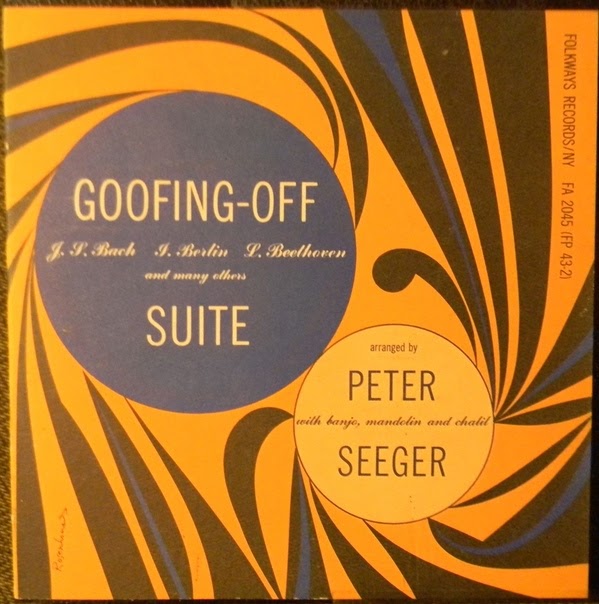
Pete Seeger - Goofing-Off Suite (1954)

Pete Seeger has been the subject of such controversy during his career that surely some people have wished that he would just shut up and play his banjo. If so, those people may be pleased by "Goofing-Off Suite", which is largely an album of instrumentals.

Seeger, the son of a composer and a violinist, took a detour from the family business into folk music, but here he returns to Bach, Beethoven, Stravinsky, and Grieg, albeit as played on the banjo. He also turns to show music for Irving Berlin's "Blue Skies" and, inevitably, mixes these tunes in with various folk themes. He can't quite keep his voice silent during the "suite," however, as he whistles, yodels, hums, and even sings a line or two of German during "Jesu, Joy of Man's Desiring." Then, as of the 12th track, "Time's A-Getting Hard," it seems that Folkways Records ran out of Seeger instrumentals, and the disc starts to turn into a regular Pete Seeger folk album, complete with his tenor vocals on traditional folk songs and his own original (co-written with erstwhile Almanac Singers/Weavers partner Lee Hays), "Empty Pocket Blues" (aka "Barrel of Money Blues"). "Sally My Dear" finds Seeger playing the flute-like chalil in between a cappella verses. One more instrumental closes the album out, Woody Guthrie's "Woody's Rag," which sounds like a guitar overdubbed by a mandolin. The concept of having Seeger make an LP's worth of his banjo arrangements of the classics is a good one, and he and Folkways might as well have carried through with it all the way.                

"Originally released as 10-inch albums...Corey and Goofing-Off Suite helped launch a generation of pickers and singers.... Grand testimony to the breadth and variety of American folk song and style.... Wonderful vintage examples of that curious mix of casual personability and determined virtuosity that have made Pete Seeger our most respected—and best liked—folk personality for over half a century." — New England Folk Almanac   


Pete Seeger - Goofing-Off Suite (1954)
(256 kbps, cover art included)

Mack The Knife - Songs Of Kurt Weill

Image
From the Weimar Republic to Broadway, Kurt Weill was unique in achieving Transatlantic success with his satirical, witty, often biting and sometimes very beautiful songs. Many have achieved lasting fame outside their original theatrical contexts. These 20 tracks are performed by Lotte Lenya, Bertolt Brecht, Walter Huston, Gertrude Lawrence, Danny Kaye, Mary Martin, Kenny Baker, Jascha Heifetz, Emanuel Bay, Benny goodman & His Orchestra, Johhny Mercer, Buddy Clark, Greta Keller, Cy Walter, Louis Armstrong and, of course, Kurt Weill himself. It’s obviously fascinating to peep into the past and hear the sleazy sound of Theo Mackeben’s Jazz Orchestra, to listen to Bertold Brecht himself recounting Mackie Messer (Mack the Knife) in a manner at once laid back and venomous, with incredible rolled “Rs” at the end of every word that finishes with that letter. Fascinating, too, to find that Lotte Lenya had a high, girlish sort of voice in those days, pretty but scarcely able to convey emotion.

This album collects 20 original recordings from the years 1929 to 1956 from the collections of David Lennick, Peter Doyle, James Kidd & Houston Maples. The earlier recordings in this collection are exceedingly rare. Some were eight inch discs, known to exist only in a few pressings.


Tracks:

01 -Die Moritat von Mackie Messer (The Ballad Of Mack The Knife) From Die Dreigroschenoper (The Threepenny Opera) (Kurt Weill–Bertolt Brecht) Orchestrola 2131, mx 1239/A8473. Recorded May 1929, Berlin

02 Bilbao Song From Happy End (Kurt Weill–Bertolt Brecht) Orchestrola 2311, mx A8718. Recorded c. October 1929, Berlin

03 Die Ballade von der Unzulänglichkeit (The Ballad Of The Futility Of All Human Endeavour) From Die Dreigroschenoper (The Threepenny Opera) (Kurt Weill–Bertolt Brecht) Orchestrola 2131, mx 1240/A8474. Recorded May 1929, Berlin

04 Alabama Song From Aufstieg und Fall der Stadt Mahagonny (Rise and Fall of the City of Mahagonny ) (Kurt Weill–Bertolt Brecht) Ultraphon A 371, mx 10710. Recorded 24 February 1930, Berlin

05Surabaya Johnny From Happy End (Kurt Weill–Bertolt Brecht) Bost 5019, mx 1229. Recorded c. 1942, New York

06 Wie man sich bettet (As You Make Your Bed) From Aufstieg und Fall der Stadt Mahagonny (Rise and Fall of the City of Mahagonny ) (Kurt Weill–Bertolt Brecht) Bost 5019, mx 1232-C. Recorded c. 1942, New York

07 September Song From Knickerbocker Holiday (Kurt Weill–Maxwell Anderson) Decca 40001, mx L 3666B and Brunswick 8272, mx B 23732-1. Recorded 31 October 1944, Los Angeles and 24 November 1938, New York

08 My Ship From Lady In The Dark (Kurt Weill–Ira Gershwin) Victor 27330, mx BS 060682-2. Recorded 23 February 1941, New York

09 Tchaikovsky (And Other Russians) From Lady in the Dark (Kurt Weill–Ira Gershwin) Columbia 36025, mx CO 29836-1. Recorded 28 January 1941, New York

10 The Saga Of Jenny From Lady In The Dark (Kurt Weill–Ira Gershwin) Victor 27330, mx BS 060683-1. Recorded 23 February 1941, New York

11 Lost In The Stars From Ulysses Africanus & Lost In The Stars (Kurt Weill–Maxwell Anderson) Bost 5017, mx 1240. Recorded c. 1942, New York

12 Lover Man (Trouble Man) From Ulysses Africanus & Lost In The Stars (Kurt Weill–Maxwell Anderson) Bost 5017, mx 1235-B. Recorded c. 1942, New York

13 Speak Low (I) From One Touch Of Venus (Kurt Weill–Ogden Nash) Heritage H-0051. From demo recording c. 1942, New York

14 Speak Low (II) From One Touch Of Venus (Kurt Weill–Ogden Nash) Decca 23296, mx 71493-A. Recorded 7 November 1943, New York

15 Moderato Assai From The Threepenny Opera (Kurt Weill, arr. Stefan Frenkel) Decca DL 8521, mx W 73199. Recorded 30 November 1945, New York

16 Moon-Faced, Starry-Eyed From Street Scene (Kurt Weill–Langston Hughes) Capitol 376, mx 1619-4. Recorded 30 January, 1947, Hollywood

17 Here I'll Stay From Love Life (Kurt Weill–Alan Jay Lerner) Columbia 38294, mx CO 38583-1. Recorded 20 December 1947, New York

18 Green-Up Time From Love Life (Kurt Weill–Alan Jay Lerner) Atlantic ALS 405, mx ALP11289. Recording January 1956, New York

19 Pirate Jenny From The Threepenny Opera (Kurt Weill–Bertolt Brecht–Marc Blitzstein) MGM E 3121, mx 54-MG-560. Recorded March 1954, New York

20 Mack The Knife (A Theme From The Threepenny Opera) (Kurt Weill–Bertolt Brecht–Marc Blitzstein) Columbia 40587, mx CO 53818-1. Recorded 28 September 1955, New York

Mack The Knife - Songs Of Kurt Weill
(192 kbps)

Sonntag, 18. Juni 2023

The Slits - John Peel Sessions (1989)

The Slits formed in 1976, when 14-year-old Ari Up recruited her friends Tessa, Viv and Palmolive to form a new all-girl punk band, with Ari on vocals. The following year, they supported The Clash during their UK tour. Still without a record contract, the Slits then recorded two sessions for John Peel, in 1977 and 1978. Later, after their period with Island Records, they recorded one final Peel session in 1981. The Slits' BBC sessions have long been celebrated as favourites of John Peel's, and it is easy to hear why. In fact, the band's debut session was always hailed by Peel as "one of our first classic sessions". These first two sessions explode with vibrant punk energy, aggression and wit.

In terms of classic punk energy, these sessions dating from September 1977 and May 1978 are unbeatable, the sound of the unsigned, untutored, and -- in the eyes of many people -- unlistenable Slits crashing defiantly through distinctly formative renditions of songs that would not reach fruition for another year, and the completion of their debut album. "Vindictive" alone was not realigned for that disc; of the other six songs, all underwent sufficient reinvention to create starry-eyed converts of even the most disdainful of early witnesses. Famously, at the band's first BBC session, an anguished technician crept out to retune their instruments while the quartet was busy elsewhere. It doesn't affect their performance.

Sometime during the mid-'90s, John Peel rated the first two Slits broadcasts among his all-time favorite sessions -- one reason why many first-time purchasers chose to overlook the repackaged Peel Sessions altogether.


Tracklist:

1 Love And Romance 2:28
2 Vindictive 2:17
3 New Town 3:31
4 Shoplifting 1:31
5 So Tough 2:19
6 Instant Hit 2:32
7 FM 3:32

(320 kbps, cover art included)

Johnny Clegg & Savuka - Cruel, Crazy, Beautiful World

When South Africa was still suffering under the apartheid system in the 1980s, Johnny Clegg & Savuka was the last thing apartheid supporters wanted in a pop group. Their lyrics were often vehemently anti-apartheid, and apartheid supporters hated the fact that a half-black, half-white outfit out of South Africa was integrated and proud of it.

Released in the U.S. at the end of the 1980s, "Cruel, Crazy, Beautiful World" is among the many rewarding albums the band has recorded. Sting and the Police are a definite influence on Clegg & Savuka, who have absorbed everything from various African pop styles to Western pop, funk, rock, and reggae. The lyrics are consistently substantial and frequently sociopolitical - "Bombs Away" addresses the violence of the apartheid regime, while "Warsaw 1943" reflects on the horrors Eastern Europe experienced at the hands of both communists and fascists during World War II. Clegg and company enjoyed a passionate following at the time, and this fine CD proves that it was well deserved. 

Tracklist
1One (Hu)'Man One Vote4:45
2Cruel, Crazy, Beautiful World4:25
3Jericho4:18
4Dela (I Know Why The Dog Howls At The Moon)4:15
5Moliva4:31
6It's An Illusion4:41
7Bombs Away4:36
8Woman Be My Country4:58
9Rolling Ocean4:09
10Warsaw 1943 (I Never Betrayed The Revolution)4:51
11Vezandlebe4:04

Johnny Clegg & Savuka - Cruel, Crazy, Beautiful World
(256 kbps, cover art included)   

Samstag, 17. Juni 2023

The Special AKA - In The Studio (1984)

Three years and a reputed £500,000 pounds in the making, and what was the result? For starters, an album that just scraped into the U.K. Top 35 and a set that rounded up three out of the four Special A.K.A. singles: "War Crimes," the double A-sided "Racist Friend"/"Bright Lights," and "Nelson Mandela," as well as the latter's 12" B-side, "Break Down the Door," and a set that spun off the group's final release, "What I Like Most About You Is Your Girlfriend." Thus, half the album had already spun at 45, poor value for the money. 

However, at a time when Wham!, Frankie Goes to Hollywood, and Duran Duran reigned supreme, "In the Studio" was offering something distinctly different, which explains its popularity. This was Jerry Dammers' baby, and the birthing had been decidedly difficult. And it's no wonder considering just how far Dammers had taken his music, light years from the Specials' roots and miles even from the group's more diverse "More Specials" finale.

"Housebound," for example, is absolutely claustrophobic, the rhythm disconcerting and the melody moving into no wave territory. "The Lonely Crowd" is even more dislocating, with the club-meets-funk rhythm crashing into the no wave jazz atmosphere, while the purer club strains of "Nite on the Tiles" are equally disturbing, with its odd blend of genres. Even the more accessible numbers have bite and exceedingly sharp edges, from the frustration that fills the soul-styled "Break Down" to the derision that floods the lyrics of "Bright Lights" and on to the cutting theme of the dreamy, roots-flavored "Girlfriend." 

Dammers' world view was growing ever darker, and his lyrics reflect this polarization. Where once there was thoughtful reasoning laced with sarcasm, here the coddling is gone, and even the irony is heavy-handed. Proof is found in the uncompromising "Racist Friend," where Dammers insists one should sever such relationships rather than attempt to alter such opinions. The evocative, Arab-esque "War Crimes" is even more militant. Israel's invasion of Lebanon, in much of the world's opinion, certainly qualified as a war crime, but Dammers overstepped the mark by comparing it to Nazi death camps. Only the warm melody and gentle delivery prevent the song from being dismissed as an outright polemic.

But the 2-Toner now saw the world only in black and white, searingly condemning everything around him. Which is why "Mandela" comes as such a shock smack-dab in the middle of the set. Its glorious melody, jubilant atmosphere, and exuberant optimism are the only bright moments on the entire album, a single song of hope which crumbles to dust by sequencing it just before the horrors of "War Crimes." 

That, like everything else on this album, was deliberate, and underscored the total desolation that Dammers saw all around him. It's an ugly vision, but the world is very much like that.


Tracklist:

"Bright Lights" (John Bradbury, Stan Campbell, Dick Cuthell, Dammers) – 4:11
"The Lonely Crowd" (Campbell, Dammers, John Shipley) – 3:52
"What I Like Most About You Is Your Girlfriend" – 4:50
"Housebound" – 4:13
"Night on the Tiles" (Dammers, Shipley) – 3:04
"(Free) Nelson Mandela" – 4:07
"War Crimes" – 6:13
"Racist Friend" (Bradbury, Cuthell, Dammers) – 3:49
"Alcohol" – 5:01
"Break Down the Door" (Bradbury, Cuthell, Dammers) – 3:36

(320 kbps, cover art included)

The Pop Group - We Are All Prostitutes

Rivaled only by the Birthday Party, the Pop Group were one of the most extreme bands from the post-punk explosion. That being said, the majority of their material is literally an assault of one's ears, as their sound was abrasive, noisy, aggressive, and funky as hell! 

Most of these tracks are excellent pieces of experimental "rock" (this term is used loosely here) that contain the raw energy of punk as well as a funky groove with some noise thrown in for fun. Dark melodies, angry political lyrics, and harsh noises walk hand in hand with dancey rhythms and reggae-influenced production and guitar. Whether it was their extreme sound, their angry slogan-like lyrics which demanded social justice, or their willingness to experiment, the Pop Group was not a band to be taken lightly. "We Are All Prostitutes," "Blind Faith," "Amnesty Report," "Feed the Hungry," and "Spanish Inquisition" are all excellent tracks. "We Are All Prostitutes" is an excellent musical documentation on one of the greatest bands in the history of rock music. A must have for all, even those who loathe music; everyone can learn something from it.


Tracklist:

1. We Are All Prostitutes 3:13 (Radar Records single A-Side)
2. Blind Faith 4:04 ("FHMLDWTMM" Track 4)
3. Justice 3:09 ("FHMLDWTMM" Track 6)
4. Amnesty Report 3:14 ("WE ARE TIME" Compilation Track 7 (or B2 on LP)
5. Feed The Hungry 4:16 ("FHMLDWTMM" Track 2)
6. Where There's A Will 5:18 (B-side to split single with THE SLITS "In The Beginning There Was Rhythm")
7. Forces Of Oppression 2:17 ("FHMLDWTMM" Track 1)
8. Spanish Inquisition 3:21 ("WE ARE TIME" Compilation Track 5 (or A5 on LP)
9. No Spectators 4:19 ("FHMLDWTMM" Track 7)
10. (Amnesty Report II) 2:42 (B-Side to Track 1 "We Are All Prostitutes" single)


The Pop Group - We Are All Prostitutes 
(ca. 200 kbps, cover art included)

Hugh Masekela - Is Alive And Well at The Whiskey (1967)

Hugh Masekela has an extensive jazz background and credentials, but has enjoyed major success as one of the earliest leaders in the world fusion mode. Masekela's vibrant trumpet and flügelhorn solos have been featured in pop, R&B, disco, Afro-pop, and jazz contexts. He's had American and international hits, worked with bands around the world, and played with African, African-American, European, and various American musicians during a stellar career. His style, especially on flügelhorn, is a charismatic blend of striking upper-register lines, half-valve effects, and repetitive figures and phrases, with some note bending, slurs, and tonal colors. Though he's often simplified his playing to fit into restrictive pop formulas, Masekela is capable of outstanding ballad and bebop work.

He began singing and playing piano as a child, influenced by seeing the film Young Man with a Horn at 13. Masekela started playing trumpet at 14. He played in the Huddleston Jazz Band, which was led by anti-apartheid crusader and group head Trevor Huddleston. Huddleston was eventually deported, and Masekela co-founded the Merry Makers of Springs along with Jonas Gwangwa. He later joined Alfred Herbert's Jazz Revue, and played in studio bands backing popular singers. Masekela was in the orchestra for the musical King Kong, whose cast included Miriam Makeba. He was also in the Jazz Epistles with Abdullah Ibrahim, Makaya Ntshoko, Gwanga, and Kippie Moeketsi.

Masekela and Makeba, his wife at that time, left South Africa one year before Ibrahim and Sathima Bea Benjamin in 1961. Such musicians as Dizzy Gillespie, John Dankworth, and Harry Belafonte assisted him. Masekela studied at the Royal Academy of Music, then the Manhattan School of Music. During the early '60s, his career began to explode. He recorded for MGM, Mercury, and Verve, developing his hybrid African/pop/jazz style. Masekela moved to California and started his own record label, Chisa. He cut several albums expanding this formula and began to score pop success. The song "Grazing in the Grass" topped the charts in 1968 and eventually sold four million copies worldwide. That year Masekela sold out arenas nationwide during his tour, among them Carnegie Hall. He recorded in the early '70s with Monk Montgomery & the Crusaders.

Tracklist
Mra (Christopher Columbus)3:57
Little Miss Sweetness3:32
A Whiter Shade Of Pale2:58
Up-Up And Away5:25
Son Of Ice Bag3:45
Senor Coraza7:50
Coincidence3:10
Ha Lese Le Di Khanna2:58

Hugh Masekela - Is Alive And Well at The Whiskey (1967)
(320 kbps, cover art included)

Freitag, 16. Juni 2023

The Specials – Live - Too Much Too Young (1979/1992)

The Specials were the fulcrum of the ska revival of the late '70s, kick-starting the 2-Tone movement that spurred a ska-punk revolution lasting for decades. As influential as they were within the realm of ska, the group and their impact can't be reduced to that genre alone. The Specials were one of the defining British bands of new wave, expanding the musical and political parameters of rock & roll with fiercely socially conscious music you could dance to. Protest was an integral part of the group, particularly their initial lead songwriter Jerry Dammers, who chronicled the tensions of the Margaret Thatcher era on such hit singles as "Concrete Jungle," "Nite Klub," and "Ghost Town." The band balanced these barbed messages with an inspired rallying call to party and an impeccable sense of style embodied by Terry Hall, a lean, laconic singer who split vocal duties with the more exuberant Neville Staple.

Though the sound quality is less than perfect, this 1979 live recording perfectly captures the raw energy of the band in its prime. The title track was the band's first number one hit in the U.K. The album was recorded at Aston University, Birmingham, UK in 1979.


Tracklist:

A1 Gangsters 2:32
A2 Do the Dog 2:20
A3 It's Up to You 4:35
A4 Monkey Man 3:04
A5 Blank Expression 2:06
A6 Stupid Marriage 4:42
A7 Doesn't Make It Alright 3:24
B1 Concrete Jungle 3:40
B2 Too Hot 2:52
B3 Nite Klub 3:15
B4 Too Much Too Young 2:06
B5 Little Bitch 2:38
B6 Skinhead Moonstomp 2:38
B7 Longshot Kick de Bucket 3:08
B8 You're Wandering Now 2:25

(192 kbps, cover art included)
Joao Gilberto - Interpreta Tom Jobim

Bossa nova today is heard and performed world wide. It has been considered a sophisticated form of Brazilian Popular Music, having had a high caliber of artists associated with it.
Joáo Gilberto said in one of his songs that if you want to sing about love, you need Tom Jobim to write the melody, the poet Vinicus de Moraes to write the poetry, and Gilberto to deliver it. Not without reason, these three artists ebodied the bossa nova moment and have often been associated with it from its beginning in the late 1950s.

When talking about bossa nova, perhaps the signature pop music sound of Brazil, frequently the first name to come to one's lips is that of Antonio Carlos Jobim. With songs like "The Girl From Ipanema" and "Desafindo," Jobim pretty much set the standard for the creation of the bossa nova in the mid-'50s. However, as is often the case, others come along and take the genre in a new direction, reinventing through radical reinterpretation, be it lyrically, rhythmically, or in live performance, making the music theirs. And if Jobim gets credit for laying the foundation of bossa nova, then the genre was brilliantly reimagined (and, arguably, defined) by the singer/songwriter and guitarist João Gilberto. In his native country he is called O Mito (The Legend), a deserving nickname, for since he began recording in late '50s Gilberto, with his signature soft, near-whispering croon, set a standard few have equaled.                

The album "Joao Gilberto – Joao Gilberto Interpreta Tom Jobim" (1978) features Antonio Carlos Jobim compositions performed by Joao Gilberto on his early recordings for the Odeon label. This is the best of both worlds and should be listened from the start until the end on a single audition.


Tracklist:
A Felicidade2:46
Desafinado1:58
Insensatez2:23
Este Seu Olhar2:14
Chega De Saudade1:58
Meditação1:43
Samba De Uma Nota So1:35
O Nosso Amor2:40
O Amor Em Paz2:24
So Em Teus Braços1:45
Corcovado1:57
Discussão1:48

Joao Gilberto - Interpreta Tom Jobim
(320 kbps, cover art included)