"We weep when a child is born into this world.
We sing and dance when the good Lord takes someone home." - Mourmer at a Jazz Funeral
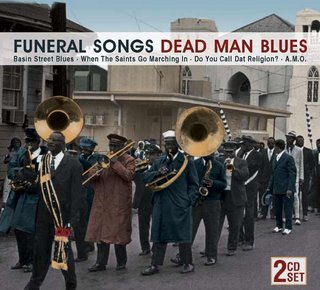
The traditional New Orleans Jazz Funeral is as much a part of New Orleans culture as is traditonal jazz itself. If could almost be said, the jazz grew out of the funeral music of the New Orleans of the late nineteenth century. The roots of the tradition are believed to be hundreds of years old, and to be connected to the culture of the people who occupy the are of West Africa that is now called Benin and Nigeria; this region of Africa was known as the "Slave Coast" to the Europeans of the seventeenth century. The captured people of that area took with them to the New World a sophisticated social structure that included two aspects important to the traditional New Orleans Jazz Funeral. Firstly, societies, often secret, were formed to ensure that their members received a proper burial at the time of death, and secondly, a funeral was seen as a major celebration. With the "Christianisation" of the African-Americans that occured over the ensuing centuries and with the growth of the Baptist and Methodist Churches in particualr, another factor came into play that surely strenghtened this notion of a funeral as a celebration. This was the commonly held belief that a birth, an arrival in the secualr world, was a time for tears, and a death, an end to earthly sorrows, was a time for rejoicing.
So, it would be unusual for a New Orleans inhabitant not to be a member of some organisation or other. On their death, that individuals would be accompanied to their final resting-place by the brass band of the society of which he or she was a member. The traditional New Orleans Funeral had two stages accompanied by music. The first was a procession of mourners journeying slowly to the cemetery accompanied by a brass band playing a slow, mournful dirge or spiritual. This was followed after the burial itself by a lively return from the cemetery to the sound of rousing music. And what better rosing music could there be than that played by a couple of "hot" jazz musicians?
Wonderful compilation with songs by Louis Armstrong, King Oliver, Kid Ory, Jelly roll Morton, Clarence Williams, the Eureka Brass Band and many more:
Funeral Songs - Dead Man Blues CD 1
Funeral Songs - Dead Man Blues CD 2
Sonntag, 26. Juni 2011
Walter Benjamin - The Work Of Art In The Age Of Mechanical Reproduction (1936)
Walter Benjamin was a German marxist and literary critic.
Born into a prosperous Jewish family, Benjamin studied philosophy in Berlin, Freiburg, Munich, and Bern. He settled in Berlin in 1920 and worked thereafter as a literary critic and translator. His half-hearted pursuit of an academic career was cut short when the University of Frankfurt rejected his brilliant but unconventional doctoral thesis, "The Origin of German Tragic Drama" (1928).
Benjamin eventually settled in Paris after leaving Germany in 1933 after Hitler came to power. He continued to write essays and reviews for literary journals, but when Paris fell to the Nazis in 1940 he fled south with the hope of escaping to the US via Spain.
Informed by the chief of police at the Franco-Spanish border that he would be turned over to the Gestapo, Benjamin committed suicide.
The posthumous publication of Benjamin’s prolific output won him a growing reputation in the later 20th century. The essays containing his philosophical reflections on literature are written in a dense and concentrated style that contains a strong poetic strain. He mixes social criticism and linguistic analysis with historical nostalgia while communicating an underlying sense of pathos and pessimism. The metaphysical quality of his early critical thought gave way to a Marxist inclination in the 1930s.
Benjamin’s pronounced intellectual independence and originality are evident in the extended essay "Goethe’s Elective Affinities" and the essays collected in "Illuminations".
The approach to art of the USSR under Stalin was typified, first, by the persecution of all those who expressed any independent thought, and, second, by the adoption of Socialist Realism - the view that art is dedicated to the "realistic" representation of - simplistic, optimistic - "proletarian values" and proletarian life.
Subsequent Marxist thinking about art has been largely influenced by Walter Benjamin and Georg Lukács however. Both were exponents of Marxist humanism who saw the important contribution of Marxist theory to aesthetics in the analysis of the condition of labour and in the critique of the alienated and "reified" consciousness of man under capitalism.
Benjamin’s collection of essays The Work of Art in the Age of Mechanical Reproduction (1936, just follow the link and enjoy reading...) attempts to describe the changed experience of art in the modern world and sees the rise of Fascism and mass society as the culmination of a process of debasement, whereby art ceases to be a means of instruction and becomes instead a mere gratification, a matter of taste alone.
"Communism responds by politicising art" - that is, by making art into the instrument by which the false consciousness of the mass man is to be overthrown.
Freitag, 24. Juni 2011
Eric Gale - Negril (with Peter Tosh)
Some weeks ago someone asked in the comment section for Eric Gale´s "Negril" - now here it is!For some reggae connoisseurs this is one of the greatest record you never heard.
Eric Gale was home in Negril wailing on his guitar behind some serious lambs bred. This album was recorded in Jamaica before Eric Gale went back to New York to become one of the most in-demand East Coast session guitarists. The music is laid-back instrumental Reggae.
This album is some of the most musically advanced reggae you can find. The tracks are all sizzling with dancing groove energy that is the perfect mix of soul and reggae. Paints a perfect picture of the beaches of Negril in Jamaica. If you like reggae and James Brown and Marvin Gaye and Phish, you should give this album a try.
Have a look at the list of the involved musicians and you get an idea of the quality:
Eric Gale (Lead Guitar), Peter Tosh (Rhythm Guitar), Richard Tee (Piano), Keith Sterling (Piano), Leslie Butler (Organ & Synthesizer), Cedric "Im" Brooks (Saxophone, Percussion), Val Douglas (Bass Guitar), Aston "Family Man" Barrett (Bass Guitar), Paul Douglas (Drums), Sparrow Martin (Drums), Joe Higgs (Percussion), Isiah "Sticky" Thompson (Percussion).
Eric Gale - Negril (with Peter Tosh)
(256 kbps, front cover included)
Sonntag, 19. Juni 2011
VA - Gospel At Newport - Recorded at the Newport Festival 1959 & 1963 - 66 (Vanguard)
The Newport Folk Festival in its 1960s heyday was noted for spotlighting new and old folkies and, to a lesser degree, rediscovered bluesmen. One of the complementary elements to the fest, however, was gospel, with leading lights of the day turning up on the regular program and as part of Sunday morning workshops.
Vanguard Records' 19-song anthology gathers a dozen performers singing songs of praise. Not all the featured artists fall into the strict gospel camp; nonsecular stalwarts including the Dixie Hummingbirds, the Swan Silvertones, and Dorothy Love Coats and the Original Gospel Harmonettes are sequenced alongside the likes of astonishing Bahaman guitarist Joseph Spence, the soulful Staples Singers, and Delta bluesman Son House.The setting has a slight modifying effect on the performers, but as a documentation of the meeting of two very different communities - the older, black, god-fearing performers and a young, white, mostly curious audience - "Gospel at Newport" is hard to beat.
VA - Gospel At Newport (1959, 1963 - 1966)
(256 kbps, cover art included)
Vanguard Records' 19-song anthology gathers a dozen performers singing songs of praise. Not all the featured artists fall into the strict gospel camp; nonsecular stalwarts including the Dixie Hummingbirds, the Swan Silvertones, and Dorothy Love Coats and the Original Gospel Harmonettes are sequenced alongside the likes of astonishing Bahaman guitarist Joseph Spence, the soulful Staples Singers, and Delta bluesman Son House.The setting has a slight modifying effect on the performers, but as a documentation of the meeting of two very different communities - the older, black, god-fearing performers and a young, white, mostly curious audience - "Gospel at Newport" is hard to beat.
(256 kbps, cover art included)
Samstag, 18. Juni 2011
Dave Brubeck Quartet - The Last Set At Newport (1971)
"Last Set at Newport" is a short but interesting Brubeck release. Of special note is the extended version of "Take Five," on which Gerry Mulligan reinterprets the sax part into a gritty acid-jazz. The quartet is in full swing in this recording displaying enormous energy to every piece. The three pieces are explored in the solos to a significant length and it is this element that makes this album so appealing.
This is not an album for a mellow night at home. Rather it will get your heart pumping.
From the linernotes:
"Dave Brubeck was never shy about coming down hard on his piano keyboard, and this live performance at the 1971 Newport Jazz Festival is perhaps the least subtle of all his recordings. After hearing these tracks and the responsiveness of the crowd, listeners will have no doubt that this is exactly what the occasion called for.
Alan Dawson (drums) and Jack Six (bass) do an excellent job of preserving the Brubeck tradition while contributing to their legendary leader's evolution in the 1970s. And of course, Gerry Mulligan, who set the standard for baritone saxophonists, is a perfect solution to the dilemma of what to do after Paul Desmond. He makes "Take Five" sound like a brand new tune. And check out what Brubeck and Mulligan do in the opener "Blues for Newport." Many times since I acquired the original LP in the early 1970s, I've found myself humming this tune - and stealing licks from it for my own solos.
This is a short program with only three tracks totaling just under 35 minutes, but it's fun to hear how much energy can be generated by an acoustic quartet. It's a must-have for fans of Brubeck and Mulligan."
Tracklist:
Dave Brubeck Quartet - The Last Set At Newport (1971)
(320 kbps, front cover included)
The Dave Brubeck-Gerry Mulligan quartet is heard in a very inspired performance at the Newport Jazz Festival, just a short time before a riot by the audience closed the festival. These versions of "Take Five" and "Open the Gates" are memorable, but it is the extended "Blues for Newport" that is truly classic. Mulligan and Brubeck (backed by bassist Jack Six and drummer Alan Dawson) constantly challenge each other during this exciting performance, making this set well-worth searching for.
This is not an album for a mellow night at home. Rather it will get your heart pumping.
From the linernotes:
"Dave Brubeck was never shy about coming down hard on his piano keyboard, and this live performance at the 1971 Newport Jazz Festival is perhaps the least subtle of all his recordings. After hearing these tracks and the responsiveness of the crowd, listeners will have no doubt that this is exactly what the occasion called for.
Alan Dawson (drums) and Jack Six (bass) do an excellent job of preserving the Brubeck tradition while contributing to their legendary leader's evolution in the 1970s. And of course, Gerry Mulligan, who set the standard for baritone saxophonists, is a perfect solution to the dilemma of what to do after Paul Desmond. He makes "Take Five" sound like a brand new tune. And check out what Brubeck and Mulligan do in the opener "Blues for Newport." Many times since I acquired the original LP in the early 1970s, I've found myself humming this tune - and stealing licks from it for my own solos.
This is a short program with only three tracks totaling just under 35 minutes, but it's fun to hear how much energy can be generated by an acoustic quartet. It's a must-have for fans of Brubeck and Mulligan."
Tracklist:
| 1. Introduction - Father Norman O'Connor |
| 2. Blues For Newport |
| 3. Take Five |
| 4. Open The Gates (Out Of The Way Of The People) |
Dave Brubeck Quartet - The Last Set At Newport (1971)
(320 kbps, front cover included)
Freitag, 17. Juni 2011
Babadi - Resistance (African Reggae)
Babadi is a reggae artist from the Comore Islands who burst on the scene in 1997 with socially conscious lyrics and a staunch defense of modern M'godro (traditional comorian song tradition). His third album "Résistance" made him a permanent figure on the Mahoran scene. His music blends M'godro with an Afro-Mahoran reggae backed by insistent percussion (think central African Kwassa tinted with Mauritian Seggae) and lightened by typical Mahoran lyric melodies.
The songs are engaged, as always, since «Chigoma Ya Léo», his first album which already talks about political hypocrisis, about decolonisation, polygamy and the consequences of rough modernity. His words touch because of its simplicity and provocates the awakening of consciences. His music finds its way between tradition (Chigowa) and modernity (Ya Léo) and in «Résistance», the brasses, voices and percussions invite us to a festive Mgodro who meets the warm rythmes of African Reggae music. Concerning the production, he managed to gather with professionnal partners.
Babadi - Resistance (African Reggae)
(192 kbps, front & back cover included, ca. 92 MB)
Dienstag, 14. Juni 2011
Rootsman: From The Dubplate Basket Vol. 1
The Rootsman is a musician and DJ based in Bradford, England. After playing in the punk band “State Oppression” he started his first local sound system in 1985 and was a pirate radio activist. Nowadays he is one of the most important neo dub producers and is running the “Third Eye Music” label.
For our great pleasure Rootsman made an absolutely breathtaking free dubplate mix-cd featuring a lot exclusive dubplates. His emphasis is on great tunes, cut with creativity in an unbelievable line up. Alongside the voices of great reggae artist, you will hear dubplates from artists from the Third Eye Music family (D. Bo General, Bongo Chilli, YT, Tony G.).
You will find the download link in the news section on the The Rootsman website or you can download it via
Rootsman - From The Dubplate Basket Vol. 1
Tracklist:
1. ROBERT LEE: BANG BANG
2. MICHAEL BUCKLEY: CRY OF A SOUNDBOY
3. SUGARBLACK: RUB A DUB
4. ANTHONY JOHNSON: OH WHAT A DAY
5. EARL 16: REGGAE ROCK
6. U BROWN: ROOTSMAN SOUND
7. TONY G: IF I EVER
8. SAMMY DREAD: THEY DIDN?T KNOW
9. GYPTIAN: JUDGEMENT NIGHT
10. YT: WICKED ACT
11. D.BO GENERAL: MAMA
12. ECHO MINOTT/HOPETON JAMES: DON´T TEST
13. JOHNNY OSBOURNE: HE CAN SURELY TURN THE TIDE
14. TURBULENCE: ON MY WAY
15. FRISCO KID: REVENGE
16. ROBERT LEE: LIVE GOOD
17. D.BO GENERAL: STRANGE THINGS
18. PHILIP FRASER: COME ROOTSMAN
19. BRAVEHEART: RED EYES
20. EVERTON BLENDER/DETERMINE: TIME LIKE THIS
21. JUNIOR DELGADO: KING OF KINGS
22. D.BO GENERAL: FREEDOM
23. TAFFARI: MORE ROOTSMAN
24. JOHNNY CLARKE: BABYLON
25. BUSHMAN: YADD AWAY HOME
26. BONGO CHILLI: READ YOUR BIBLE
27. LUCIANO: FINAL CALL
28. EARL 16: CHANGING WORLD
29. FRED LOCKS: BLACK STAR LINER
30. JOSEY WALES: SLACKNESS DEAD
31. EARL 16: PRESSURE
32. TURBULENCE: NOTORIOUS
33. LYMIE: LOVE WE MUST HAVE
Big up the Rootsman Soundsystem and D. Bo Gegeral!
Do The Reggay!
A few years ago René Wynands wrote a wonderful book about the ever-changing history of jamaican music from the early days of pocomania to nowadays dancehall dons.
Beacause the book is out of print for a long time, Mr. Wynand gives us all an alternative oportunity to read his work:
You can download the whole text on the following site (pdf-file in german language): http://www.oktober.de/reggae/ .
Beacause the book is out of print for a long time, Mr. Wynand gives us all an alternative oportunity to read his work:
You can download the whole text on the following site (pdf-file in german language): http://www.oktober.de/reggae/ .
Freitag, 10. Juni 2011
The Weavers - The Best Of The Weavers (1959)
The Weavers - comprised of Pete Seeger, Lee Hays, Fred Hellerman and Ronnie Gilbert - were the most important group of the folk revival. They helped invent hootenany culture, and charged it with a political urgency. They sang everything: Maoist anthems, civil rights hymns, even children's songs like "If I Had a Hammer."
The Decca recordings are historic but not always indicative of the Weavers art. "Goodnight Irene" ia given more production than suited the quartet's ethos, even if those songs would help change America forever.
The recording career ofthe Weavers falls into two categories: pre-blacklist and post-blacklist. In their pre-blacklist days, they recorded for Decca, and their adaptations of folk songs were backed by orchestras and choruses. Frequently, these songs (notably "Goodnight Irene"), were giant pop hits.
Tracklist:
Side 1:
1. Goodnight Irene
2. Kisses Sweeter Than Wine
3. So Long (It's Been Good to Know Yuh)
4. Old Paint (Ride Along Little Dogies)
5. Around the Corner (Beneath the Berry Tree)
6. Wimoweh
Side 2:
1. On Top of Old Smokey
2. The Wreck of the John B
3. Midnight Special
4. The Roving Kind
5. Lonesome Traveler
6. When the Saints Go Marching In
The Weavers - The Best Of The Weavers (1959)
(192 kbps, front cover included)
Mittwoch, 8. Juni 2011
The Abyssinians - Forward On To Zion (1978)
Few groups better captured the heart and soul of roots reggae than the Abyssinians; the vocal trio's heavenly close harmonies, dark melodies, and Rastafarian themes, all delivered with a deep spiritual feeling, were instrumental in defining and refining the genre.
The Abyssinians were formed in 1968 by founding members Donald Manning, Bernard Collins and Linford Manning. It was in 1969 with their release “Satta Massagana” recorded on Coxson Dodd’s Studio One label - a Rastafarian hymn based on the Ethiopian Amharic language, that launched them into the ranks of Reggae music greats. “Satta Massagana” became one of reggae’s most popular songs; becoming an anthem that was heard on the radios, in the dancehalls and in the churches of Jamaica. It was also covered by many other International artists’ including Third World.
"Forward On To Zion" is an alternative title for the "Satta Massagana" album, released in 1978 on the Different labe. It is one of those legendary reggae albums: if you had to pick the five most influential Rasta anthems of the 1970s (and Jah knows there have been few if any since then), the title track of this album would be one of them. So, most likely, would "Declaration of Rights," which has been remade in countless different versions. And the Abyssinians themselves are a fine vocal trio. So enjoy this wonderful album!
(256 kbps, cover art included)
Dienstag, 31. Mai 2011
Super Eagles - Viva Super Eagles (Gambia, 1968)
The Gambian band Super Eagles were pioneers of popular music in the Senegambian region at the end of the 1960s/start of the 70s, delivering a progressive blend of afrocuban, pop, soul, bluebeat, Congolese rumba, highlife and ndagga music. Using Wolof lyrics & rhythms, ndagga is the basis of what was to become 'mbalax'. During their five year existence, the Super Eagles became one of the best travelled bands in West Africa.
Tracklist:
(A) VIVA SUPER EAGLES (Touray,Cham)
DOHI GUDI BAHUT (D.Ndiaye)
GAMBIA SU NOUS RAEW (O.Ndiaye,Jobe)
ADUNA POTI NDALA (Cham,Gassama)
LOVE'S A REAL THING (Touray,Jobe)
HEY JODE (Lennon,McCartney)
(B) GAMBIA ZAMBIA-AFRICAN UNITY (O.Ndiaye)
DON'T DO THAT TO ME (Touray,Jobe)
TAGU NEIN LEIN (Cham,O.Ndiaye,D.Ndiaye)
ALIEU GORI-MAMI (O.Ndiaye)
FALSE LOVE (Touray,Valentine)
GAIL GAIN CHI RABI (Trad.)
Super Eagles - Viva Super Eagles (Gambia, 1968)
(192 kbps, front cover included)
Apart from the LP 'Viva Super Eagles' they released 4 singles, recorded in the Ghana Film Studios, which at the time was one of the few West African studios with sophisticated recording facilities.
Tracklist:
(A) VIVA SUPER EAGLES (Touray,Cham)
DOHI GUDI BAHUT (D.Ndiaye)
GAMBIA SU NOUS RAEW (O.Ndiaye,Jobe)
ADUNA POTI NDALA (Cham,Gassama)
LOVE'S A REAL THING (Touray,Jobe)
HEY JODE (Lennon,McCartney)
(B) GAMBIA ZAMBIA-AFRICAN UNITY (O.Ndiaye)
DON'T DO THAT TO ME (Touray,Jobe)
TAGU NEIN LEIN (Cham,O.Ndiaye,D.Ndiaye)
ALIEU GORI-MAMI (O.Ndiaye)
FALSE LOVE (Touray,Valentine)
GAIL GAIN CHI RABI (Trad.)
Super Eagles - Viva Super Eagles (Gambia, 1968)
(192 kbps, front cover included)
Samstag, 28. Mai 2011
Gil Scott-Heron - Live at the Village Gate, New York 1976 (Bootleg)
The poet passed away. But his music will stay.
Enjoy this great show with some fantastic live tracks from Gil Scott-Heron playing the Village Gate in New York in 1976.
Tracks:
01. Intro Jam
02. 17th Street
03. Must Be Something We Can Do
04. It's Your World
05. Home Is Where The Hatred Is
06. Johannesburg
Gil Scott-Heron - Live At The Village Gate, New York (1976)
(320 kbps, front & back cover included)
Gil Scott-Heron is dead - Rest in peace!
Sad, sad news...
Gil Scott-Heron died yesterday in a New York hospital aged 62, after becoming sick on returning from a European trip.
His style melded jazz, blues political expression and spoken-word poetry on songs such as "The Revolution Will Not Be Televised", which critiqued mass media in the 1970s.
His influence on generations of rappers and hip-hop artists has been demonstrated through sampling of his recordings by artists, including Kanye West.
Although Scott-Heron was often called the "Godfather of Rap", it was a title he rejected.
“It might have been that there was music in certain poems of mine, with complete progression and repeating 'hooks’ which made them more like songs than just recitations with percussion,” he wrote, in an introduction to a collection of poems, in 1990.
Instead, he referred to his work as “bluesology” or “black American music”.
Scott-Heron’s most recent album "I’m New Here", released last year, was widely acclaimed and brought him to the attention of a new generation. As news of his death was announced, modern artists including Chuck D of Public Enemy paid tributes.
Throughout his musical career, the poet and musician took on political issues of his time, including apartheid in South Africa, and nuclear arms. Before turning to music, he was a novelist, who published a murder mystery, called The Vulture, at the age of just 19.
Freitag, 20. Mai 2011
Dock Boggs - Legendary Singer and Banjo Player (Folkways, 1964)
Dock Boggs was just one of the primeval hillbillies to record during the '20s, forgotten for decades until the folk revival of the '60s revived his career at the twilight of his life. Still, his dozen recordings from 1927 to 1929 are monuments of folk music, comprised of fatalistic hills ballads and blues like "Danville Girl," "Pretty Polly," and "Country Blues." Born near Norton, VA, in 1898, Boggs was the youngest of ten children. (He gained his nickname at an early age, since he was named after the doctor who delivered him.) Boggs began working in the mines at the age of 12. In what remained of his spare time, he began playing banjo, picking the instrument in the style of blues guitar instead of the widespread clawhammer technique.
Boggs began picking up songs from family members and the radio. He married in 1918 and began subcontracting on a mine until his wife's illness forced him to move back to her home. He worked in the dangerous moonshining business and made a little money playing social dances.
His big break finally came in 1927, when executives from the Brunswick label arrived in Norton to audition talent. He passed (beating out none other than A.P. Carter), and recorded eight sides in New York City for the label. Though they didn't quite flop, the records sold mostly around Boggs' hometown. He signed a booking agent, and recorded four more sides for W.E. Myer's local Lonesome Ace label. The coming of the Great Depression in late 1929 put a hold on Boggs' recording career, as countless labels dried up. He continued to perform around the region until the early '30s, however, when his wife forced him to give up his music and go back into the mines. Boggs worked until 1954, when mechanical innovations forced him out of a job.
Almost a decade later, in 1963, folklorist Mike Seeger located Boggs in Norton and convinced him to resume his career. Just weeks after their meeting, Boggs played the American Folk Festival in Asheville, NC. He began recording again, and released his first LP, "Legendary Singer & Banjo Player", later that year on Smithsonian/Folkways. Two more LPs followed during the '60s, although, like his original recordings, they too were out of print not long after his death in 1971.
The revival of interest in early folk music occasioned by a digital reissue of Harry Smith's "Anthology of American Folk Music" finally brought Boggs' music back to the shelves. In 1997, John Fahey's Revenant label released "Complete Early Recordings (1927-1929)", and one year later "His Folkways Years (1963-1968)" appeared.
Dock Boggs - Legendary Singer And Banjo Player (1964)
(256 kbps, cover art included)
Montag, 16. Mai 2011
Dr. Alimantado - Born For A Purpose

Doctor Alimantado was born James Winston Thompson in Kingston 1952.
He grew up in the ghetto of the city's west side, an area notorious for its poverty and violence.
The fine but only sporadically productive Doctor Alimantado made two albums for the Greensleeves label in the mid-'70s. After completing the widely praised "Best Dressed Chicken in Town", he released "Born for a Purpose", which consists of second-string material from the same recording sessions and is consequently not quite as consistently excellent. Still, there are some great tracks here, notably the exquisite title song (presented in an extended 12" mix), an ode to Muhammed Ali that is strongly reminiscent of some of Glen Brown's work of the same period, and a paradoxically cheerful-sounding song of warning entitled "Careless Ethiopians Repent." Doctor Alimantado's clear, sweet voice is a constant delight throughout, and his skill as a DJ is almost matched by his singing ability. The backing rhythms are provided by a shifting cast that includes members of the Revolutionaries, Roots Radics, and the Aggrovators and, while no producer apart from Doctor Alimantado himself is given credit, at least a couple of mixes bear the strong stylistic mark of Bunny Lee.
(256 kbps, front & back cover included)
Donnerstag, 12. Mai 2011
Johnny Cash - Live At Newport 1964
This is a soundboard recording by Johnny Cash at Newport Folk Festival, Newport, RI, July 25, 1964 in a very good sound quality. Enjoy it!
Tracklist:
1. Intro by Pete Seeger / Big River
2. Folsom Prison Blues
3. I Still Miss Someone
4. Rock Island Line
5. Don't Think Twice It's Alright
6. I Walk the Line
7. The Ballad of Ira Hayes
8. Keep on the Sunny Side
Johnny Cash - Live At Newport 1964
(320 kbps, front cover included)
Tracklist:
1. Intro by Pete Seeger / Big River
2. Folsom Prison Blues
3. I Still Miss Someone
4. Rock Island Line
5. Don't Think Twice It's Alright
6. I Walk the Line
7. The Ballad of Ira Hayes
8. Keep on the Sunny Side
Johnny Cash - Live At Newport 1964
(320 kbps, front cover included)
Dienstag, 26. April 2011
Junior Wells and Buddy Guy & Junior Wells Blues Band - Newport Folk Festival, Rhode Island 1968
"Born in 1936 in Lettsworth, Louisiana, George "Buddy" Guy remains one of the world's most vital blues musicians and certainly one of the genre's most influential guitarists. Guy grew up on a diet of uniquely expressive blues stylists like Lightnin' Hopkins and T-Bone Walker. Eventually relocating to Chicago, he would learn directly from the likes of Muddy Waters, Guitar Slim, and Otis Rush. Guy would develop his own distinctive high-energy style that was typified by extreme string bending and a tense, staccato attack. Guy himself would strongly influence an impressive list of next generation guitarists, with Jimi Hendrix, Eric Clapton, and Stevie Ray Vaughan the most obvious examples.
Junior Wells family hailed from Memphis and he was raised in Arkansas. Born Amos Wells Blakemore Jr., two years earlier than Buddy Guy, Wells initially emulated Sonny Boy Williamson and Memphis-based Junior Parker. Wells too would be drawn to Chicago, where at age 19, he was recruited into Muddy Waters' band, replacing Little Walter. An exciting vocalist, Wells is more often revered for developing the modern amplified style of harmonica playing, where he soon became second to none.
Both Guy and Wells became recording artists on their own as the 1950s waned. At the dawn of the 1960s they collaborated for the first time on Guy's recording of "Ten Years Ago." The two would continue recording on their own, as well as collaborating, which provided them a wealth of material when they performed together. The dynamic stage presence of these two powerhouse musicians was something special indeed, and this performance, recorded at the 1968 Newport Folk Festival, is an extraordinary testament to Guy and Wells' onstage power.
The recording begins with Festival director George Wein's introduction. The band, which includes the exemplary rhythm section of bassist Jack Myers and jazz drummer-turned bluesman Fred Below, and A.C. Reed as a one-man horn section, kick things off with a hot warm-up instrumental before sinking their teeth into Guy's "One Room Country Shack." Possibly the quintessential track from Guy's classic 1968 A Man And The Blues LP, this sets the stage for the controlled fury yet to come.
With A.C. Reed's sax serving as additional rhythmic punctuation, Guy and Wells next tear into "Checkin' On My Baby," another essential song in their catalogue. Wells belts it out and blows a mean harp while Guy's stratocaster cuts like a knife between every line. Next they slow it down for a smoldering read of "Somebody Hoodooed The Hoodoo Man" followed by Junior Wells' signature song, "Messin' With The Kid." On the latter, Guy's biting tone is particularly raunchy and it's an outstanding performance all around.
To bring the set to a close, Guy and Wells pull out all the stops during a nearly nine-minute exploration of Sonny Boy Williamson's "Help Me." This is pure blues of the highest order, with Guy sounding like B.B. King on steroids and Wells and the band improvising up a storm. On this performance in particular, one can clearly hear how much this band influenced younger musicians, like Johnny Winter and the Butterfield Blues Band. This performance also sounds like a precursor to the incredible version on Van Morrison's "It's Too Late To Stop Now," recorded five years later but in remarkably similar form right down to the vocals. Wells' passionate vocals and the style of these musicians were obviously having a far-reaching impact. This number must certainly have been a highlight of the entire day and the Newport audience lets them know it. Despite George Wein desperately trying to keep the show moving, the audience is literally howling for more, causing Wein to finally relent and invite Guy, Wells & Co. back to the stage for a short (and Wein clarifies it has to be short!) encore.
Guy and Wells have other plans and treat the audience to a fantastic double encore beginning with "Stormy Monday," another tasty slow blues that starts off with a delicate touch but soon has Guy squeezing off a barrage of fiery riffs. He even manages to interject some spontaneous humor into one of his searing solos, by quoting the traditional folksong "Mary Had a Little Lamb" (it was a folk festival after all). Just when everyone was expecting the song to wind to a close, the band veers off into a funky take on James Brown's "I Got You," which must have had the already ecstatic audience up on their feet dancing.
Previously unheard and newly mixed direct off the 1/2" 4-track master reel, this sho
uld prove a rewarding listen for anyone even remotely interested in amplified blues. For those already well aware of the raw energy generated by Guy and Wells together in their prime, this recording is destined to become an important part of their legacy."
(from: http://www.wolfgangsvault.com/ - thanks a lot!)
3. Checkin' On My Baby
4. Somebody Hoodooed The Hoodoo Man Intro
5. Somebody Hoodooed The Hoodoo Man
6. Messin' With The Kid
7. You Gotta Help Me Intro
8. You Gotta Help Me
9. Crowd/Talk
10. Stormy Monday/I Feel Good
Buddy Guy - Guitar, Vocals
Junior Wells - Vocals, Harmonica
A.C. Reed - Sax
Jack Myers- Bass
Fred Below - Drums
Junior Wells family hailed from Memphis and he was raised in Arkansas. Born Amos Wells Blakemore Jr., two years earlier than Buddy Guy, Wells initially emulated Sonny Boy Williamson and Memphis-based Junior Parker. Wells too would be drawn to Chicago, where at age 19, he was recruited into Muddy Waters' band, replacing Little Walter. An exciting vocalist, Wells is more often revered for developing the modern amplified style of harmonica playing, where he soon became second to none.
Both Guy and Wells became recording artists on their own as the 1950s waned. At the dawn of the 1960s they collaborated for the first time on Guy's recording of "Ten Years Ago." The two would continue recording on their own, as well as collaborating, which provided them a wealth of material when they performed together. The dynamic stage presence of these two powerhouse musicians was something special indeed, and this performance, recorded at the 1968 Newport Folk Festival, is an extraordinary testament to Guy and Wells' onstage power.
The recording begins with Festival director George Wein's introduction. The band, which includes the exemplary rhythm section of bassist Jack Myers and jazz drummer-turned bluesman Fred Below, and A.C. Reed as a one-man horn section, kick things off with a hot warm-up instrumental before sinking their teeth into Guy's "One Room Country Shack." Possibly the quintessential track from Guy's classic 1968 A Man And The Blues LP, this sets the stage for the controlled fury yet to come.
With A.C. Reed's sax serving as additional rhythmic punctuation, Guy and Wells next tear into "Checkin' On My Baby," another essential song in their catalogue. Wells belts it out and blows a mean harp while Guy's stratocaster cuts like a knife between every line. Next they slow it down for a smoldering read of "Somebody Hoodooed The Hoodoo Man" followed by Junior Wells' signature song, "Messin' With The Kid." On the latter, Guy's biting tone is particularly raunchy and it's an outstanding performance all around.
To bring the set to a close, Guy and Wells pull out all the stops during a nearly nine-minute exploration of Sonny Boy Williamson's "Help Me." This is pure blues of the highest order, with Guy sounding like B.B. King on steroids and Wells and the band improvising up a storm. On this performance in particular, one can clearly hear how much this band influenced younger musicians, like Johnny Winter and the Butterfield Blues Band. This performance also sounds like a precursor to the incredible version on Van Morrison's "It's Too Late To Stop Now," recorded five years later but in remarkably similar form right down to the vocals. Wells' passionate vocals and the style of these musicians were obviously having a far-reaching impact. This number must certainly have been a highlight of the entire day and the Newport audience lets them know it. Despite George Wein desperately trying to keep the show moving, the audience is literally howling for more, causing Wein to finally relent and invite Guy, Wells & Co. back to the stage for a short (and Wein clarifies it has to be short!) encore.
Guy and Wells have other plans and treat the audience to a fantastic double encore beginning with "Stormy Monday," another tasty slow blues that starts off with a delicate touch but soon has Guy squeezing off a barrage of fiery riffs. He even manages to interject some spontaneous humor into one of his searing solos, by quoting the traditional folksong "Mary Had a Little Lamb" (it was a folk festival after all). Just when everyone was expecting the song to wind to a close, the band veers off into a funky take on James Brown's "I Got You," which must have had the already ecstatic audience up on their feet dancing.
Previously unheard and newly mixed direct off the 1/2" 4-track master reel, this sho
uld prove a rewarding listen for anyone even remotely interested in amplified blues. For those already well aware of the raw energy generated by Guy and Wells together in their prime, this recording is destined to become an important part of their legacy."
(from: http://www.wolfgangsvault.com/ - thanks a lot!)
Tracklist:
1. Intro
2. One Room Country Shack3. Checkin' On My Baby
4. Somebody Hoodooed The Hoodoo Man Intro
5. Somebody Hoodooed The Hoodoo Man
6. Messin' With The Kid
7. You Gotta Help Me Intro
8. You Gotta Help Me
9. Crowd/Talk
10. Stormy Monday/I Feel Good
Buddy Guy - Guitar, Vocals
Junior Wells - Vocals, Harmonica
A.C. Reed - Sax
Jack Myers- Bass
Fred Below - Drums
(320 kbps, no cover art)
Sonntag, 17. April 2011
The Newport Folk Festival
The Newport Folk Festival is an American annual folk-oriented music festival in Newport, Rhode Island, which began in 1959 as a counterpart to the previously established Newport Jazz Festival. The festival features performances by folk, blues, country, bluegrass and folk rock musicians, and since the 1990's has featured performers from related contemporary genres, such as alternative country, indie folk and folk punk.
The Newport Folk Festival was founded in 1959 by George Wein, founder of the already-well-established Newport Jazz Festival, backed by its original board: Theodore Bikel, Oscar Brand, Pete Seeger and Albert Grossman.
The Festival is renowned for introducing a number of performers who went on to become major stars, most notably Joan Baez (who appeared as an unannounced guest of Bob Gibson in 1959), and Bob Dylan, whose first Newport appearance, as a guest of Joan Baez in 1963, is generally regarded as his premiere national performance. Dylan and Baez also played together in 1964. Dylan became the artist most notably associated with the festival.
The festival draws on folk music in a wide and loosened sense. For instance, in the 1960s there were famous performances by Johnny Cash and Howlin' Wolf, artists usually described as representing country music and blues respectively. The festival was associated with the 1960s Blues Revival, where artists "lost" since the 1940s (e.g. Delta blues singers) were "rediscovered".
Concerts have been a rich source of recordings. Murray Lerner directed the 1967 film "Festival" based on the 1963-1965 festivals, now available on DVD.
We´ll present some of the Newport Folk Festival recordings in the next days.
Freitag, 8. April 2011
Fulanito - Hombre Mas Famoso de la Tierra
You don´t know Fulanito? Doesn´t matter, just listen to the music: You will find yourself moving to the music and their hot beats. Even if you don't speak Spanish, you'll find their rhyming hot and catchy.
You don´t love merengue and dominican music? This is an even better combination. These guys combine rap, hip hop, merenge and house music to make a unique, danceable and high energy combination.
Fulanito's modern take on merengue's sound and style is original, catchy and naughty all at once. The lyrics are filled with innuendo and are delivered in catchy and sing-songy raps over the backbeat of a techno rhythm, mixed with Latin and Italian influences (the occasional accordeon riffs to remind us of the mafiaso image the band wants to maintain). They also integrate cumbia into their merengue sound on "Merencumbiaso" (Track 3). It is almost impossible to shake the highly catchy hooks that the tracks open with. It's like a team of Dominican guys decked out in mafia style suits with Panama Hats have spotted you on the dance floor, have grabbed your hands and summoned you to surrender to the beat of the merengue. Irresistable!
Fulanito - Hombre Mas Famoso de la Tierra (new link)
(mp3, 128 kbps, ca. 42 MB)
Donnerstag, 7. April 2011
Wade In The Water Vol. IV - African American Community Gospel
This is the fourth part of a four-disc set, drawn from the musical examples to Bernice Johnson Reagon's outstanding National Public Radio series on African-American gospel music, deals respectively with the concert tradition in spiritual singing, the 19th-century roots of African-American congregational singing, the pioneering composers, and community gospel.
"Wade in the Water, Vol. 4: African American Community Gospel" focuses on the sacred music of two vastly different areas of the U.S. - Washington D.C. and rural Alabama - to illustrate the differences brought about by local perspective. The eight Alabama tracks run the gamut from newly arranged renditions of traditional favorites to popular hits to original compositions; all are in the quartet style, which remains the primary gospel vehicle throughout the state - group anniversary celebrations are even regularly held, with other quartets traveling from miles around to perform in their peers' honor. In D.C., the trend is toward performances connected with the worship services of the urban church community; again, however, the scope is vast, including traditional styles, processional praise songs and a contemporary reading of "Peace in the Valley."
Wade In The Water Vol IV - African American Community Gospel
(192 kbps)
Abonnieren
Posts (Atom)


