Dienstag, 16. April 2024

Paul Dessau - Lilo Herrmann - An die Mütter und an die Lehrer - Der anachronistische Zug (NOVA)


Liselotte Hermann was a German student who became involved in anti-Nazi activities. She was arrested and sentenced to death for high treason, becoming the first woman to be executed in Hitler's
Third Reich.

She was an engineer’s daughter and had a middle-class liberal upbringing. After completing her Abitur, she went to work in a chemical factory to support her studies in chemistry, starting in 1929, and later also in biology as of 1931. She took these programmes at the Technische Hochschule Stuttgart (now the University of Stuttgart) and the University of Berlin. She joined the Kommunistischer Jugendverband Deutschlands (“Communist Youth Federation of Germany”) in 1928 or 1930, and also became a member of the Roter Studentenbund (“Red Students’ League”). From 1931, she was a member of the Communist Party of Germany (KPD).

Early in 1933, she signed a “Call for the Defence of Democratic Rights and Freedoms” at the university in Berlin, and was therefore, together with 111 other students, reprimanded and debarred by the university on 11 July 1933. From that time, she worked illegally against Germany's fascist dictatorship. On 20 December 1933, her husband was slain in Gestapo custody.
She took a job as a nanny and socialized with the armed resistance within the KPD. In 1934, Liselotte's son Walter was born. From September of the same year, she lived once again in Stuttgart, where she worked as a shorthand typist at her father's engineering office.
She reestablished contacts with the now banned KPD. From late 1934, she worked as a technical aid with Stefan Lovasz, the Württemberg KPD leader. She obtained from Arthur Göritz information about secret weapons projects - munitions production at the Dornier factory in Friedrichshafen and the building of another, underground munitions factory near Celle - which she relayed to the KPD's office that had been set up in Switzerland.

On 7 December 1935, Liselotte Hermann was seized. For 19 harrowing months she was held in remand custody, whilst her young son had to be cared for by his grandparents. Charged before the Volksgerichtshof, Herrmann was sentenced to death by the Second Senate of the Volksgerichtshof in Stuttgart on 12 June 1937 for "treason and conspiracy to commit high treason". Lina Haag was held in the same Remand Prison at that time, and remembers the night she was sentenced in her book 'A Handful of Dust' or 'How Long the Night'.
After a year in the Berlin Women's Prison, she was transferred to Plötzensee Prison, also in Berlin, for execution. Despite international protests, Liselotte Hermann was sent to the guillotine on 20 June 1938. Her political friends Stefan Lovasz, Josef Steidle and Arthur Göritz were also put to death the same day.

In East Germany, many schools, streets, and institutions were named after her, but after German reunification in 1990, many were given new names in the rush to erase all references to Communism.
Indeed, even in Stuttgart, where Liselotte Herrmann studied, she has been a controversial figure. In 1988, unknown persons placed a simple memorial stone to her on the University of Stuttgart campus, which caused a bit of a stir. "Lilo-Herrmann-Weg" was the city's tribute to her, but it is little more than a 100 m-long blind alley affording access to public and private parking. No-one lives there. In the 1970s, students at the university tried to get a new residence named after her, but the university administration balked at the idea.

The German writer Friedrich Wolf worked after the World War I as a doctor in Remscheid and Hechingen, where he focused on care for common people and prescribed treatment using naturopathic medicine. In 1923 and 1925 his sons Markus und Konrad were born. After 1928 he became a member of the Communist Party and the Association of Proletarian-Revolutionary Authors. In 1929 his drama "Cyankali" sparked a debate about abortion, and he was briefly arrested and charged for performing abortions.
In early 1932 he founded the Spieltrupp Südwest in Stuttgart, a communist agitprop group of lay actors that created controversial pieces about current topics.
After the Nazis came to power, Wolf emigrated with his family to Moscow. In 1938 he made his way to Spain to work as a doctor in the International Brigades. However, he was arrested in France and interned in the concentration camp Le Vernet. In 1941 he gained Soviet citizenship and returned to Moscow where he became a founder of the National Committee for a Free Germany (NKFD) .
In 1945 he returned to Germany and was active in literary and cultural-political issues. From 1949 to 1951 he was the first ambassador of East Germany to Poland. On October 5, 1953, he died in his personal office in Lehnitz.

Friedrich Wolf wrote the biographic poem "Lilo Herrmann", which was set to music in 1954 by the German conductor and composer Paul Dessau. This album features his melodrama for speaker, chorus & ensemble "Lilo Herrmann" besides "An die Mütter und an die Lehrer" and "Der anachronistische Zug", a collaboration with Bertolt Brecht.

Paul Dessau - Lilo Herrmann - An die Mütter und an die Lehrer - Der anachronistische Zug (NOVA)
(320 kbps, vinyl rip, small front cover included)

Freitag, 12. April 2024

Nikki Sudden - Groove (1989)

Though Nikki Sudden's liner notes claim that "half of the rhythm section lost all of their enthusiasm" during the making of "Groove", that laziness is nowhere evident in the final product. 

A big, swaggering, barnburner of a record, "Groove" pits toothy chords against thundering drums, making for what could best be described as post-punk designed to fill Madison Square Garden. 

The only thing that keeps the affair from being a full-blown bow to stadium rock is Sudden's wobbly, nasal vocals and his stubborn refusal to bow to conventional song structure. Forget anthemic singalong choruses -- Sudden's songs are all verse. Though scattered moments recall the stomp and pout of Marc Bolan, Sudden is too obtuse to be especially sexy. The brash, furious "Great Pharoah" has a two-note vocal melody, and the mournful cover of Neil Young's "Captain Kennedy" is interrupted up by long, loping guitar interludes. 

"Groove" works because it revels in the tension between the muscular arrangements and Sudden's passive drawl.


"This album is dedicated to Karl Stephenson who was killed on Christmas eve 1988, age 24 ... somebody had to play Peter Pan."


Tracklist:

1 See My Rider 6:20
2 Murder Valley 4:47
3 French Revolution Blues 3:25
4 Breaking Lines 4:45
5 Groove 5:08
6 Sea-Dog Blues 3:40
7 Great Pharaoh 4:05
8 Poor Relation 3:33
9 Wild Cathedral 3:29
10 Beethoven's Ring 4:37
11 Back To The Coast 2:55
12 Too Bad For You 5:00
13 Village Green 7:51
14 Wedding Hotel 3:39

(ca. 254 kbps, cover art included)

Mittwoch, 10. April 2024

Gil Scott-Heron – Reflections (1981)

"Reflections" is an album by the American poet and musician Gil Scott-Heron, released in 1981. It was his second album without Brian Jackson. Scott-Heron supported the album with a North American tour. The album peaked at No. 106 on the Billboard 200.

Arista Records mailed a copy of "'B' Movie'" to every member of Congress. "'B' Movie" was a hit on Black radio stations.

Recorded at TONTO Studio, the album was coproduced by Malcolm Cecil. Scott-Heron was backed by the Midnight Band. "'B' Movie" is a criticism of Ronald Reagan, whose image appears on the album cover in one of the lenses of Scott-Heron's glasses. "Inner City Blues" is a version of the Marvin Gaye song. "Grandma's Hands" is a cover of the Bill Withers song.

Robert Christgau called "'B' Movie" Scott-Heron's "smartest political rap ever"; Knight Ridder deemed it "a bitter tour de force." The Tucson Citizen labeled the album Scott-Heron's "slicing philosophy of America's determined return to the years before social conscience and civil rights." The Philadelphia Daily News praised the "brilliantly articulated bad-tidings."

The Independent deemed the album "a classic." The Guardian concluded that, "unlike some of those he influenced, Scott-Heron had enough intellectual and musical flexibility to ensure that his medium wasn't crushed under the ponderous weight of his message."


Tracklist:

1."Storm Music" 4:51
2."Grandma's Hands" 5:24
3."Is That Jazz?" 3:43
4."Morning Thoughts" 4:37
5."Inner City Blues (Poem: 'The Siege of New Orleans')" 5:46
6."Gun" 4:00
7."'B' Movie" 12:10

(320 kbps, cover art included)


Montag, 8. April 2024

Scritti Politti – Songs To Remember (1982)

One needn't look much further than the song titles on the back of Songs to Remember to be struck with the thought that Scritti Politti had changed their scheme. Gone were the days of "Bibbly-O-Tek" and "Skank Bloc Bologna," replaced by brow-raising titles like "Gettin' Havin' and Holdin'" and, er, "Sex." Then there's the photo of Green Gartside -- he looks chipper! And at what point did his shoulders get so big? Oh, those must be shoulder pads. During a lengthy recovery process necessitated by a physical meltdown, 

Gartside found himself rejuvenated with a new agenda to become less like the Pop Group in favor of being more like a pop group; young communism would now be replaced by young romanticism. Influenced heavily by R&B and lovers rock reggae, Gartside opted to aim his group at the pop charts. After cajoling his returning mates to go with the flow, Gartside took advantage of producer Adam Kidron's rare availability and went about recording Scritti Politti's first LP with most of the material far from realization. With the addition of a saxophonist and a trio of backing singers, Scritti resurfaced with a rather scatterbrained record. Sometimes it sounds like T. Rex in miniature form ("Jacques Derrida"); sometimes it sounds like wannabe Dirty Mind-era Prince ("Sex"); sometimes it sounds like wannabe Young Americans-era David Bowie ("A Slow Soul"). 

Despite the well-intended but overt appropriations, there are moments of full-on glory that aren't sunk in their influences. The infectiously naïve "Asylums in Jerusalem" matches sunny reggae with '70s Stevie Wonder; the blue-eyed soul of "Faithless" is simply good, not simply red; and then there's the closing dessert of "The Sweetest Girl," a peerless block of lovers rock-inspired synth pop. In sum, there's as much to love as there is to skip. (allmusic.com)


Tracklist:
A1 Asylums In Jerusalem 3:12
A2 A Slow Soul 3:15
A3 Jacques Derrida 4:58
A4 Lions After Slumber 6:08
A5 Faithless 4:13
B1 Sex 4:20
B2 Rock-A-Boy Blue 5:49
B3 Gettin' Havin' & Holdin' 5:16
B4 The Sweetest Girl 6:16

(320 kbps, cover art included)

Sonntag, 7. April 2024

Holger Hiller - Ein Bündel Fäulnis in der Grube (1983)

Holger Hiller studied art at the Hochschule für bildende Künste in Hamburg, where he met Walter Thielsch and Thomas Fehlmann and recorded first works with them. With Fehlmann he later founded the band Palais Schaumburg in 1980, of which he was the singer. At the same time his solo career began. Hiller was one of the first musicians in Europe to use the sampler as his main or sole instrument.

From 1984 on, he lived in London, eventually working as producer for Mute Records. In 1988, he started a band project called Ohi Ho Bang Bang with video artist Akiko Hada, recording a song/video called "The Two," releasing it as both a 12" single and a CD Video. The video shows Hiller and Karl Bonnie creating different sounds from every item in a room, which Hada edited together to make a song out of the sounds whilst keeping the video footage of their creation intact. This transfer of sampling techniques from music to video might have been pioneering; only 10 years later, it got popular with "Timber" by Coldcut, who used custom-made software to create it.

Since 2003, Hiller lives in Berlin, working as an English language teacher.

With „Ein Bündel Fäulnis in der Grube“, Holger Hiller presented his solo debut having left Palais Schaumburg. Originally released in 1983 on the Düsseldorf scene label Ata Tak, an international release followed in 1984 via Cherry Red Records. Combining electronic sequencer sounds and sampling fragments with unconventional lyrics its multidisciplinary approach locates it somewhere between the pop and avant-garde. 


Tracklist:

01. Liebe Beamtinnen und Beamte
02. Blass schlafen Rabe…
03. Budapest - Bukarest
04. Jonny (du Lump)
05. Akt mit Feile (für A. O.)
06. Hosen, die nicht aneinander passen
07. Chemische und physikalische Entdeckungen
08. Mütter der Fröhlichkeit
09. Ein Bündel Fäulnis in der Grube
10. Das Feuer
11. Ein Hoch auf das Bügeln


Holger Hiller - Ein Bündel Fäulnis in der Grube (1983)
(320 kbps, cover art included)

Samstag, 6. April 2024

Lord Kitchener – Klassic Kitchener Volume One (1993)

Lord Kitchener (born Aldwyn Roberts) shares with Mighty Sparrow the title of the world's best known Calypso singer.

He began his career in Trinidad and won his first Road March award for singing in 1946. In 1948, Kitch emigrated to England in the company of singer Lord Beginner and newsreel footage of the time shows him singing "London Is the Place for Me."

This Kitchener compilation is a gem with all the obvious reasons why Kitchener's musical compositions were always favored at Carnival by steel pan orchestras. Pannists trained on Calypso, Jazz and Tchaikovsky always choose Kitch! He seems the only composer who consistently makes songs that lend themselves to the complex arrangements of an orchestra. This is the most sophisticated side of Calypso music, but the lyrics are as loaded with innuendo and social critique as ever.


Tracklist:
1 When A Man Is Poor 3:07
2 Nora 3:53
3 Trouble In Arima 2:51
4 Tie Tongue Mopsy 2:52
5 Cricket Champions 3:51
6 Old Lady Walk A Mile & A Half 3:36
7 Chinese Never Had A VJ Day 4:03
8 Steel Band Music 3:04
9 If You're Brown 3:08
10 Doctor Kitch 3:51
11 Batty Mamselle 3:57
12 Law And Order 3:47

(320 kbps, cover art included)

Freitag, 5. April 2024

Love Inc. – Life's A Gas (1996)

If you want to get a glimpse of 90s german techno I would take this cd and the Maurizio compilation. A seriously damn fine album with real nice minimal house/techno tracks and enuff going on for both the head and the body.

Everyone talked about the prophetic vaporwave of the title track epic in regards to this record, But I think many people underrate just how good Voigt's sampling and production is on the whole. Seriously, this record is so ahead of the curve in places that I'd believe it was released in 2016, not two decades earlier.

And then there´s "Life´s a gas", the outstanding ending track of th album. I could live in there. I could live inside its blue lava lamp walls til i fade awa
y, and not have wasted a day of my life...


Tracklist:

Income 5:05
Club N.C.N. 5:33
Back To Life 6:16
Hot Love (Mike Mix) 4:52
Where It's At 5:23
R.E.S.P.E.C.T. Rmx 6:22
Lady Democracy 6:26
Contradition 8:44
Hot Love (Gas Mix) 8:03
Life's A Gas 14:53


Love Inc. – Life's A Gas (1996)
(320 kbps, cover art included)

Dave Van Ronk - Van Ronk (1971)

"Dave and I both had a love/hate relationship with this album, because it had some of his greatest material but the arrangements keep undercutting or overwhelming his vocals. His take was, "they gave me impressive recording budgets, and we worked out some pretty interesting arrangements, with strings and horns and what-all. I enjoyed that, at times, and it gave me a chance to do some material that I would not have otherwise done, though I also was coaxed into doing some arrangements that even at the time seemed overblown and buried the material."
In this period he had fully committed himself to the new styles being created by friends like Joni Mitchell and Leonard Cohen, which he thought of as a new kind of art or cabaret song and mixed with Brecht and Jacques Brel. His version of Mitchell's "Urge for Going" stays pretty close to his guitar chart, with nice strings, and is altogether a good example of what he could do with full orchestration (though he hated the drums), and "Legend of the Dead Soldier" is one of his most frighteningly powerful versions of a Brecht lyric. Peter Stampfel's "Random Canyon" is Dave at his most intentionally and ridiculously bombastic, and works just fine. "Fox's Minstrel Show" is a strange piece of material, but well suited to the big arrangement, and although Dave eventually decided that Brel's "Port of Amsterdam" was too drenched in nostalgie de la boue, he sings it well. Dave kept toying with the idea of rerecording the material he liked best from this album, but was held back by the fact that he never worked out his own ways of performing things like the Brel or Randy Newman's "I Think It's Going To Rain Today. All in all, this is a mixed bag, but well worth hearing after one knows his basic repertoire--I find it exciting to revisit it once and a while and wonder what he might have done if he'd had the chance to go on experimenting with these kinds of production values."  - Elijah Wald

Tracklist:

Bird On The Wire 3:55
Fox's Minstrel Show 3:05
Port Of Amsterdam 3:25
Fat Old John 1:06
Urge For Going 4:37
Random Canyon 2:05
I Think It's Going To Rain Today 3:50
Gaslight Rag 2:55
Honey Hair 3:15
Legend Of The Dead Soldier 4:05
Ac-cent-tchu-ate The Positive 2:30

Dave Van Ronk - Van Ronk (1971)
(ca. 256 kbps, cover art included)

Die Conrads – Brecht die Macht der Monopole (1971)

"Brecht die Macht der Monopole", released in 1971 by "Die Conrads" on the Pläne label is one of the most underrated and unknown german polit rock LPs -  "Break the power of the monopolies": Propaganda against capitalism, imperialism and fascism, for socialism, communism and the peace movement, served with folk rock and acid kraut.

The German lyrics are often not sung but spoken. If you fancy Lokomotive Kreuzberg, Floh de Cologne or 3 Tornados, don't miss it.

Tracklist:
01. Holzhammerlied 1 03:28
02. Ein Schwein bleibt ein Schwein 04:48
03. Lied vom Aufmucken 03:39
04. Mieter-Song 05:02
05. Lied vom roten Punkt 04:27
06. Familienballade 05:32
07. Giftgas 06:25
08. Als die Nazis frech geworden 04:08
09. Wem soll getraut werden 03:54
10. Holzhammerlied 2 02:49
Total time: 44:07

Musicians
Reinhold Conrads: guitar, harmonica, vocals
Herrmann Conrads: banjo, bass, vocals
Heinz Conrads: guitar, bass, vocals
Josef Schmitz: drums, percussion

Die Conrads - Brecht die Macht der Monopole (1971)
(ca. 256 kbps, cover art included)

Donnerstag, 4. April 2024

Eartha Kitt - That Bad Eartha (1953)

"That Bad Eartha" is a twelve-song reconfiguration of material from American singer Eartha Kitt's first two eight-song, 10-inch albums issued by RCA Victor. It contains all eight songs from the 1953 album RCA Victor Presents Eartha Kitt. It repurposes the cover image and title, and four of the songs from Eartha's 1954 second 10-inch album, That Bad Eartha (10-inch, 8-song album). In this way, it could be considered an expansion of the first short-length album, supplementing it with packaging and selected songs from the second.

In May 1953, RCA Victor released the 10-inch vinyl album RCA Victor Presents Eartha Kitt, which reached No. 2 on the pop albums chart and featured 8 songs. The album was recorded in four sessions between March and October 1953 with Henri Rene and His Orchestra

RCA released her second album, That Bad Eartha, in the 10″ popular format, in 1954. It was also released in a 45 RPM extended play version with two songs on each side of two disks. That Bad Eartha spent 12 weeks on the pop albums chart, peaking at No. 5.

Long-playing records were introduced in 1948 by Columbia with 10-inch albums as the popular music format and the 12-inch album the format for classical music. RCA introduced the 45 RPM format shortly afterwards. By the mid-50s, 10″ LPs were phased out, replaced by 12″ ones for popular as well as classical music. At this point, in approximately 1956, RCA Victor reconfigured these two 8-song albums into a 12-track album, jettisoning 4 songs. This then became the standard version of the album.

Several singles were issued from various configurations of these albums. "Under the Bridges of Paris" charted in the UK Singles Chart in 1955 at #7.


Tracklist:

Want To Be Evil
C'est Si Bon (It's So Good)
Angelitos Negros
Avril Au Portugal (The Whispering Serenade)
Let's Do It
My Heart Belongs To Daddy
Uska Dara
African Lullaby
Mountain High, Valley Low
Lilac Wine (Dance Me A Song)
Under The Bridges Of Paris
Smoke Gets In Your Eyes


Eartha Kitt - That Bad Eartha (1953)
(320 kbps, cover art included)

The Almanac Singers - Their Complete General Recordings (1941, reissued 1996)


They were only together for about a year in the early '40s, but the Almanac Singers' repertoire, and individual members, would go on to much later greatness in the decades that followed. Comprised of folk legends Woody Guthrie, Pete Seeger, Lee Hays, Pete Hawes, and Millard Lampell, the group performed mostly at left-wing political conventions and labor rallies with a set list that mixed the traditional with the political.

The songs contained on "Complete General Recordings" are some of their finest moments, and many of the tunes would see later life covered by the Weavers (Seeger and Hays's future band) and even - in the case of "House of the Rising Sun" - the Animals.
Produced by another music legend, Alan Lomax, "Their Complete General Recordings" is an essential document of folk music's history and a great chance to these classic numbers in a raw, unadulterated form. The Almanac Singers may not have sold as many records as their contemporaries (blame that on the unpopular pacifism they preached as the United States entered World War II), but their versions of these tunes are simply timeless.


Tracklist:
1. Blow Ye Winds Heigh Ho - Pete Seeger
2. Away, Rio - Pete Hawes
3. Blow The Man Down - Woody Guthrie
4. House of the Rising Sun - Woody Guthrie
5. Ground Hog - Pete Seeger
6. State of Arkansas - Lee Hays
7. The Weaver's Song - Ensemble
8. I Ride An Old Paint - Woody Guthrie
9. Hard, Ain't It Hard - Woody Guthrie
10. The Dodger Song - Lee Hays
11. Greenland Fishing - Pete Seeger
12. The Golden Vanity - Pete Seeger
13. The Coast of High Barbary - Pete Seeger
14. Haul Away, Joe - Pete Hawes

(The name of the artist at the end of each track indicates the lead singer)

The Almanac Singers - Their Complete General Recordings (1941)
(320 kbps, booklet fully scanned)

Ernst Busch - Spanien - Venceremos (Aurora, 1967)


Ernst Busch was called "the singing heart of the labor movement". He was, along with Helene Weigel, one of the best-known singer/actors who popularized Brecht's political plays in the early 30s. His powerful, "metallic" voice was a perfect instrument for outdoor rallies and large performance halls in a time when amplification was generally unavailable. Busch spent the last years of the war in a Nazi prison and, following his release, resumed his singing and acting career in East Germany.

On March 9, 1933, Busch escaped Nazi Germany for the Netherlands, where he worked at Radio Hilversum. His exile took him to Belgium, France and Switzerland; in 1935 he moved on to Moscow, working for the Comintern radio station. From January 1937 to August 1938, he worked as an artist entertaining the International Brigades in Spain and on Radio Madrid. In 1938 he took part in concerts held in Belgium to support volunteers in the Spanish civil war and Jewish refugees from Germany. Busch was arrested in Antwerp on May 10, 1938 and deported to France, where he was interned in the St. Cyprien and Gurs camps.

This EP is a part of Ernst Busch´s recordings on the "Aurora" label between 1964 and 1974 for his wonderful "Chronicle of the first half of the 20st century in songs and ballads".  It features songs rememebering the fight of the International Brigades in the Spanish Civil war. The songs were recorded between June, 1966 and January, 1967, with the conductor Adolf Fritz Guhl.

Tracks:
A1 Riego-Hymne
A2 Söhne des Volkes
A3 Las Companias de Acero
A4 Halt´ stand, rotes Madrid

B1 Wenn das Eisen mich mäht
B2 Hans Beimler, Kamerad
B3 Abschied von der Front
B4 Es wird die neue Welt geboren

Ernst Busch - Spanien - Venceremos (Aurora, 1967)
(320 kbps, cover art included, vinyl rip)


Teresa Stratas - The Unknows Kurt Weill (1981)

Kurt Weill was both well respected and popular in his own day, and in the years since his death in 1950 his reputation has only increased. As a result, many of the songs on "The Unknown Kurt Weill "(recorded in 1981) are no longer quite so unknown.
Perhaps that's because Weill's melodies are so catchy that they take up residence in your brain after just a listen or two. No wonder "Mack the Knife" (not included here) became an enormous pop hit for Bobby Darin. But crossover appeal aside, these are songs that beg for individual interpretation.

Teresa Stratas is a Weill specialist, having been tapped by Weill's widow - the gravel-voiced chanteuse Lotte Lenya - to carry the musical torch. The notoriously volatile Stratas is no longer singing (due to a faulty throat operation), but on this recording, she sounds terrific, sinking her teeth into stunning songs like "Und was bekam des Soldaten Weib" (Ballad of the Soldier's Wife) and "Nanna's Lied" (both with texts by Bertolt Brecht).

Of this production Harold Lawrence writes "Easily one of the outstanding early digital releases is this Nonesuch recording of 14 songs of Kurt Weill's theater music. The soprano, Teresa Stratas, who made such a deep impression in the role of Jenny in the Metropolitan Opera's revival of "Mahagonny", sings 14 songs by Weill in this release, Kurt Weill's widow, Lotte Lenya, was in the audience on opening night and wrote Miss Stratas that 'nobody can sing Weill's music better than you do.' She offered Stratas a number of unpublished songs that she had guarded since her husband's death in 1950. The result was a New York concert in January 1980 in which these songs formed the nucleus of the program. The event attracted the interest of Jac Holzman, Nonesuch's enterprising director. Holzman lost no time in signing up Teresa Stratas and pianist Richard Woitach to commit the concert to disc. The album is a fascinating collection, spanning some 20 years. Teresa Stratas sings with total understanding of the different sides of the composer and the recording, on Nonesuch Records, ranks as one of the best early digital efforts."
.
This recording is a revelation because it testifies to Weill's heritage and place in music: from the profane to the metaphysical, the seedy to the classic, it connects Weill to both the German dance- and concert-halls. Stratas interpretation places this music in the Berg tradition, using a wide range of color and emotion that rushes the melodious songs at you in a brilliant and immediate way. This is an album that I would grab first in a fire and I believe is a true classic in recording history.

Teresa Strata - The Unknown Kurt Weill (1981)
(192 kbps, front cover included)

Mittwoch, 3. April 2024

VA – Chansons De Kurt Weill - De L'Opéra De Quat' Sous A September Song (Phillips, 1958)

Kurt Weill (1900-1950) began his career in the early 1920’s, after a musical childhood and several years of study in Berlin. By the time his first opera, The Protagonist (Georg Kaiser), was performed in April 1926, he was an established young German composer. But he had already decided to devote himself to the musical theater, and his works with Bertolt Brecht soon made him famous all over Europe. 

He fled the new Nazi leadership in March 1933 and continued his indefatigable efforts, first in Paris (1933-35), then in the U.S. until his death. 

Certain common threads tie together his career: a concern for social justice, an aggressive pursuit of highly-regarded playwrights and lyricists as collaborators, and the ability to adapt to audience tastes no matter where he found himself. His most important works: the Violin Concerto (1925), The Threepenny Opera (Bertolt Brecht and Elisabeth Hauptmann, 1928), Rise and Fall of the City of Mahagonny (Brecht and Hauptmann, 1930), The Pledge (Caspar Neher, 1932), The Seven Deadly Sins (Brecht, 1933), Lady in the Dark (Moss Hart and Ira Gershwin, 1941), Street Scene (Elmer Rice and Langston Hughes, 1947), Lost in the Stars (Maxwell Anderson, 1949). 

He died of heart failure in 1950, shortly after he and Anderson began work on a musical adaptation of Huckleberry Finn, leaving behind a large catalogue of works and a reputation that continues to grow as more of his music is performed.

Weill was raised in a religious Jewish family in Dessau, Germany. Although he was not observant, he composed a number of “Jewish” works, from a vast score to The Eternal Road (1937, Franz Werfel) to a setting of the Kiddush. 

He married actress Lotte Lenya in 1926; they maintained a close relationship throughout his life despite their divorce in 1933 (they remarried in 1937).


Tracklist:

A1 Les Quatre Barbus– Chant Des Canons
A2 Catherine Sauvage– Bilbao Song
A3 Yves Robert – Complainte De Mackie
A4 Catherine Sauvage– Chanson de Barbara
A5 Les Quatre Barbus, Christiane Legrand– Le Roi D'Aquitaine
A6 Catherine Sauvage– La Fiancée Du Pirate
A7 Franck Aussman Et Son Orchestre– Grandeur Et Décadence De la Ville De Mahagonny
A8 Christiane Legrand– Speak Low (Tout Bas)
B1 Franck Aussman Et Son Orchestre– Ballade De La Vie Agréable
B2 Catherine Sauvage– Sorabaya Johnny
B3 Les Quatre Barbus– Le Grand Lustucru
B4 Catherine Sauvage– Nanna's Lied
B5 Franck Aussman Et Son Orchestre– Tango Des Matelots
B6 Christiane Legrand– J'attends Un Navire
B7 Catherine Sauvage– Alabama Song
B8 Franck Aussman Et Son Orchestre– September Song (J'ai Peur De L'Automne)

(705 kbps, one track each album side, cover art included)


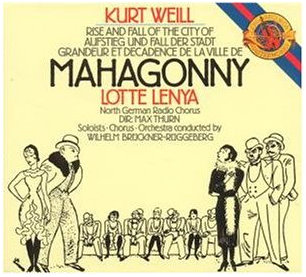
Kurt Weill & Bert Brecht - Rise And Fall Of the City Of Mahagonny

In the 1920´s Kurt Weill and Bertolt Brecht worked togehter on the "song-play" "Mahagonny", based on poems taken from Brecht´s "Hauspostille". They interrupted adapting the song-play into a "Mahagonny" opera in May 1928 so that they could concentrate on a new version of the classical "Beggar´s Opera", which enjoyed its premiere performance as "The Threepenny Opera" in autumn 1928 in Berlin. The piece took the rest of Europa by storm and Brecht and Weill were alredy working on their next project - The "Mahagonny" opera.

This opera tells the story of three criminals (Leokadja Begbick, Trinity Moses and Fatty) creating the city of Mahagonny. Drinking, gambling, prize-fights and similar activities are the sole occupation of the inhabitants, and money rules. The implications for a society organized on such a value system is the overarching theme of the opera, which explores scenarios of greed, gluttony, lust, and a justice system in which a murderer can buy his way to freedom, but inability to pay a bill results in conviction and a death sentence.
There are only two main characters, Jenny, a prostitute, and Jim Mahoney, a lumberjack. Mahagonny is threatened by a hurricane at the end of Act 1, which despite much anticipation & causing much distress simply bypasses the city. In Act 2 following the hurricane nothing is forbidden and various scenes of debauchery occur. Jenny and Jim try to leave but Jim cannot pay his debts and is arrested. Another character arraigned for murder, bribes his way out of it, but Jim has no money and is condemned to death for not paying for his whisky. The opera ends with discontent destroying the city, which burns as the inhabitants march away.
The music uses a number of styles, including rag-time, jazz and formal counterpoint, notably in the "Alabama Song" (covered by The Doors and later David Bowie).
The lyrics for the "Alabama Song" and another song, the "Benares Song" are in English (albeit specifically idiosyncratic English) and are performed in that language even when the opera is performed in its original German language.

This opera enjoyed its premiere performance in 1930 as "The Rise And Fall Of The City Of Mahagonny". This event became one of the greatest theatre scandals in the history of the Weimarer Republic. Organized groups of Nazi troublemakers attended the performance and caused such tumultuous scenes that the performance could only be completed with the greatest of effort. The reaction of the right-wing press also made it clear that "Mahagonny" was not only considered an opera but also a political issue. Weill left Germany in 1933.

Kurt Weill & Bert Brecht - Rise And Fall Of the City Of Mahagonny pt 1
Kurt Weill & Bert Brecht - Rise And Fall Of the City Of Mahagonny pt 2
(192 kbps, cover art included)

Kurt Weill - From Berlin To Broadway

Kurt Weill died 74 years ago.

British archival label Pearl's "Kurt Weill - From Berlin to Broadway: A Selection" is a single-disc condensation of a pair of two-CD sets, "Kurt Weill - From Berlin to Broadway" (GEMM 9189) and "Kurt Weill - From Berlin to Broadway, Vol. 2" (GEMM 9294).

It presents recordings from seven of Weill's stage musicals made around the times the shows were produced and sung in most cases by the performers who introduced them onstage. There are also private recordings by Weill himself, by his German collaborator Bertolt Brecht, and by his wife Lotte Lenya.

The collection begins with two songs, "Moritat von Mackie Messer" (Mack the Knife) and "Kannonensong" (Cannon Song) sung by Harald Paulsen, who first played the part of Mack the Knife in "Die Dreigroschenoper" ("The Threepenny Opera") in 1928, and recorded the same year. Lenya and Brecht are also heard performing songs from the show. Lenya handles most of the songs from the other two German musicals included, "Happy End" and "Aufstieg und Fall des Stadt Mahagonny" ("Rise and Fall of the City of Mahagonny"), two of them in scratchy private recordings.

After the initial nine tracks, the rest consists of Broadway material. Though the recording of full-length original cast albums did not become common until after the success of the "Oklahoma!" album in 1943, it was not uncommon before that for labels to make records of individual songs from Broadway shows using those shows' principals, and that is largely what one hears here, including a single of "September Song" that Walter Huston recorded for Brunswick in 1938 and selections from "Lady in the Dark" recorded by Gertrude Lawrence for RCA Victor and Danny Kaye for Columbia.

Decca recorded a five-record 78 rpm cast album of "One Touch of Venus" in November 1943, and five of the songs are here, sung by Mary Martin and Kenny Baker. "Lost in the Stars", Weill's final show, actually began life years earlier as "Ulysses Africanus", and Walter Huston recorded a version of the song "Lost in the Stars" for Decca in 1944, five years before the musical opened. In a private recording, Lenya sings "Lover Man," an early version of "Trouble Man" from the show.

The CD closes with four performances by Weill himself of songs for "One Touch of Venus", one of which is an early version of "Way Out West in Jersey," here called "Jersey Plonk."

One can hear the change in Weill's approach from the innovative sound of "Die Dreigroschenoper" and the other German shows to the more conventional style of the Broadway material. But Weill's individual style is always apparent, no more so than in his own performances and those of his wife when his music is stripped to just a piano and voice. These vintage recordings are crucial to an appreciation of Weill, even if they are not always in the best fidelity, and since they range from available commercial recordings to acetates in private hands, the compilation has unparalleled breadth.

(192 kbps, front cover included)

Brave Old World - Dus gezang fin geto Lodzh / Song of the Lodz Ghetto

Klezmer music traces back to the dance music played by itinerant Jewish music that traveled throughout Europe in the nineteenth century. The tradition is brought up to contemporary standards by Brave Old World, a group that includes members from California, Chicago, New York and Berlin. "The Washington Post' called Brave Old World "the revival's first supergroup. Every player is a virtuoso". "The Boston Globe" explained that Brave Old World "plays a klezmer music that is entirely grounded in the present, so intensely evolved from the music as it was, and, yet, so clearly, obviously, entirely klezmer that one could not seperate out many of the influences".

The original lineup of Brave Old World featured Joel Rubin on clarinet, Ben Bazyler on drums, Stu Brotman, a former member of 1960s' rock band, Kaleidescope and an ex-sideman for Canned Heat, Geoff and Maria Muldaur and Ry Cooder, on bass, cymablom, tilinka and percussion, Indiana-born and Berlin-based Alan Bern on keyboards and Michael Alpert, a founding member of Kapelye and a research associate at the YIVO Institute for Jewish research, on violin, accordion and vocals. Rubin was later replaced by Kurt Bjorling, musical director of the Chicago Klezmer Ensemble since 1984. In 1992, the group won first prize at the International Klezmer Festival in Sofed, Israel. In addition to their recordings, Brave Old World has been featured on two albums with violinist Itzhak Perlman.

This album was recorded live in Bordeaux. Song of the Lodz Ghetto is a unique musical work, a song cycle in which memory and imagination freely interact to create a Proustian journey between present and past. At the center are Brave Old World's arrangements of the rare Jewish street and cabaret songs from the Nazi ghetto of Lodz, Poland, 1940-44. Leading through the Lodz repertoire like stepping-stones through the river of memory are Brave Old World's own original compositions, reflections on 17 years of performing Jewish music. Michael Alpert's moving Berlin 1990 forms the emotional and musical counterpoint to the passionate and ironic street songs of the bard of the Lodz ghetto, Yankele Herszkowicz. A musical and spiritual journey of resistance, love, and reconciliation.

Tracklist:


1Rumkovski Khayim/Lodzh-Fidl2:43
2Lodzh-Overtur4:02
3A Gants Fayn Mazltov4:35
4Nisht Nor Simkhe/Veynendiks4:57
5Vayl Ikh Bin A Yidele3:28
6S'iz Kaydankes, Kaytn4:08
7Kimts In Herts /Rumkovski Khayim4:03
8Yikhes/Vinter 19425:58
9Makh Tsi Di Eygelekh3:11
10Berlin 19901:19
11Es Geyt A Yeke4:03
12Ver Klapt Du Azoy?/Geto Varyant4:24
13Geto, Getunya4:06
14Kuyavyak2:22
15Amerike Hot Erklert/Kemfn!4:20
16Berlin 19902:28
17Lodzh-Coda2:25
18Bobover Khupe-Marsh/Rumkovski Khayim6:56

Brave Old World - Dus gezang fin geto Lodzh / Song of the Lodz Ghetto
(192 kbps, cover art included)

Bertolt Brecht - Auszüge aus dem Arbeitsjournal 1948 - 1954


Today Brecht is best known as a poet, and most critics consider his poetic talent his strong point. His plays were mostly based on the works of others. But he was an innovator with his theatrical "Verfremdungseffekt" ("alienation effect"), designed to make the audience active, thinking participants in a play, rather than just passive observers who get lost in dramatic illusion. Many people today know Brecht best through the "Threepenny Opera" songs he wrote with the composer Kurt Weill ("Mackie Messer"/"Mack the Knife"). Like many artists, Brecht has become more appreciated after his death than he was during his lifetime. His sardonic humor now seems almost contemporary.

Born into a bourgeois family with a Catholic father and a Protestant mother, Brecht became a Marxist who was critical of society and religion in general. Forced into exile by the Nazis in 1933, Brecht was a man without a country for much of his life. He seemed to live in his own "alienation effect." Even after his return to East Germany in 1949, Brecht went from being viewed as a radical Marxist in the West, to being viewed suspiciously by the East for his unorthodox dramatic theories.For a brief time Brecht worked in Hollywood - a place he did not like very much. With the Austrian director Fritz Lang, Brecht wrote the script for "Hangmen Also Die" (1943), inspired by the assassination of Reinhard Heydrich by Czech resistance fighters, and the ensuing retaliation by the Nazis. Forced out of Hollywood by HUAC, Brecht finally settled in East Berlin.

Brecht quickly discovered, however, that the German Democratic Republic was not quite his ideal brand of Communism, and he was often at odds with his East German hosts. He did not care to keep up appearances, and because of his scruffy, unshaven appearance, East German security guards once excluded him from a Berlin reception being held in his own honor.
He died in East Berlin in 1956.

During the exile period, Bertolt Brecht was forced to develop new aesthetic forms since it was often difficult to find theaters to produce his work. The prose works of the exile period such as Me-Ti, the Keuner stories, and the Tui novel, as well as Brecht's Arbeitsjournal, can be seen as an extension of his aesthetic experiments to the realm of prose literature.

Bertolt Brecht - Auszüge aus dem Arbeitsjournal 1948 - 1954
(192 kbps, cover art included)


Dienstag, 2. April 2024

Carla Bley – Fleur Carnivore (1989)

On "Fleur Carnivore", pianist Carla Bley deftly integrates her beautiful melodies into five complex, yet effortless sounding pieces. Taken from 1988 live dates at Copenhagen's Montmartre club, Carnivore spotlights Bley's very accomplished big band, which includes, amongst several others, trumpeter Lew Soloff, alto saxophonist Wolfgang Pusching, trombonist Gary Valente, tenor saxophonist Andy Sheppard, and organist/harmonica player Karen Mantler (Bley's daughter). 

The title track is a romantically bittersweet ballad swinger, which includes impassioned solos from Pusching and Soloff, while, in nice contrast, there's the buoyant, Latin-tinged "Song of the Eternal Waiting of Canute," featuring rousing solos by Valente and tenor saxophonist Christof Lauer. 

In addition to these extended pieces, there is the suite composition, "The Girl Who Cried Champagne (Parts 1/2/3)." This breezily swinging bossa nova features meaty tenor work from Sheppard and a minimalist harmonic solo by Mantler. Rounding out the set are the whimsical "Ups and Downs" and the gospel R&B tune "Healing Power." 

Combining surprising arrangements and pop song melodies, Bley creates a unique jazz language, setting herself apart from both traditionalist bandleaders (Wynton Marsalis, Thad Jones) and more avant-garde stylists (Muhal Richard Abrams, George Russell). "Fleur Carnivore" is one of Bley's best titles and good place to start for newcomers.

Tracklist:

"Fleur Carnivore" - 11:12
"Song of the Eternal Waiting of Canute" - 9:48
"Ups and Downs" - 7:05
"The Girl Who Cried Champagne Parts 1-3" - 17:15
"Healing Power" - 10:27

Recorded at the Montmartre, Copenhagen, Denmark on November 14–16, 1988.

(320 kbps, cover art included)

Buffy Sainte-Marie - Illuminations (1969)

In the year 2000, the Wire magazine picked this spaced out gem from Native American folksinger and activist Buffy Sainte-Marie as one the "100 Albums That Set the World on Fire", originally released in 1969.

 Interestingly enough, it's a record Sainte-Marie doesn't even list on her discography on her website. It doesn't matter whether she cares for it or not, of course, because Illuminations is as prophetic a record as the first album by Can or the psychedelic work of John Martin on Solid Air. For starters, all of the sounds with the exception of a lead guitar on one track and a rhythm section employed on three of the last four selections are completely synthesized from the voice and guitar of Sainte-Marie herself. There are tracks whose vocals are completely electronically altered and seem to come from the ether -- check out "Mary" and "Better to Find Out for Yourself" as a sample. But the track "Adam," with its distorted bassline and Sainte-Marie throwing her voice all over the mix in a tale of Adam's fall and his realization -- too late -- that he could have lived forever, is a spooky, wondrous tune as full of magic as it is mystery and electronic innovation.

The songs here, while clearly written, are open form structures that, despite their brevity (the longest cut here is under four minutes), break down the barriers between folk music, rock, pop, European avant-garde music and Native American styles (this is some of the same territory Tim Buckley explores on Lorca and Starsailor). It's not a synthesis in any way, but a completely different mode of travel. This is poetry as musical tapestry and music as mythopoetic sonic landscape; the weirdness on this disc is over-exaggerated in comparison to its poetic beauty. It's gothic in temperament, for that time anyway, but it speaks to issues and affairs of the heart that are only now beginning to be addressed with any sort of constancy -- check out the opener "God Is Alive, Magic Is Afoot" or the syncopated blues wail in "Suffer the Children" or the arpeggiated synthesized lyrics of "The Vampire." When the guitars begin their wail and drone on "The Angel," the whole record lifts off into such a heavenly space that Hans Joachim Rodelius must have heard it back in the day, because he uses those chords, in the same order and dynamic sense, so often in his own music.

Some may be put off by Sainte-Marie's dramatic delivery, but that's their loss; this music comes from the heart -- and even space has a heart, you know. One listen to the depth of love expressed on "The Angel" should level even the crustiest cynic in his chair. Combine this with the shriek, moan, and pure-lust wail of "With You, Honey" and "He's a Keeper of the Fire" -- you can hear where Tim Buckley conceived (read: stole) the entirety of Greetings From LA from, and Diamanda Galas figured out how to move across octaves so quickly. The disc closes with the gothic folk classic "Poppies," the most tripped out, operatic, druggily beautiful medieval ballad ever psychedelically sung. That an album like Illuminations can continue to offer pleasure 32 years after it was recorded is no surprise given its quality; that it can continue to mystify, move, and baffle listeners is what makes it a treasure that is still ahead of its time.  - allmusic.com     

Tracklist:
01. God Is Alive, Magic Is Afoot
02. Mary
03. Better To Find Out For Yourself
04. The Vampire
05. Adam
06. The Dream Tree
07. Suffer The Little Children
08. The Angel
09. With You, Honey
10. Guess Who I Saw In Paris
11. He's A Keeper Of The Fire
12. Poppies


Buffy Sainte-Marie - Illuminations (1969)
(320 kbps, cover art included)