Dienstag, 24. Oktober 2023

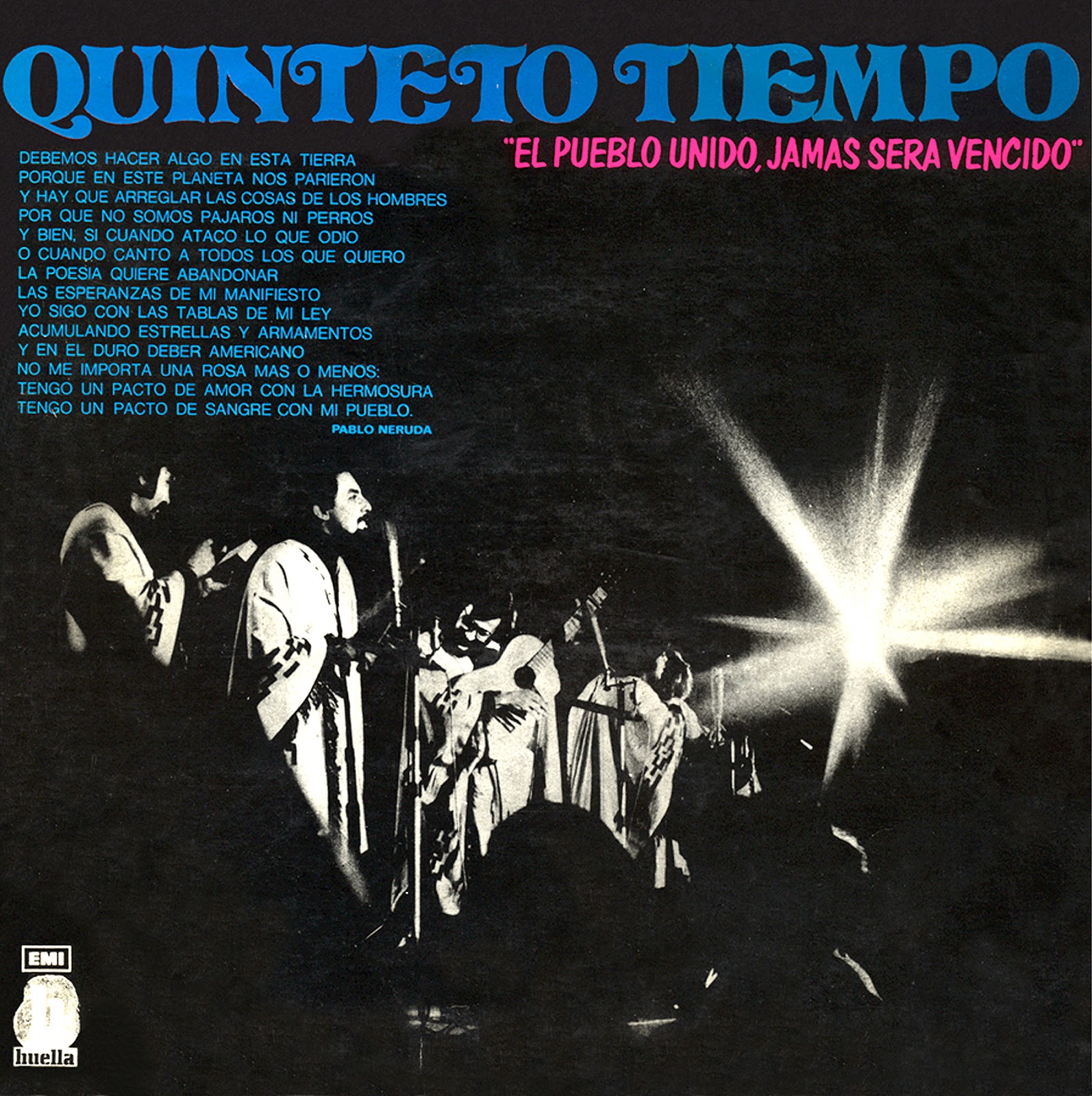
Quinteto Tiempo - 1975 - El Pueblo Unido, Jamas Sera Vencido


The group Quinteto Tiempo originated in the city of La Plata, Argentina.

Since 1975 and especially with the dictatorship installed in 1976 the group suffered threats and censorship, which prevented them from disseminating their work in Argentina. Under such restrictions they recorded five albums between 1975 and 1982 and participated in international festivals and worked together with other important artists.

For example they performed at the 4.
"Festival of Political Song" in 1974 in East Berlin.

This LP was recorded in Argentina in the mid to late 1974 for Emi-Odeon, but (according to the information on the group´s website) published since 1975 in Uruguay, Chile, Colombia, Venezuela, Panama, Costa Rica, Nicaragua, Guatemala, El Salvador, Honduras, Mexico, Spain, Italy, Germany, Finland and Japan by record labels like EMI, CBS, DIDECA, Disco, Capitol and Toshiba.


Tracklist:
01. Adagio en mi país (Alfredo Zitarrosa)
02. El cambá (Gilberto Rojas)
03. Zamba del riego (Armando Tejada Gómez-Oscar Matus)
04. El aguatero porteño (Enrique Maciel-Francisco Carbonaro)
05. Soneto a Matilde (Pablo Neruda-César Isella)
06. A Víctor (Roberto Todd-Otilio Galíndez)
07. Run Run se fue pa’l norte (Violeta Parra)
08. Juanillo Manta (DR)
09. La baguala canta y llora (coplas populares y de Ariel Gravano, Andino Álvarez y Armando Tejada Gómez-Carlos Groisman)
10. Chaya de la soledad (César Perdiguero)
11. Te recuerdo Amanda (Víctor Jara)
12. El pueblo unido jamás será vencido (Sergio Ortega)

Quinteto Tiempo - 1975 - El Pueblo Unido, Jamas Sera Vencido
(192 kbps, front & back cover included)

Hanns Eisler - Klingende Dokumente I (NOVA, 1974)


Hanns Eisler on the meaning of music:"Someone who knows only music, understands nothing about it."

Some composers may have tried to escape the upheavals of their century through the illusion of "pure music," but not Hanns Eisler. His lifelong conviction was that music should not be subjective but objective, not obscure but transparent, not metaphysical but grounded in history. Eisler's art held up a mirror to the revolutionary hopes and bitter disappontments of his generation - a generation that witnessed two world wars, the rise and fall of empires, an age of revolutions.


"A composer knows," Eisler wrote on the eve of his expulsion from the United States, "that music is written by human beings for human beings and that music is a continuation of life, not something separated from it."

The album "Klingende Dokumente I" was released on the label NOVA (catalog number 8 85 039) in 1974. It contains vocal music with various performers, including Hanns Eisler, and interviews with the composer.

Tracklist:

Side 1:
01. Anmut sparet nicht noch Mühe (Vocals: Hanns Eisler)
02. Das Lied im Kampfe geboren (Interview with Hanns Eisler, December 1957)
03. Ohne Kapitalisten geht es besser (Vocals: Gisela May)
04. Über die Dummheit in der Musik (Interview with Hanns Eisler by Hans Bunge, September 1961)
05. Die haltbare Graugans (Vocals: Hanns Eisler and Irmgard Arnold, recorded in 1958)

Side 2:
01. Handwerkliches Können und Höhe der Musik (Interview with Hanns Eisler by Nathan Notowicz, March 1958)
02. Die Ballade vom Wasserrad (Vocals: Hanns Eisler, recorded 1958)
03. Über Brecht (Interview with Hanns Eisler by Hans Bunge, May 1958)
04. Begegnungen mit einem Literaturindustriellen (Interview with Hanns Eisler by Hans Bunge, May 1958)
05. Lied von der belebenden Wirkung des Geldes (Vocals: Hanns Eisler, recorded 1958)

Hanns Eisler - Klingende Dokumente I (NOVA, 1974)
(192 kbps, cover art included)


Thommie Bayer Band - Silchers Rache (1978)

Thommie Bayer (Thomas Bayer-Heer, born 22 April 1953) is a German writer, musician and painter.

Bayer was born in Esslingen am Neckar, near Stuttgart (where he attended school). From 1972 to 1978, he studied painting at the "Staatliche Akademie der Bildenden Künste Stuttgart" (Stuttgart State Academy of Art and Design).

From 1974, he was a musician and songwriter, first with the duo Thommie und Tomaske, then with his own band, the Thommie Bayer Band. He often shared the stage with friends Thomas C. Breuer and Bernhard Lassahn. His most successful hit was in 1979 with "Der letzte Cowboy kommt aus Gütersloh". His work is affected by the idea that we all are cowboys (bad!) or indians (good!).

During the 80s he was bound by the divorce from his first wife and lots of individual problems. He reduced his engagement in music and began a career as book author ("Das Herz ist eine miese Gegend").

The album "Silchers Rache" was released in 1978 on the Bellaphon label. Alex Köberlein from the band "Schwoißfuaß" played saxophon and was part of the background singers.


Tracklist:
A1 Ich hab das alles mitgemacht Teil 1 3:26
A2 Litanei 2:06
A3 Ich hab Lise gesehn 3:27
A4 Wir, die wir mitten im Leben stehn 2:52
A5 Ich hol dir keine Sterne mehr vom Himmel 3:48

B1 Dann und danach 3:17
B2 Mich juckt’s 2:43
B3 Wenn ... 2:27
B4 Heinrich der Adler 5:29
B5 Brief einer Mutter 3:05
B6 Ich hab das alles mitgemacht Teil 2 2:17


(320 kbps, cover art included)

Samstag, 21. Oktober 2023

VA - México Chile Solidaridad (1974)


The album "México Chile Solidaridad " was released in Mexico in solidarity with the people of Chile after the military coup of 1973. Los Folklorists, Oscar Chavez, Amparo Ochoa, Salvador Ojeda and Guadalupe Trigo, among others sing songs dedicated to the people of Chile. Remarkable is the wonderful version of "Al Centro De La Injusticia" (written by Isabel and Violeta Parra) by the unforgettable Amparo Ochoa. And the first track of this album documents Salvador Allende's own voice uttering his last speech facing the military coup.

On the back cover of the album we can read this prophetic text:
"The National Committee of Solidarity and Support to Chile greets fellow artists through the songs recorded on this record, they express their solidarity with the struggle of the Chilean people.
Now more than ever it is worth considering that the triumph of the Chilean people depends much of the future of freedom in Latin America. Therefore it is urgent to increase international pressure aimed at isolating the fascist junta, and redouble efforts to support civil resistance inside Chile, fight against fascism, and seek restoration of democratic order that will allow the continuation of political struggle and the building of a new society "
.


Tracklist:

Side A:
1. Ultimo mensaje del presidente Allende (11 sep. 1973)
2. A Salvador Allende / Oscar Chavez
3. La tarde nublada / Conjunto Peña Movil
4. Compañero Salvador / Margarita y Anthar
5. Al centro de la injusticia / Amparo Ochoa

Side B:
1. Plegaria del labrador / Los Folkloristas
2. En lota la noche es brava / Salvador Ojeda
3. Canto a Neruda / Guadalupe Trigo
4. Que dira el santo padre / Conjunto Icnocuicatl
5. Cuanto nos ha dolido / Julio Solorzano
6. Canta Sta. Ma. Iquique cancion final / Conjunto Tupac
 

(320 kbps, cover art included)
 

Hanns Eisler - Lieder - Irmgard Arnold (Sopran) - Zeitgenossen Ost

The series "zeitgenossen ost" presents 20th-century music whose rank will be retained well into the 21th century. It centres around characteristic works of outstanding compsers and exemplary performances by prominent artist from the former German Democratic Republic.

At the Second All-German Musical Festival in Coburg in the late summer of 1956 Irmgard Arnold gave her first Eisler concert. This amrked the beginning of Eisler´s collaboration with the singer. In numerous rehearsals with the composer she aquired a large repertory of his songs, ballads and solo cantatas written at different times of his life.
In the years that followed she gave numerous eisler song recitals accompanied by Andre Asriel on the piano. Undoubtedly, their concerts were of great importance for making this group of works popular.

The increasing split of Germny into East and West together with the fact that Irmgard Arnold due to her intense work at the Komische Oper could only perform these Eisler recitals very rarely prevented her interpretations from becoming popular in the West. Here it was the actress and chansonette Gisela May, with whom Eisler had also collaborated in the 1950s, who along with Ernst Busch came to be regarded as the congenial interpreter of Eisler´s vocal works in her concert appearance in Western Europe and the United States.
Thus these over 40-year-old recordings of two Arnold-Asriel concerts - November, 21 1956 and October, 14 1957 at the Berliner Staatsoper Unter den Linden -  are reaching us as something of a legacy, an authorized interpretation which, more than many others, met the composer´s original intentions.

.
Hanns Eisler - Lieder - Irmgard Arnold (Sopran)
(192 kbps, small front cover included)

Erich Kästner - gelesen von Werner Schneyder - Zeitgenossen, haufenweise

Erich Kästner, (born Feb. 23, 1899, Dresden, Ger.—died July 29, 1974, Munich) was a German satirist, poet, and novelist who is especially known for his children’s books. He was the most durable practitioner of the style of witty, laconic writing associated with the highbrow cabaret, the Berlin weekly Die Weltbühne (“The World Stage”), and the Neue Sachlichkeit (New Objectivity) movement of the mid-1920s.

Kästner studied at Rostock, Leipzig, and Berlin to become a teacher. Later, as a journalist, he became a free-lance writer (1927). Four volumes of light but fundamentally serious poetry appeared before 1933. He also wrote the remarkable tragic novel Fabian (1931). His children’s books are notable for their humour and respect for the child’s moral seriousness. The most famous of these, Emil und die Detektive (1929; Emil and the Detectives), was several times dramatized and filmed. 

Prevented by the Nazis from publishing in Germany (1933–45), he printed his works in Switzerland. After the war, Kästner became magazine editor of Die Neue Zeitung of Munich and subsequently founded a children’s paper. From 1952 to 1962 he was president of the German branch of PEN, an international organization of writers. His post-World War II works are characterized by a greater emphasis on social philosophy but do not sacrifice their elegance and entertaining qualities. These include Das doppelte Lottchen (1950; “The Double Lottie”); Zu treuen Händen (1950; “Into Faithful Hands”); the play Die Schule der Diktatoren (1956; “The School of Dictators”); and Als ich ein kleiner Junge war (1957; “When I Was a Young Man”). Kästner’s collected works, Gesammelte Schriften, 7 vol., appeared in 1959.

Tracklist:
1. "Das war der Krieg" 0:13
2. Die Entwicklung der Menschheit 1:29
3. Der Mensch ist gut 1:40
4. "Der Alte Herr..." 1:28
5. Wie lese ich den Handelsteil 1:54
6. Ansprache an Millionäre 2:18
7. Zeitgenossen haufenweise 1:50
8. Der synthetische Mensch 2:19
9. "Im Ernst, worüber lacht der Mensch..." 1:51
10. Maskenball im Hochgebirge 1:29
11. Winterspoet 1:15
12. Der Humor 0:23
13. Die Fabel von Schnables Gabel 1:28
14. Misanthropologie 1:17
15. Die Wirklichkeit als Stoff 0:28
16. Große Zeiten 1:00
17. Die Deutsche Einheitspartei 1:37
18. Marschliedchen 1:36
19. "Wenn ein kleiner Kaufmann..." 0:40
20. Kämpfe zu Hause 1:19
21. Die andere Möglichkeit 1:25
22. "Sie gingen zu Gaßmeier..." 1:03
23. Fantasie von übermorgen 1:08
24. Aus "Streiflichter aus Nürnberg" 1:01
25. Das letzte Kapitel 1:57
26. Liebe zum Theater 0:25
27. Der konzessionierte Moralbesitzer 0:55
28. Hamlets Geist 1:29
29. "Hausmittel und Außerhausmittel" 1:39
30. Der Handstand auf der Loreley 1:53
31. Der Gesang vom Singen 0:57
32. Die leichte Muse 0:12
33. Ankündigung einer Chansonette 1:13
34. "Theodor Däubler... über die Poesie 0:54
35. Sachliche Romanze 1:12
36. "Fabian war zweiunddreißig..." 1:50
37. Gewisse Ehepaare 1:44
38. "Gedanken eines Hotelgastes" 1:35
39. Hotelsolo für eine Männerstimme 1:19
40. "Mißtraut euren Schulbüchern" 0:35
41. Klassenzusammenkunft 1:23
42. "Es gab damals Lehrer ... 1:48
43. An die beleidigten Lehrer 1:05
44. "Am 1. August 1914" 0:28
45. Kurzgefasster Lebenslauf 1:41
46. Warnung vor Selbstschüssen 0:56
47. Und überhaupt 0:55
48. Man altert nicht von ungefähr 2:12
49. Alter Mann, anno 1970 1:22
50. Dem Revolutionär Jesus zum Geburtstag 1:24
51. Wenn es eine Gärtnerei gäbe... 0:48
52. Die Maulwürfe 3:39
53. Und wo bleibt das Positive? 0:12


Erich Kästner - gelesen von Werner Schneyder - Zeitgenossen, haufenweise
(256 kbps, front cover included)

Dienstag, 17. Oktober 2023

Lin Jaldati & Ensembel - Rejsele - Music of the Eastern European Jews Vol. IV

After World War II, there were still artists who performed Yiddish music on both sides of the Berlin Wall. In West Germany these included the folk singer Peter Rohland, the ensembles Zupfgeigenhansel and Espe, and the duo Hai and Topsy Fankl. East Germany had the state-subsidized Synagogue Choir in Leipzig (Leipziger Synagogalchor) and a handful of artists who, like Perry Friedman and Lin Jaldati, devoted themselves to Yiddish song.

Interestingly, Friedman, who immigrated to the GDR in the 1950s from Canada, and Jaldati, who moved to East Berlin from Holland, were devoted Communists and viewed Yiddish songs as vehicles for political statements. Lin Jaldati, venerated in the GDR as the First Lady of Yiddish song, perfomed continuously until 1988, when she gave one of her last concerts at the second festival of Yiddis Culture in East Berlin.

"Rejsele" was record at the Yiddish Folk Festival Zurich 1984, with Lin Jaldati and Jalda Rebling (vocals), Kathinka Rebling (viola) and Eberhard Rebling (piano).


Lin Jaldati & Ensembel - Rejsele - Music of the Eastern European Jews Vol. IV
(256 kbps, cover art included)


Hanns Eisler - Irmgard Arnold singt Eisler

On his return to Europe from the USA in 1948 Eisler had a large stock of vocal compositions "in his bagage", written in exile but as yet virtually unperformed.
Finding suitable artists to interpret this large group of works was exceptionally difficult. Not until 1956 did Eisler find a singr in the person of Irmgard Arnold who had everything he needed for his music - in his own words: "lightness, intelligence, friendliness, strictness, grace and hardness, fun an seriousness." The soprano Irmgard Arnold was born into a Munich family of musicians in 1919 and after engagements in Augsburg and Halle came in 1949/50 to the Komische Oper ensemble in Berlin. She gave her first Eisler concert at the second All-German Music Festival, held in Coburg at the endo of August and beginning of September 1956.

The vocal works on this recording were presented over the course of many years at her lieder recitals - accompanied by Andre Asriel, who had been top of Eisler´s composition class at the Academy of Arts in East Berlin in 1950/51. The works on the album are presented in chronological order, not as they were originally heard in the concert hall or presented on gramophone records. Irmgard Arnold´s concerts did much to reveal the "unknown" Eisler. Her way of singing Eisler can still be useful for deeper understanding of the difficulties caused to the inquring artist by this side of Eisler - and for the enthusiasm and enjoyment that intensive work can yield.

Hanns Eisler - Irmgard Arnold singt Eisler
(192 kbps, front cover included)

Ewan MacColl & Dominic Behan - Streets Of Song (1959)

For nearly 60 years, Ewan MacColl, an activist and left-wing socialist, expressed his views as a playwright, social activist, songwriter and performer. During the course of his lifetime he composed a body of work that ranks among the best in the British folk genre. Among the songs he wrote that others recorded and made famous are "Dirty Old Town" (Rod Stewart, the Pogues), "Freeborn Man" (The Pogues), and his Grammy Award-winning song "The First Time Ever I Saw Your Face," a hit single for Roberta Flack in 1971, and which he wrote for his longtime collaborator and life partner, Peggy Seeger.


From the sleeve notes:

"Childhood memories of City Streets from Glasgow, Salford and Dublin
The Oral Lore of Children

In listening to this recording, one will find three distinct types of oral children's lore. First there are the items which have little or no restrictions of national boundary. Some of the pieces recited and sung in this recording are known throughout the English-speaking world, originating, perhaps, in the British Isles and spreading out from there to all of the many countries culturally and linguistically affected by the British and their far-flung empire. Who, in the English-speaking world, for example, has not heard one or another version of the singing-game The Farmer Wants a Wife (heard in a Dublin Irish version on this recording), or Poor Mary Sat A-Weeping (from Salford on this recording). You may know these pieces by other names, and in forms differing quite radically from those presented on this recording, but it will require little imagination or insight to realise the relationship of the versions you know to those presented here.

A second category of pieces found in this recording are those which appear to have strictly national boundaries, being known either only in the British Isles or, perhaps, only in a single country or national group. Such pieces are frequently related to festivals or events which are purely national in character and incidence, or are so dependent upon purely national events or references as to make them almost meaningless outside of the national boundary of the country in which, they may be found. Such pieces include the holiday song Christmas is Coming (item number 67, from Dublin, but known throughout the British Isles), and the Scottish jibe, Wha saw the tattle howkers (item number 62, from Glasgow, but known in other parts of Scotland) among numerous others.

The third category consists of those pieces of a purely local nature, existing almost exclusively in a single community, town or county, but rarely found elsewhere. The reasons for such limitation of tradition are similar to those given for the second category mentioned above, but with considerably more localised references or language. Such piece include Up The Mucky Mountains (item number 64) and Jessie Stockton (item number 68), both from Salford, and Cheer up, Russell Street (item number 56) from Dublin. Into this last category must also go those pieces which are the creative efforts of a moment, in use for only a short period of time, and fading into the world of lost traditions almost before they were born. Occasionally such-pieces fall into the collector's lap, but the collector (at best, just an accident in time, in such instances) has no way of sorting out these pieces from those which are more than just mere ephemera.

The record contains an even 100 pieces of diverse examples of children's lore. Here will be found game songs, nonsense rhymes and ditties, counting games, ball-bouncing games and rhymes, skipping-rope pieces, jibes, taunts, oaths, street ballads, seasonal songs, and insults. What is the origin of these pieces? For most of them we cannot even begin to speculate on the question of origins.

Some few can be pinpointed to historical occurrences and personages King Henry, King Henry (item number 12), tells of the affairs of love of a well-remembered English monarch. Others are the breakdown of older traditional ballads and tales; I know a woman, she lives in the woods (item number 23), obviously derives from the ballad The Cruel Mother (Child 20). Some like items 4, 56 and 59, are children's parodies of recent creations, including music hall and popular songs. Most of the pieces are created out of happenings and sights of everyday life. Because of the universality of their subject matter they might arise anywhere or at almost any time so it is an impossible task to do much more than guess at their origins.

First, we are introduced to the cultural milieu with which we are dealing. Poverty, a proud working-class inheritance, slum conditions, and the everyday, mundane things and occurrences affecting the individuals concerned. Next, we are presented with the oral products of that environment, set off against a train of thought concerning those products, not of the children living, playing and reciting those pieces of lore, but of two adult bearers of this urban tradition whose sensitivity to the setting is expressed in terms of mature afterthought. The opportunity presented by this recording to study the whys and wherefores of urban childhood traditions is the next best thing to working in the field with the children themselves.

One fascinating problem suggested by working with children's lore, and, even more specifically, with the lore of working-class children, is the question of class boundaries of such lore. Of this question, Dominic Behan has written:

"It can — so far as kids are concerned — be made only by children who own so little other rights to amusement that they must sing and make up songs about themselves and the places they inhabit; tenement house schools, neighbours, and, most and biggest of all, their playground — the streets. Maybe this is not quite true, maybe other classes of folks' children make up other classes of songs. All I can say is if they do, I have never heard them."

"So much for the songs: what of the games? Are they 'class' bound? Do they belong to certain people or are they the property of all? Once again, I don't know. Once again I will guess, and say all".

The challenge has been issued. It is the duty of folklorists, sociologists, and psychologists to take it up and answer the question. An attempt to do so from a library chair will prove futile; the data are insufficient and largely undocumented in most of the existing works on children's lore. By utilizing the existing tools of each discipline we can expect to arrive at a satisfactory conclusion. We are fortunate in dealing with children's lore, to be working in an area which appears to have no beginning or end in time, and while some scholars have bemoaned the dying of oral tradition (such claims have been made for the past century, though I for one prefer to think of traditions changing and evolving rather than dying), none will be so rash as to deny the very vital nature of children's songs and games. There is no question of the existence of sufficient material for study.

Kenneth S. Goldstein"
Tracklist:
A1 Introduction And Oaths
A2 Singing Games And Ring Games
A3 Skipping Rope, Ball Bouncing And Counting Rhymes
B1 Chants, Cheers An Election Ditties
B2 Seasonal Songs And Dhants
B3 Rhymes And Taunts
B4 The Day's End

(256 kbps, front cover included)

Sonntag, 15. Oktober 2023

Jewish Songs - Traditionals 1911 - 1950


Klezmer is a traditional style of Jewish ensemble music with roots in Eastern Europe that features vocals and various instruments, especially the violin and the clarinet. It has had an big influence on American popular music.

Klezmer is dance music that is both happy and sad at the same time. A music that comes from the heart but which also moves the heart, which in spite of its refreshing drive, in spite of the infectious rhythms and catchy melodies, always illuminates the more tragic aspects of life.

This music has developed over centuries and contains many elements of Eastern Europe folk music. The slow "hora", the yearning "dojna", the passionate "bulgar" and the fast "sirba" all come together in a festive music that does justice to all of the emotions. Klezmer was originally played by travelling musicians who went from village to village. This music was - and still ist - to be heard first and foremost at weddings, festivities and religious holidays outside of the synagogue.

Alongside Yiddish literature there are a huge number of Yiddish folk songs - and each of these songs is a declaration of love for the language that survived the camps and ghettos.


Schroeder - Hurra! (1984) - R.I.P. Frank Hocker!

Frank Hocker, Schroeder´s great guitar player, died last Friday - thanks a lot for all the music and rest in peace!

The band probably originated with members of the music projects "Die jeilen Träumer" and "Zarah Zylinder". The political rock clown band first appeared in 1975 under the name "Uli Hundt and Schroeder", and was renamed shortly afterwards as Schroeder Roadshow. They offered biting ironic and political texts as well as an eclectic musical style. The band attacked more or less everything, including themselves.

Musically their main focus was saxophone-heavy rock, but with elements from many other styles. Political messages were ambiguous, though the band were on the political left. They also wrote ballads, such as "Tanz mit mir hinaus" and "Wir sind die Brüder der romantischen Verlierer". They worked with Wolf Maahn as producer, Wolfgang Niedecken, and Christian Wagner (solo producer).

One studio album is called "Live in Tokyo", although they have never appeared in Tokyo.

When Uli Hundt and Rich Schwab left in 1984, the band cut the "Roadshow" from their name. They also appeared twice in the "Rockpalast": in 1982 as Schroeder Roadshow, and in 1985 as Schroeder.

Through all the changes in the band they continued to be active on the political rock festival scene. One of the biggest of these was the 1986 festival in Burglengenfeld, against the atomic reprocessing plant in Wackersdorf; in front of 120,000 spectators the band lined up in two parts, some performing as "Die Firma" and the others as "Uli Hundt und die Betablocker".

Then the band went quiet, recording no more LPs, until the comic artist Brösel's "Werner" comic was brought to life when he lined up with his Horex Motorbike "Red Porsche Killer" on a specially closed motorway against the Porsche of his friend. Then the recording of the band's appearance at the accompanying festival, in front of 200,000 spectators, became Schroeder's last album, and their last appearance was a year later at Werner's Revival party - until their late revival in 2008 which saw the release of another studio album.

Schroeder - Hurra! (1984)
(128 kbps, front cover included)

Berlin - Großstadtklänge - Rare Schellacks 1908 - 1953

Here´s another volume of the series with rare schellack recordings, this time collecting historic recordings of Berlin performers from 1908 - 1953.

Throughout the world, the rise of mass culture in the 19th century brought the music of the common man to the forefront of the popular agenda.
Expressions of "high culture" no longer dominated in the big cities. The taste of recently-urbanised country migrants was increasingly catered for.
Since the turn of the 20th century popular melodies, folk songs, humorous commentaries and dance music with a hard edge gained widespread acceptance.

In the suburbs of Vienna, Berlin, Munich, Leipzig and Dresden new types of urban folk singers and entertainers emerged at the cutting edge of recreation.

Their songs reflected the dissonant and raucous reality of urban life in harsh and critical lyrics, but always modified by a pinch of irony and a considerable amount of humor. The commercial recording industry recognized the mass appeal of these emergent syncretic forms and a representative sample from that early period, recorded in Berlin, is featured on this compilation.

Tracklist
1Paul BendixDie Radiorevue 'Der neue Lautsprecher'0:54
2Unknown ArtistDas war knorke1:37
3Schorsch Ruselli mit OrchesterbegleitungDas Mädchen vom Weissensee2:53
4Erwin HartungMöbel-Hübner-Marsch2:44
5Otto ReutterSeh'n Sie, darum ist es schade, dass der Krieg zu Ende ist2:15
6Alexander Flessburg, KrückeSportpalast-Walzer3:25
7Bully Buhlan und Peter RebhuhnChattanooga Choo Choo II (Kötschenbroda-Express)2:15
8Arnold Rieck und Rosi LoibnerIm Lustgarten ist Frühkonzert2:35
9Ludwig ArnoPaula mach die Bluse zu2:49
10Paul BendixFräulein Backhaus2:57
11Paul BendixRadiorevue Ausschnitt0:12
12Pola NegriZeig' der Welt nicht dein Herz2:54
13Max HansenRobes Modes3:09
14Claire WaldoffClaire Waldoff spricht...!0:52
15Claire WaldoffDie Radpartie2:50
16Otto ReutterO Du liebes, deutsches Gretchen3:43
17Die Drei Travellers08/15 Cocktail3:00
18Jugendchor des Mitteldeutschen Rundfunks LeipzigBaut Berlin2:21
19MargareteMax hat'n Knax2:10
20Gustav Schönwald und Elsa GüdeIm Berliner Zoo2:42
21Marta HübnerInventur Ausverkauf3:10
22Homocord OrchesterIch möcht' ein Würstchen, mit Senf beschmiert2:36
23Alexander FlessburgDas Neue Tempelhof Lied (Was hab'n wir für 'ne Feuerwehr bei uns in Tempelhof)2:49
24Claire WaldoffWie wohl ist mir am Wochenend2:51
25No ArtistDie Wasserminna (Verlagsankündigung)0:57
26Max HansenIch reiß mir eine Wimper aus3:07
27Claire WaldoffIch kann um Zehne nicht nach Hause geh'n3:00
28Paul GraetzBerlin2:53
29Paul BendixRadiorevue Ausschnitt0:32


Berlin - Großstadtklänge - Rare Schellacks 1908 1953
(256 kbps, cover art included)

Max Hansen - Perlen der Kleinkunst

Image

Max Hansen was born in Mannheim, Germany, but was raised by his step parents in Munich. His mother was a Danish Actress, Eva Haller, his father's name was von Waldheim.

In his school days, he already sang at the Opera House, so he earned the nickname "The Little Caruso" ("Der kleine Caruso"). Later he studied Music and Voice and got a job at the "Simplizissimus Cabaret" in Munich. From 1914 he played operettas in Vienna and became a good friend of Franz Lehár. After that he worked in Berlin at the Metropole Theater and became there a superstar of operettas, revues, cabaret and radio.

He began acting in five silent films, from 1926 to 1928. His first talkie was "Wien, du Stadt der Lieder" (1930) ("Vienna, City of Song") (1930). In 1932 he played opposite Gitta Alpar in "Die - oder keine" (1932) ("She, or Nobody").

His career was brought to an abrupt end because of his Jewish origin but this was only a pretext. He attracted anger of the Nazis above all since he ridiculed Adolf Hitler as homosexual in his hit "Warst Du schon mal in mich verliebt?" in 1932.

Hansen went to Vienna in 1933 and continued to play in theaters. Only before the affiliation of Austria with the Deutsche Reich Hansen moved to Copenhagen. From there he appeared in scandinavian theaters and found work in the Sweden film business. In addition he wrote several songs under the pseudonymous "Sylvester".
In 1951 Max Hansen returned to Germany for occasional stage engagements but he didn't shoot films any longer.
He died in Copenhagen, Denmark in 1961.

Here´s a fine compilation with 40 tunes by Max Hansen:

Max Hansen - Perlen der Kleinkunst CD 1 & 2
(192 kbps, cover art included)

Grethe Weiser - 20 Rare Chansons


“This small tough person does not need a monument. It already stands,” wrote the critic Friedrich Luft after her death in 1970. Grethe Weiser was a highly talented comedian, whose greatest genius was her verbal eloquence. With her sassy, offhanded quick-wittedness, she was able to elicit thunderous applause from her audiences. Her film and stage partners praised her great discipline in the craft and her helpfulness in general. It was also very important to her personally not to steal anyone else’s show.

Mathilde Ella Dorothea Nowka, the daughter of well-to-do entrepreneurs, was born in Hanover and raised in Dresden, where she attended secondary school for young ladies. At the age of eighteen she engaged in a hunger strike to win her parents’ permission to marry the Jewish-Austrian sugar producer Josef Weiser. He was a wealthy man and was able to rent a mansion for his wife in Dresden, where she gave birth to their son Günther in 1922. In the course of the depression, however, Josef lost his fortune. He then tried to establish a new livelihood in Berlin through various projects, among them the management of the Cabaret Charlott, where Grethe rehearsed for her first performances.

By the time her marriage had deteriorated on account of Josef’s many affairs, she had already found her calling as an actress and cabaret artist. From 1929 on, she played important supporting roles in movies, portraying cooks and other household personnel, and dazzled her fans with her cunningly sharp tongue. She experienced her greatest movie successes in 1937 with her roles in Die Göttliche Jette (The Divine Jette) and Mädchen für Alles (Maid-of-All-Work).

During the second world war, Weiser was not only commissioned for theater duty at the front, but also acted in over thirty movies. For more favorable career opportunities membership in the Theater Guild of the German Reich was required, and for this Grethe Weiser would have had to join the Nazi Party (NSDAP), which, in turn, would have meant renouncing her husband and child. She refused to do this, however, sent her son to boarding school in England (Josef had already fled to the Netherlands), and was miraculously left in peace. Her comedy, evidently, was indispensable in time of war.

In 1948 Grethe met Ida Ehre, proprietor of Hamburg’s Studio Theatre Kammerspiele, who offered her the leading role in Das Kuckucksei (The Cuckoo’s Egg). The premiere brought Weiser tremendous ovations, and she frequently went on tour with this piece. Cooperation with Ida Ehre on Hauptmann’s Der Biberpelz (The Beaver Coat)where she played Mother Wolffen, deepened their contact, which eventually developed into a close friendship.

In the movies made during the era of the “economic miracle” following the war, Grethe embodied the type of the Berlinwoman, known for her big heart and even bigger mouth, who was nobody’s fool and nobody’s victim. In 1968 she was given the Medal of Honour of the Federal Republic of Germany. An Inter-City Express train on the route between Frankfurt and Hanover has also been named after her, as well as a 100-Pfennig postage stamp from the permanent series “Women in German History”, which was dedicated to her in the year 2000.

When Weiser was killed in a car accident together with her second husband, the movie producer Hermann Schwerin, Ida Ehre wrote in an obituary, “You were one of steadfast loyalty. Whomever you locked in your heart was anchored there firmly … you will always be within me, dear Grethe …”.

Grethe Weiser - Perlen der Kleinkunst - 20 rare Chansons
(192 kbps, front cover included)

Sonntag, 8. Oktober 2023

Joey Adams, Sholom Secunda – Jewish Folk Songs

Joey Adams (born Joseph Abramowitz; January 6, 1911 – December 2, 1999) was an American comedian, vaudevillian, radio host, nightclub performer and author, who was inducted into the New York Friars' Club in 1977 and wrote the book Borscht Belt in 1973. Adams grew up in Brownsville, Brooklyn, "a predominantly Jewish section of the borough at the time of his birth."[

His father Nathan Abramowitz was a tailor who later moved to the Bronx. His mother was Ida Chonin.
Sholom Secunda was an American composer of Ukrainian-Jewish descent, born 4 September 1894 in Aleksandriya, Kherson Governorate, Russian Empire, now Oleksandriia, Kirovohrad Oblast, Ukraine. He died 13 June 1974 in New York City and was the father of lyricist and songwriter Sheldon Secunda.


Tracklist:

Medley (3:31)
A1a Oif'n Pripetchok
A1b Ich Furh Aheim-tzu Palestina
A1c Wu Sannen Meine Sieben Gute Yohr
A1d Ih Vil Zich Spielen
 
Medley (5:09)
A2a Az Men Farzoocht
A2b Alle Villen Singen
A2c Am Yisruhl Chi
A2d Wus Geven Is Geven
 
Medley (5:20)
A3a Oi Mamme! Bin Ich Farliebt
A3b Abee Gesint
A3c Oi Malkele
A3d In Meine Oigen Bist Du Shain

Medley (3:45)
A4a Lomir Alle Singen
A4b Lomir Sich Iberbeten
A4c Sha Shtil Mach Nisht Kein Gerider
A4d Mein Shtetele Belz
 
B1 Shain Vie Die Levoone 4:25

Medley (5:03)
B2a Mein Yiddishe Meidele
B2b Bei Mir Bist Du Shain
B2c Chi-ri-bim, Chi-ri-bim
 
Medley (2:39)
B3a Roshenkis Mit Mandlin
B3b A Brivele Der Mamme
 
B4 A Share 1:06

Medley (4:28)
B5a Ein Bottle Beer
B5b Die Greene Koseene
B5c Sha Sha Der Rebbi Gait
B5d Ich Bin A Boarder Bei Mein Vibe
B5e Wus Lerent A Yingele
B5f Gut Voch
 
B6 Mishetetske Ladinu 3:13

B7 Finale: Az Men Farzoocht 1:59


Joey Adams, Sholom Secunda – Jewish Folk Songs
(192 kbps, one track for each album side, cover art included)


Isabel Parra & Quilapayun - Lieder aus Chile (Amiga, 1972)

 
Isabel Parra is a famous Chilean singer-songwriter and interpreter of Latin American musical folklore. She was part of the "Nueva canción" (Spanish for 'new song') movement -  a movement and genre within Latin American and Iberian music of folk music, folk-inspired music and socially committed music. Nueva canción is widely recognized to have played a powerful role in the social upheavals in Portugal, Spain and Latin America during the 1970s and 1980s. Salvador Allende´s Unidad Popular government had enormous support among Nueva canción musicians who composed the campaign song "Poder Popular" for the presidential election of 1970 and recorded "El pueblo unido jamás será vencido" in June 1973.

Isabel Parra was born in Chile in 1939 and began her career in music at the age of 13 when she made her first recording with her world-renowned mother, the folklorist Violeta Parra. She has since interpreted and recorded the songs of some of the most famous Latin American folk singers. After the September 11, 1973 Chilean coup d’etat she lived in exile in Argentina and France for many years. She returned to Chile when democracy returned to her country.

Isabel Parra has toured extensively during her career and was a distinctive figure in the Nueva Canción Chilena (New Chilean Song) movement. Isabel Parra is also the sister of the famous folk singer Ángel Parra and the niece of the famous poet Nicanor Parra.

Isabel Parra visited the GDR several times in the 1960s and 1970s -  for example to take part in the "X. Weltfestspiele der Jugend" in 1973. 
In 1971 Gerhard Siebholt and Karl Heinz Ocasek produced this album with Isabel Parra and the musicians from Quilapayun in the AMIGA studio, East Berlin. It was released in 1972 and is a part GDR's support for the struggle of the Chilean people and the Unidad Popular government of Salvador Allende for a better tomorrow, one of equality and free from tyranny - music as "a weapon in the anti-imperialist struggle".
Tracklist:
01 - La muralla
02 - A desolambrar
03 - Que dira el Sto, Padre
04 - Ayudame, Valentina
05 - Canto de la cuculi
06 - Deme su voz, deme su vano
07 - Por Vietnam
08 - Lo que mas quiera
09 - Quiaquenita
10 - En septiembre canta el gallo
11 - Elegia al Che
12 - El desconfiado
13 - Solita duermo en mi cama
14 - Amores Bailando
15 - Comienza la vida nueva

(320 kbps, cover art included)