Donnerstag, 9. Januar 2025

Miriam Makeba - Malaisha


Makeba´s life has consistently been marked by struggle. As the daughter of a sangoma, a mystical traditional healer of the Xhosa tribe, she spent six months of her birth year in jail with her mother. Gifted with a dynamic vocal tone, Makeba recorded her debut single, "Lakutshona Llange," as a member of the Manhattan Brothers in 1953. Although she left to form an all-female group named the Skylarks in 1958, she reunited with members of the Manhattan Brothers when she accepted the lead female role in a musical version of King Kong, which told the tragic tale of Black African boxer, Ezekiel "King Kong" Dlamani, in 1959. The same year, she began an 18-month tour of South Africa with Alf Herbert's musical extravaganza, African Jazz and Variety, and made an appearance in a documentary film, Come Back Africa. These successes led to invitations to perform in Europe and the United States.

Makeba was embraced by the African American community. "Pata Pata," Makeba's signature tune, was written by Dorothy Masuka and recorded in South Africa in 1956 before eventually becoming a major hit in the U.S. in 1967. In late 1959, she performed for four weeks at the Village Vanguard in New York. She later made a guest appearance during Harry Belafonte's groundbreaking concerts at Carnegie Hall. A double-album of the event, released in 1960, received a Grammy award. Makeba has continued to periodically renew her collaboration with Belafonte, releasing an album in 1972 titled "Belafonte & Miriam Makeba". Makeba then made a special guest appearance at the Harry Belafonte Tribute at Madison Square Garden in 1997.

Makeba's successes as a vocalist were also balanced by her outspoken views about apartheid. In 1960, the government of South Africa revoked her citizenship. For the next 30 years, she was forced to be a "citizen of the world." Makeba received the Dag Hammerskjold Peace Prize in 1968. After marrying radical black activist Stokely Carmichael, many of her concerts were canceled, and her recording contract with RCA was dropped, resulting in even more problems for the artist. She eventually relocated to Guinea at the invitation of president Sekou Toure and agreed to serve as Guinea's delegate to the United Nations. In 1964 and 1975, she addressed the General Assembly of the United Nations on the horrors of apartheid.
           
Miriam Makeba - Malaisha
(256 kbps, front cover included)

Mittwoch, 8. Januar 2025

B.B. King, Big Mama Thornton, Muddy Waters - Live At Newport

Universally hailed as the reigning king of the blues, the legendary B.B. King is without a doubt the single most important electric guitarist of the last half century. His bent notes and staccato picking style have influenced legions of contemporary bluesmen, while his gritty and confident voice - capable of wringing every nuance from any lyric - provides a worthy match for his passionate playing.

A postwar Chicago blues scene without the magnificent contributions of Muddy Waters is absolutely unimaginable. From the late '40s on, he eloquently defined the city's aggressive, swaggering, Delta-rooted sound with his declamatory vocals and piercing slide guitar attack. When he passed away in 1983, the Windy City would never quite recover.

Willie Mae "Big Mama" Thornton only notched one national hit in her lifetime, but it was a true monster. "Hound Dog" held down the top slot on Billboard's R&B charts for seven long weeks in 1953. Alas, Elvis Presley's rocking 1956 cover was even bigger, effectively obscuring Thornton's chief claim to immortality.
That's a damned shame, because Thornton's menacing growl was indeed something special.
Released on the "Golden Legend Series" this album collects 7 tracks recorded at the Newport festival:

01. Little Red Rooster - Thorton
02. Ball And Chain - Thorton
03. Outside Help - B.B.King
04. Long Distance Call - Waters
05. Where's My Woman Benn - Waters
06. Got My Mojo Workin'- Waters
07. You Done Lost Your Good Thing Now - B.B.King


B. B. King, Big Mama Thornton, Muddy Waters - Live At Newport
(192 kbps, cover art included)

The New Lost City Ramblers – Gone To The Country (1963)

During the folk boom of the late '50s and early '60s, the New Lost City Ramblers introduced audiences to the authentic string band sound of the 1920s and '30s, in the process educating a generation that had never heard this uniquely American sound of old-time music. While maintaining music with a social conscience, they added guts and reality to the folk movement, performing with humor and obvious reverence for the music.

Joined on this recording by fiddler Tracy Schwarz, this album explores new musical territory "at least ten years in either direction," including unaccompanied ballad singing and bluegrass. Of especial note is the variety of banjo styles represented, from drop thumb frailing to Ralph Stanley's style of early bluegrass three-finger picking.


Tracklist:

A1 Hello John D.
A2 Grey Cat On The Tennessee Farm
A3 Liza Jane
A4 Buck Dancer's Choice
A5 Long Lonesome Road
A6 Danville Girl
A7 Tom Sherman's Bar Room
A8 Little Glass Of Wine
A9 Sinking In The Lonesome Sea
B1 Riding On That Train 45
B2 Wild And Western Hobo
B3 Pretty Little Miss Out In The Garden
B4 Rambler's Blues
B5 She Tickles Me
B6 The Little Carpenter
B7 Down South Blues
B8 Ain't No Bugs On Me


(256 kbps, cover art included)

Orchestra of the Jewish Theatre Bucharest - Yiddish Folksongs

I have owned this cd for several years and never get tired of listening to it. It points up the star quality of the Bucharest State Jewish Theater, which somehow prospered under the repressive Ceausescu regime in Romania. I am not sure if it still exists, but this wonderful and inexpensive disk preserves an excellent record of their virtuosity and talent.

These are some of the most delightful Yiddish folk songs, sung in the Southern Yiddish dialect, and beautifully! I hope that this wonderful troupe still exists and performs in Romania! Zayt gezunt!

 - Murray B. Woldman


Tracklist:
1A Nigndl2:49
2Gei Ich Mir Spazim1:48
3Leig Ich Mir Mein Kepale3:05
4Lamce Ram Ciam1:35
5Di Mame Is Gegangn2:27
6Inter A Klein Beimale2:21
7Di Warnicikes2:24
8Ein Mul Ti Ich Si Banalen2:42
9Lomir Singen Ciri Bim, Ciri Bom2:43
10Wus Dergeisti Mir Di Lurn3:22
11Oi Awram1:16
12Di Mame Kocht Warenikes1:43
13Mamenlu; Liubeniu3:53
14Mit A Nudl Un A Nudl2:17
15Asoj Wie-s Is Bitter2:40
16Bin Ich Mir A Schneiderl1:25
17Meheteineste Meine2:29
18Wus-Je Wilsti?2:13


Orchestra of the Jewish Theatre Bucharest - Yiddish Folksongs
(320 kbps, cover art included)

Dienstag, 7. Januar 2025

Sonja Kehler - Dessau Lieder (Nova)


This is an album with songs by Paul Dessau and lyrics by Bertolt Brecht, in the interpretation of Sonja Kehler. The album was recorded in 1976 and released in 1977 on the NOVA label in the GDR.

Paul Dessau, (born Dec. 19, 1894, Hamburg, Ger.—died June 28, 1979, East Berlin, GDR) was a German composer and conductor best known for his operas and other vocal works written in collaboration with Bertolt Brecht. Dessau’s conducting career included posts in Cologne (1919–23) and Berlin (1925–33). His long collaboration with Brecht began in 1942 in the United States, where he wrote the music (1946) for Brecht’s play Mutter Courage und ihre Kinder (Mother Courage and Her Children), the most popular of the Brecht-Dessau works. From 1948, they continued their partnership in East Germany, where Dessau composed his most successful opera, Die Verurteilung des Lukullus (1949; “The Sentencing of Lucullus”; also called Das Verhör des Lukullus [“The Trial of Lucullus”]), with libretto by Brecht. Dessau’s other works include the opera Einstein (1971–73).
His opera "Die Verurteilung des Lukullus" drew sharp criticism from the Party. Still, Dessau was highly respected: in 1952, he was voted membership into the Academy of Arts in East Berlin, then was appointed its vice president in 1957, serving until 1962. From 1962 to 1975, he taught at a primary school in the Berlin suburb of Zeuthen, where he lived since 1954. He remained active in composition in his last years and never acquiesced to Party officials, who often condemned his works.        

Sonja Kehler was born on February 2, 1933 in Haldersleben near Magdeburg. After graduating from the College of Drama in Leipzig she was given engagements at several theatres in the GDR, before launching on an international career as a freelance singer and actress. Sonja Kehler made a name for herself above all as a performer of works by Bertolt Brecht, whether as Shen Te in “The Good Person of Sezuan”, as Jenny in “The Threepenny Opera” or as Grusche in “The Caucasian Chalk Circle”.
Nevertheless in the 80s she was barely alowed to perform in the GDR. The repression started when one of her musicians didn´t come back to GDR after a concert “in the West”. Sonja Kehler told about that time in an interview: “I couldn´t get work in the GDR, no concerts, no recordings, but I was allowed to tour abroad again because it brought in foreign currency. I had of course done a lot in the GDR before that: concerts, theatre, shows, television work. But at a particular point that all stopped and I was only allowed to perform abroad. At that time Bernd Wefelmeyer was already my accompanist. In 1978 I made a very accomplished Brecht recording with hi but it was never released in the GDR, although WERGO did market it in the West”.
 

Tracklist:

Das Zukunftslied
Zwei Lieder aus Der Kaukasische Kreidekreis"
Bei den Hochgestellten
Zwei Kinderlieder
Drei Lieder aus "Mutter Courage und ihre Kinder"
Historie vom verliebten Schwein Malchus
Tierverse
Kampflied der schwarzen Strohhüte
Drei Lieder aus"Der gute Mensch von Sezuan"
Bitte der Kinder aus Herrnburger Bericht"

Sonja Kehler - Dessau Lieder (Nova)
(ca. 224 kbps, cover art included)

Kurt Weill - Street Scene - Hollywood Bowl, 1949

"Street Scene" is a Broadway musical or, more precisely, an "American opera" by Kurt Weill (music), Langston Hughes (lyrics), and Elmer Rice (book). Written in 1946 and premiered in Philadelphia that year, Street Scene is based on the Pulitzer Prize-winning play of the same name by Rice.

It was Weill who referred to the piece as an "American opera" (he also called it a "Broadway opera"), intending it as a synthesis of European traditional opera and American musical theater. He received the first Tony Award for Best Original Score for his work, after the Broadway premiere in 1947. Yet Street Scene has never been revived on Broadway; it is fairly regularly produced by opera companies. Musically and culturally, even dramatically, the work inhabits the midground between Weill's Threepenny Opera (1928) and Bernstein's West Side Story (1957).

The score contains operatic arias and ensembles, some of them, such as Anna Maurrant's "Somehow I Never Could Believe" and Frank Maurrant's "Let Things Be Like They Always Was," with links and references to the style of Giacomo Puccini. It also has jazz and blues influences, in "I Got a Marble and a Star" and "Lonely House." Some of the more Broadway-style musical numbers are "Wrapped In a Ribbon and Tied In a Bow", "Wouldn't You Like To Be On Broadway?" and "Moon-faced, Starry-eyed," an extended song-and-dance sequence.

This is a rare recording of Kurt Weill’s musical, Street Scene, taken from a performance at the Hollywood Bowl in 1949, and featuring Polyna Stoska, who created the work’s leading role.

It was intended for overseas broadcast by the Armed Forces Radio, the present disc including just seventeen tracks of vocal music and omits all of the linking narrative. That leaves little more than half of the original that started life as a Broadway musical in 1947, but with so much competition at the time, it enjoyed modest success.

The plot concerns the everyday life of six couples from differing nationalities who live in the close confines of a tenement block in New York. It opens in a workaday atmosphere, the young ones longing for something better, but are unable to break out of their humdrum existence. Anna Maurrant tries to protect her children from a bullying husband, and out of her mundane life emerges her own need for romance which she finds it in Steve. By chance her husband comes home unexpectedly early and finding them together kills them in a jealous rage. The end of the work sees life in the tenement slowly returning to normal. Dorothy Sarnoff sings the part of Rose Maurrant, the smart girl who is capable of escaping from the tenement, and it is with her the performance comes to life. The remainder of the cast is routine, though it probably portrays the work as it sounded on Broadway, and is much different to the two modern complete recordings that use casts of opera singers. This original recording is of haphazard balance and prone to overlading, but the restoration engineer has worked miracles.

This version of Street Scene was part of a two-hour concert broadcast live from the Hollywood Bowl and recorded by the Armed Forces Radio Service, who pressed it on sixteen-inch transcription discs. Program host Jack Little, not heard here, described the proceedings and introduced the performers but said nothing about the plot or characters, and in fact we’ve had to make educated guesses concerning a couple of numbers he did not announce. He also apologized to the radio audience after the opening number because one microphone failed to work, leaving the vocal ensemble almost inaudible.


Tracklist:

Act I:
1 Ain't It Awful, The Heat
2 I Got A Marble And A Star
3 Gossip Trio: Get A Load Of That
4 When A Woman Has A Baby
5 Scene: SomehowI Never Could Believe
6 Ice Cream Sextet
7 Let Things Be Like They Always Was
8 Lonely House
9 What Good Would The Moon Be?
10 Remember That I Care

Act II:
11 Entr'acte; There'll Be Trouble
12 A Boy Like You
13 We'll Go Away Together
14 The Woman Who Lived Up There
15 Interlude; Lullaby
16 I Loved Her Too
17 Don't Forget The Lilac Bush; Ain't It Awful, The Heat


Kurt Weill - Street Scene - Hollywood Bowl, 1949
(192 kbps, cover art included)

Montag, 6. Januar 2025

The Selecter - Too Much Pressure (1980)

Of the many bands that charged out of the gate after the Specials launched the British Ska Revival in 1979, the Selecter were one of the strongest, and one who had a musical mind of their own. 

Though the Specials' hot-rodded take on the vintage Jamaican sound was a clear influence, the deeper grooves of roots reggae were a significant part of their formula, and with lead vocalist Pauline Black, their music had a subtle but clear feminist undertow that was a welcome alternative to the boy's club perspective of their peers. Like many of their fellow 2 Tone groups, the Selecter's initial run was short, resulting in just two albums (though they would have a long and productive life after reuniting in the 1990s); however, their debut, 1980's Too Much Pressure, was one of the best LPs to arrive in the wake of the Specials' breakthrough. 

The vocal interplay between Pauline Black and Arthur "Gaps" Hendrickson was inspired, with the rougher, more aggressive tone of his voice adding ballast to Black's more flexible instrument, and the group's political broadsides were more effective for their unified report. Songs like "Three Minute Hero," "They Make Me Mad," "Murder," and the title cut are taut, nervy, and pack a welcome punch. Elsewhere, the dubwise reworking of "James Bond" splits the difference between Jamaican ska and early reggae and works on both levels, and "My Collie (Not a Dog)" is an amusing homage to recreational marijuana use. 

Bassist Charley Anderson and drummer Charley "H" Bembridge were a potent rhythm section who could gracefully turn on a dime, Desmond Brown's keyboards add abundant color and texture to the arrangements, and the guitar work from Neol Davies and Compton Amanor is sharp and concise. The Selecter never won the larger audience that the Specials, Madness, and the (English) Beat would command, but Too Much Pressure confirms it was never because they lacked the talent, and this remains one of the most satisfying LPs from the first salvo of British ska. (- allmusic.com)


Tracklist:

A1 Three Minute Hero 3:00
A2 Time Hard 3:10
A3 They Make Me Mad 2:47
A4 Missing Words 3:22
A5 Danger 2:38
A6 Street Feeling 3:11
A7 My Collie (Not A Dog) 2:45
B1 Too Much Pressure 3:48
B2 Murder 2:39
B3 Out On The Streets 3:28
B4 Carry Go Bring Come 3:02
B5 Black And Blue 3:17
B6 James Bond 2:16
(
plus bonus tracks)

The Selecter - Too Much Pressure (1980)
(320 kbps, cover art included)

Bert Brecht & Kurt Weill - The Threepenny Opera

The artistic co-operation of Brecht and Weill began in 1926 in Berlin, at a point in time when Brecht had already achieved a certain degree of fame through his poems and expressionist play "Trommen in der Nacht". The composer Weill and the lyricist Brecht harmonized excellently together, mainly due to their personal attitudes and the perfect mix of their talents.
The "Threepenny Opera" is regarded to be the most important work by this writing team. The premiere took place on the 28th August, 1928 at the "Theater am Schiffbauerdamm" in Berlin. The enthusiastic response of the audience during this first performance gave an idea of the success to come and that the "Threepenny Opera" was to become the greatest musical success of the twenties in Germany.
This piece of musical history, which is staged in the "Milieu", was based on an opera persiflage and period satire by the Englishmen Pepusch and Gay. Brecht transported the subject matter into the 20th century and turned it into an attack by the "proletarian world" on the "corrupt middle-class".
The recording on hand is one of the most famous productions of the opera in existence. Two of the highlights of this recording are most certanly the titles sung by Brecht himself: "The Ballad Of Mack The Knife (Moritat)" and "The Ballad Of Why Human Effort Is Always Futile".

The opera "The Rise And Fll Of The City Of Mahagonny", a cross-section of which can be found on this CD, enjoyed its premiere just one year after the "Threepenny Opera" and caused a theatre scandal on the grounds of its crooks-and-whores milieu and the broadcasting of hollow phrases. The National Socialists already had so much influence that they were able to put a ban on furhter performances whithin an short space of time.

Weill and Brecht emigrated in 1933.

Bert Brecht & Kurt Weill - The Threepenny Opera
(256 kbps, cover art included)

Sonntag, 5. Januar 2025

Neil Young & Crazy Horse - Danny By The River (Bootleg, Cincinnati, February, 25, 1970)

"Danny By The River" presents an almost complete soundboard from the first show on one of Neil Young’s early tours with Crazy Horse.

Recordings from this show have been released before on the two LP vinyl release "Winterlong". The acoustic set has been released on "Acoustic Tokens" and "The Loner" (along with tracks from the January 21st, 1971 Boulder, Colorado tape). The electric set has been issued as "Electric Prayers". This recording is listenable and considered one of the better tapes from this tour, but it is incomplete with only a fragment of “Don’t Let It Bring You Down” and “The Old Laughing Lady” missing from the first half.

This soundboard tape has been issued before on the two cdr set "Winterlong" on The Swingin’ Pig (TSP-CD-042-2) but the master reel-to-reel surfaced recently with much better sound. Seymour was the first to press it on to silver disc with "Danny By The River". There are faint traces of hiss during the acoustic set and the emphasis is upon the middle frequencies with an overall dull and quality. The mix of the instruments is very good in the electric set with only a cut eighteen minutes into “Down By The River” eliminating some words of the final verse of the song. The sound quality is very good to almost excellent and, compared to the audience recordings circulating, offers the best sounding document.

Young played six shows with Crazy Horse in February 1969 at The Bitter End in New York, but Cincinnati is the first show on the first proper tour with his band as he explains before “Broken Arrow”, “This is the first of a series of concerts with Crazy Horse, mostly in the east. Only one west coast gig. Even though we live there we play here.” They played ten shows over a month and this is one of the longest with sixteen different songs performed over an acoustic solo set at the beginning and a full band electric set in the second half. “On The Way Home” opens the show and is followed by the Buffalo Springfield tune “Broken Arrow”, which Neil sings in a very shaky and out-of-tune voice. Before “Dance Dance Dance” he becomes very chatty and asks, “should I play one of those up temp ones for you? I don’t have many up-tempo ones. I live up tempo but play down tempo. This is a new song. It’s going to be on the next Crazy Horse album… It could have been a big hit by Tommy Roe” which ends abruptly after two verses with Neil saying “this is where the chicks start singing and I can’t do anymore”. Only a minute and a half of the new song “Don’t Let It Bring You Down”, making its stage debut, is played before segueing into “The Old Laughing Lady”. Whenever Young plays a solo acoustic set he brings warmth that add a lot. The electric set comprises is the bulk of the show. What warmth is lost is balanced by the intensity of the band playing together. “It Might Have Been” makes its live debut and is introduced as a song Young learned at a church dance and “kinda hokey”.

“Down By The River”, which reached thirty minutes in the Philadelphia show following this one, reaches a mere twenty in Cincinnati and is the only epic performed. It isn’t noted on the liner notes, but the post show talking is tracked separately. It is three and a half minutes of the audience calling for an encore and an announcer saying that the band are finished playing since they’ve gone past their contract.

Thanks to http://www.collectorsmusicreviews.com for informations.

Tracklist:

1-1On The Way Home3:39
1-2Broken Arrow5:48
1-3I Am A Child3:43
1-4Helpless6:01
1-5Dance, Dance, Dance3:30
1-6Sugar Mountain6:04
1-7Don't Let It Bring You Down2:27
1-8The Old Laughing Lady5:50
1-9The Loner5:29
1-10Everybody Knows This Is Nowhere4:23
1-11Winterlong5:22
1-12Come On Baby Let's Go Downtown4:36
1-13Wonderin'3:44
2-1It Might Have Been6:10
2-2Down By The River19:40
2-3Cinnamon Girl4:43
2-4Outro2:23
Bonus Track : Philadelphia, February 28, 1970
2-5Down By The River31:49

Neil Young - Danny By The River (Cincinnati, February, 25, 1970) - CD 1
Neil Young - Danny By The River (Cincinnati, February, 25, 1970) - CD 2
(320 kbps, cover art included)

Now the second zippy-file includes the bonus track "Down by the river". Sorry for the mistake!

Bertolt Brecht & Kurt Weill (Théâtre de l´est Parisien) - L´opéra de Quat´sous (1970)

"L'opéra de Quat'sous" is french for "Dreigroschenoper". This is an album with recordings of the 1970 performance at Theatre de l´Est in Paris, directed by Guy Rétoré.


Tracklist:

01. Maxime Casa - Complainte de Mackie
02. Albert Médina - Cantique matinal de Peachum
03. Albert Médina & Rose Thiéry - Au lieu de...
04. Marie-Claude Mestral - Jenny des corsaires
05. Théâtre de l'est Parisien - Le chant des canons
06. Marie-Claude Mestral - Le chant de Barbara
07. Marie-Claude Mestral - Chanson de Polly
08. Rose Thiéry - Ballade de l'esclavage des sens
09. Arlette Théphany & Maurice Barrier - Ballade du souteneur
10. Maurice Barrier - Ballade de la bonne vie
11. Sabine Lods & Marie-Claude Mestral - Duo de la jalousie
12. Albert Médina - L'inanite de l'effort humain
13. Arlette Théphany - Le sage Salomon
14. Maurice Barrier - Épitre
15. Maurice Barrier - Ballade de merci


Brecht & Weill (Théâtre de l'est Parisien) - L'opéra de Quat'sous (1970)
(320 kbps, cover art included)

Samstag, 4. Januar 2025

Muddy Waters - At Newport 1960


For many back in the early '60s, this was their first exposure to live recorded blues, and it's still pretty damn impressive some 40-plus years down the line.

Muddy, with a band featuring Otis Spann, James Cotton, and guitarist Pat Hare, lays it down tough and cool with a set that literally had 'em dancing in the aisles by the set closer, a rippling version of "Got My Mojo Working," reprised again in a short encore version. Kicking off the album with a version of "I've Got My Brand on You" that positively burns the relatively tame (in comparison) studio take, Waters heads full bore through impressive versions of "Hoochie Coochie Man," Big Bill Broonzy's "Feel So Good," and "Tiger in Your Tank."

A great breakthrough moment in blues history, where the jazz audience opened its ears and embraced Chicago blues.

Tracklist:
01.  I Got My Brand on You
02.  I'm Your Hoochie Coochie Man
03.  Baby Please Don't Go
04.  Soon Forgotten
05.  Tiger in Your Tank
06.  I Feel So Good
07.  I've Got My Mojo Working
08.  I've Got My Mojo Working, Part 2
09.  Goodbye Newport Blues

Muddy Waters - At Newport 1960
(320 kbps, cover art included)

Paul Dessau - Songs (1995)

Paul Dessau was born on 19 December 1894. His grandfather was a synagogoue cantor. He first took up violin lessons at the age of 6, and from 1910 to 1912 he attended the Klindworth-Scharwenka Conservatory. However, he chose conducting as his career goal. In 1912 he started at the Hamburg City Theatre as coach, witnessing the prime time of such conductors as Arthur Nikisch and Felix Weingartner. From 1919, he was engaged by Otto Klemperer at the Cologne Opera, and later move to the City Opera in Berlin under Bruno Walter. Meanwhile his composing career also produced an abundance of works. His Concertino for solo violin with flute, clarinet and horn won him a prize in Donaueschingen. The aspiring musician was soon attracted by the new medium, film, and started a prominent career as music director at various film theatres. During this period, he strove to bring new music and sound techniques into film. His first experiment in sound movies, Episode, entered the 1929 Baden-Baden festival, where he had met Bertolt Brecht for the first time two years before. While his major output was film music, there were also concert pieces as well as works for proletarian children's choirs.

In 1933 he emigrated to Paris, earning a living by composing music for other èmigrè film directors from Germany. In 1936, he met René Leibowitz and started to study the 12-tone symtem. As the Spanish Civil War broke out, he composed such political marching songs as "Thälmannkolonne" to the text by his wife Gudrun Kabisch (both under pseudonyms). This exile period also saw his attempts in compositions with Jewish themes as he struggled to find the root of his religious background. In 1938 he composed music for the Paris performance of the Brecht play "Fear and Misery in the Third Reich" which was directed by Slatan Dudow. The next year he moved to New York. The first years in the US was particularly difficult for him, surviving on various odd assignments like teaching music lessons or commisions from synagogues.

In 1943, Dessau met Brecht again on the occassion of an anti-Nazi concert where his 1936 song "Kampflied der schwarzen Strohhüte" was included on the program. The German refugees from California subsequently persuaded Dessau to work in the film industry. In October 1943, he moved to Hollywood. In addition to close contact with Arnold Schönberg, he mainly composed or arranged orchestration for movie studios. A new phase began in his career as he collaborated with Brecht in various projects. He was now more committed to political causes and historical dialecticism, which eventually led to his joining of the US Communist Party in 1946.

Dessau's musical aesthetics shifted in a new direction after his working relationships with Brecht began. Influenced by the latter, Dessau's music can be described as a parallel along the text. Its fuction is to interpret instead of to support. There are many contradictions in his music language that requires the listners to resolve by themselves, thus fostering a heightened political awareness.

In 1948, he returned to Germany. Besides his work for Brecht, he first made acquaintance with Hans Werner Henze in 1949. In 1951 his music for the "Trial of Lucullus" was charged with formalism when socialist realism was held as the official principle. While Brecht, throughout the course, has been changing parts of the scripts and subsequently, the title to avoid misinterpretation, Dessau remained reticent. On Brecht's insistence due to the antiwar message, the newly revised opera received its official premiere in October of the same year. Then, it was not performed until 1960. In 1952 he was elected member of the Academie der Künste and was now enthusiastically involved in music education for school-age children. The next major project in theatre "The Caucasian Chalk Circle" began in 1953 as Brecht finally settled on Dessau as the composer. This score absorbs a variety of folk traditions and its exotic nature fittingly underlines the alienation effect generated through the setting of the play. After the premiere of this latest play in October 1954, he moved to Zeuthen in the suburb of Berlin. There he would live until his death.

The untimely death of Brecht in August 1956 also affected Dessau's career as he sought to find other lyricists who were compatible with his aesthetic views. Dessau now once again turned to the 12-tone system as his major vehicle, attracting young admirers in the avant-garde movement such as Luigi Nono, while he continued to put his ideas of music education in a socialist state into practice as he taught at the Zeuthener Grundschule. The result of the latter effort would be published in Musiarbeit in der Schule. During the new phase, he also completed two operas which were based on Brecht's ideas. "Puntila" was premiered in 1966, and "Einstein", 1974.

Paul Dessau died on 28 June 1979.


Tracklist:

1 Begrüßung
2 Dreistrophig
3 Philosophen Und Die Liebe
4 Weltklavier
5 Hebraisches Hirtenlied
6 Sohnlein, Kauf Dir Einen Strick
7 Kleines Lied
8 Wir Vogel Singen Nicht Egal
9 Froher Morgen
10 An Die Blaume
11 Intermezzo
12 Das Lied Vom Achten Elefanten
13 Arioso Der Shen Te
14 Lied von Der Wehrlosigkeit Der Gotter Und Guten
15 Alles Für Die Liebste
16 Schone Tage
17 Der Stör
18 Wo Bist Du Jetzt
19 Ein Herz Laviert Nicht
20 Shakespeare - Sonett 8
21 Zu Den Sternen
22 Jahreskreis
23 Küsse
24 Tierverse
25 Konzert
26 Lied des Azdak
27 Kriegslied
28 Doktrin
29 Rundgesang


(192 kbps, front & back cover included)

Fela Ransome Kuti & The Africa 70 – Music Of Fela - Roforofo Fight (1972)

It's true that Fela Kuti's early-'70s records tend to blur together with their similar groupings of four lengthy Afro-funk-jazz cuts. In their defense, it must be said that while few artists can pull off similar approaches time after time and continue to make it sound fresh, Kuti is one of them. 

Each of the four songs on the 1972 album "Roforofo Fight" clocks in at 12 to 17 minutes, and there's a slight slide toward more '70s-sounding rhythms in the happy-feet beats of the title track and the varied yet rock-solid drums in "Go Slow." There's just a hint of reggae in "Trouble Sleep Yanga Wake Am," in the pace, vocal delivery, ethereal keyboards, and lilting yet dramatic minor melodic lines. 

The James Brown influence is strongly heard in the lean, nervous guitar strums of "Question Jam Answer," and the horns cook in a way that they might have had Brown been more inclined to let his bands go into improvisational jams.


Tracklist:

A Roforofo Fight 15:33
B Trouble Sleep Yanga Wake Am 12:00
C Question Jam Answer 13:45
D Go Slow 17:21

(320 kbps, cover art included)

Freitag, 3. Januar 2025

Cochise - Die Erde war nicht immer so (1984)

Maybe this is another great "Volksmusik" recording in the literal sense: Simple, but always nice melodies, uncomplicated lyrics, refrains you can sing along and all in all songs that tell us stories about real life in a certain society and time, about the social struggles and everyday fights. Thanks, Jenny Bauer, for bringing our attention to this topic (see Staff Benda Bilili concert review).

Cochise from Dortmund played folk music with mostly political lyrics inspired by left wing perspective.

Cochise were founded in 1979 and became one of the musical voices of the alternative movement in Germany.

They developed an unique lyrical and musical language connecting the political contents of the 70s and 80s with powerfull, delightfull music and the rebellious attitude of a whole generation.

Tracklist:
A1Die Erde war nicht immer so5:11
A21, 2, 3, laßt die Leute frei4:16
A3Lacht mich ruhig aus3:50
A4Raus, raus, raus3:00
A5Sachbeschädigung3:16
B1Komm zu uns4:02
B2Der Staat ist doof und stinkt3:43
B3Feuer4:45
B4Schnee zu Ostern5:28
B5Die Nacht nach der Heidehof-Räumung1:45

Cochise - Die Erde war nicht immer so (1984)
(192 kbps, cover art inlcuded)

Nathan "Prince" Nazaroff – Jewish 'Freilach' Songs

Nathan Nazaroff was a Jewish musician born in Odessa (now Ukraine) and came to the U.S. in 1914 . He appeared with the Russian Bal-let Theater at the old Palace in New York. The tradition of his style is as old as Odessa and other ports where the street musician is "the life of the party" especially at dances and weddings.

"Freilach" is a Yiddish expression that means "happy" or "cheerful," and is commonly used to refer to a form of music. On Jewish Freilach Songs, Nathan "Prince" Nazaroff sings classic Jewish folk songs from Eastern Europe―such as the well-known "Tumbalalaika" and "Vander Ich Mir Lustig" (While I'm Happily Walking), with its very familiar melody - accompanying himself on the accordion and the octofone (a mandolin-like string instrument).


Tracklist:

A1 Vander Ich Mir Lustig (While I'm Happily Walking)
A2 Tum Balalaika
A3 Ihr Fregt Mich Vos Ich Troier (You Ask Me Why I'm Sad?)
A4 Arum Dem Feier (Around The Fire)
B1 Freilchs (Medley Of Freilachs)
B2 Yiddle Mit Sein Fiedel (Little Jew With His Fiddle)
B3 Maidlach Vie Blumen (Girls Are Like Flowers)
B4 Der Koptzen (The Poor Man)
B5 Fishalach (Little Fish)
B6 Ich A Mazeldicker Yid (Oh! Am I A 'Mazeldicker' Jew!)


Nathan "Prince" Nazaroff – Jewish 'Freilach' Songs
(320 kbps, cover art included)

The Sextet Of Orchestra USA - Mack The Knife And Other Berlin Theatre Songs Of Kurt Weill (1964)

Third Stream, Gunther Schuller's well-intentioned but commercially doomed idea of forcing contemporary classical (i.e. serial) composition music to cohabit with hard bop, produced but a handful of fine recordings, most notably the classic 1960 Atlantic Jazz Abstractions and this 1964 sextet outing under the stewardship of trombonist Michael Zwerin.

The choice of Kurt Weill's sleek and elegant compositions was astute: the bittersweet harmonies of Weill (who ultimately emigrated to the U.S. from Germany) lend themselves particularly well to jazz soloing, and accordingly, an outstanding rhythm section featuring the Modern Jazz Quartet's John Lewis (an enthusiastic advocate of Third Stream from its inception) and Connie Kay. Bassist Richard Davis is on hand to support some splendid horn work from Thad Jones, Nick Travis, Jerome Richardson, and most notably Eric Dolphy, whose wild bass clarinet leaps on "Alabama Song" are a pure joy to hear, and proof that the saxophonist's harmonic concept, while undeniably "out" for the standard-based harmonic repertoire of bop, was most definitely "in" the wider scheme of musical thought that Third Stream aspired to.               


Tracklist:

1 Alabama Song 5:22
2 Havanna Song 6:16
3 As You Make Your Bed 5:26
4 Mack The Knife 5:04
5 Bilbao Song 3:47
6 Barbara Song 5:04
7 Pirate Jenny 3:34
8 Mack The Knife (Alternate Take) 4:50
9 Bilbao Song (Alternate Take) 3:45
10 Pirate Jenny (Alternate Take) 4:23


The Sextet Of Orchestra USA - Mack The Knife And Other Berlin Theatre Songs Of Kurt Weill (1964)
(320 kbps, cover art included)

Donnerstag, 2. Januar 2025

Pavel Haas, Karel Berman - Composers from Theresienstadt, 1941 -1945


Originally posted n September 2016:


Tomorrow will be the 26rd "Tag der Erinnerung und Mahnung" with different activities against racism, neo-nazism and war.

Inspired by that event we feature the album "Pavel Haas, Karel Berman - Composers from Theresienstadt 1941 - 1945". Pavel Haas wrote the "Lieder" on this album for Karel Berman, who premiered them in Theresienstadt. The recordings were done in Prague in 1985.

Theresienstadt concentration camp, also referred to as Theresienstadt Ghetto, was established by
the SS during World War II in the fortress and garrison city of Terezín (German name Theresienstadt), located in what is now the Czech Republic. During World War II it served as a Nazi concentration camp staffed by German Nazi guards.
Tens of thousands of people died there, some killed outright and others dying from malnutrition and disease. More than 150,000 other persons (including tens of thousands of children) were held there for months or years, before being sent by rail transports to their deaths at Treblinka and Auschwitz extermination camps in occupied Poland, as well as to smaller camps elsewhere.

The Czech composer Pavel Haas was born to a Jewish family in Brno on 21 June 1899. The Haas family encouraged the young Pavel’s increasingly evident talent, and by the age of fourteen he had already produced his earliest attempts at formal composition. At the Brno conservatory, Haas studied from 1920-22 with the eminent composer Leoš Janáček, who was a decisive influence on his compositional style. While Czech composers in general, and Janáček in particular, played an important role in shaping Haas’ artistic sensibility, however, he also drew inspiration from a diverse range of sources including Moravian folksong, Jewish synagogue music, and art music composers such as Stravinsky, Honegger, Milhaud, and Poulenc. His mature style is evident particularly in his opera Šarlatán (The Charlatan), which premiered in Brno on 2 April 1938.
As it did for so many Jewish musicians across Europe, the Nazi onslaught brought about dramatic changes to Haas’ life and career. Performances of his works were banned, and he and his wife were forbidden employment. On 2 December 1941, Haas was sent on a transport from Brno to Theresienstadt, where he continued to compose. His first composition in the ‘model ghetto’ was the choral work Al S’fod (Do not lament), based on a Hebrew text by David Shimoni, followed by the Study for Strings (1943), and the Four Songs on Chinese Poetry (1944), both of which were performed by prisoners in Theresienstadt itself. The bass Karel Berman performed the Four Songs in Theresienstadt in 1944, and frequently included the work in his post-war programmes.
Haas was deported to Auschwitz on 16 October 1944, and probably died in the gas chambers shortly after arrival.
 
One of the most active and popular musical performers in Theresienstadt, the bass Karel Berman was born in Bohemia on 14 April 1919. His studies at the Prague Conservatory were forcibly interrupted by the Nazi invasion, and in 1941 he was deported to Theresienstadt, where he distinguished himself as a versatile musician in a range of activities from stage directing and conducting to composition and performance: as a pianist and, most notably, as a bass. Berman’s many opera performances in the camp included Czech composer Smetana’s The Bartered Bride and The Kiss, as well as Mozart’s The Marriage of Figaro and The Magic Flute. He was also featured as a soloist in the renowned performance of Verdi’s Requiem in the ghetto, under Rafael Schächter’s baton. He gave frequent solo recitals, incorporating standard repertoire, Czech compositions, and works by young Theresienstadt composers. An extant programme from a concert on 22 June 1944 includes, for example, works by Beethoven and Dvorák alongside Pavel Haas’ Four Songs to the Text of Chinese Poetry, a work that Berman continued regularly to include in his post-war programmes. In addition to his prolific performance activities, Berman also became conductor of a girls’ chorus in Theresienstadt, and conducted one performance of the one-act comic opera In the Well by the Czech composer Vilém Blodek. He also composed some notable works, including Three Songs for high voice and piano, a suite for piano titled Terezín, and a cycle of four songs for bass and piano titled Poupata (The Rosebuds); some of these works were performed under the auspices of Viktor Ullmann’s Studio für neue Musik (Studio for New Music). In one of his most enthusiastic reviews in Theresienstadt, Ullmann described Berman as an ‘eloquent, courageous, all-round talented artist, singer, composer, conductor’.
Berman was taken to Auschwitz in October 1944, and after a few days was transferred to Kaufering, a sub-camp of Dachau. He survived a death march and was liberated by the American army in May 1945. After the war, Berman returned to the Prague Conservatory to complete his studies, and graduated in 1946 as a singer and stage director. He has since worked in both capacities, and has been particularly active as a performer in operas, oratorios, as well as solo recitals throughout Europe and Japan.
 
(256 kbps, front cover included)

Fela Kuti - Shuffering And Shmiling (1977)

After the 1977 police attack on Fela's Kalakuta Republic, where his mother and about 80 members of his entourage and band were injured and arrested, he set out to light a fire underneath the authority figures and his various other enemies that were causing him and, in his eyes, the people of Nigeria to suffer in the form of harassment, oppression, and economic devastation.

"Shuffering and Shmiling" is one of those comments. While continuing along in his tradition of savvy instrumental innovation, "Shuffering and Shmiling" plays out with the same intensity and voracious soloing that mark other great Africa 70 performances like "Confusion", "Gentleman", and "No Agreement"; but the point of departure here is the outward remarks he makes on a touchy topic: religion. Fela had become increasingly concerned about the growing influence of non-traditional religions fracturing African countries. He believed that these divisions had created a population unable to unify and stand up for themselves and instead had them living in conditions that forced "them go pack themselves in like sardine (into a bus): Suffering and smiling," and without trying to change things he says they "Suffer suffer for world/Enjoy for heaven."

"Shuffering and Shmiling" is another highly recommended Fela Kuti and Africa 70 release.               
Tracklist:
  • "Shuffering and Shmiling (Vocal)" - 12:12
  • "Shuffering and Shmiling (Instrumental)" - 9:47

  • Fela Kuti - Shuffering And Shmiling (1977)
    (192 kbps, cover art included)

    Mittwoch, 1. Januar 2025

    Raoul Journo - Jewish-Arab Song Treasures


    Snce 2006, Buda Musique in Paris is re-releasing a series of albums in the series "Trésors de la Chanson Juéo-Arabe" ("Treasures of Jewish-Arab song"). These albums are featurening recordings by popular Jewish singers from Tunisia and Algeria, such as Raoul Journo, Line Monty, René Perez, Reinette l´Oranaise, Alice Fitoussi and Blond-Blond.

    This culture has left a deep mark on the soul of the Maghreb Jews. It still resounds in the hearts and uprooted souls of Israel s immigrants; it rings in their music, their songs, their folklore, and their rituals, with a feeling of homesickness. The culture is that which Jews and Muslims shared, nurtured, practiced, and sustained together for over ten centuries. Most Jewish-Arab singers were born in the Maghreb (Algeria, Morocco, Tunisia), and many of them lived in France, in decors evoking the 1930s 60s: the years of all creative daring.           

    They all cultivate flowers of rhetoric that draw their essence and fragrance from the blessed times of Andalucia, the nerve centre of the Mediterranean cultural ferment where Jews, Christians and Muslims respected and fraternised with one another.

    Tracklist:
    Journo, Raoul - Orkos Ya Rakassa5:16
    Journo, Raoul - Ya Samra3:47
    Journo, Raoul - Tal Elouahch5:57
    Journo, Raoul - Targuiya4:05
    Journo, Raoul - Forguet Lahbab5:57
    Journo, Raoul - Ana Ettargui5:39
    Journo, Raoul - Aala Khadek Bousset Khal5:37
    Journo, Raoul - Maktoub4:56
    Journo, Raoul - B'nat Essahra5:44
    Journo, Raoul - Khallouni eih3:06
    Journo, Raoul - Ya Mahfel Ritouche Khdija5:14
    Journo, Raoul - Salma4:29
    Journo, Raoul - Alache Kalbi5:45
    Journo, Raoul - Ya Nass Elfarah6:21


    Raoul Journo - Jewish-Arab Song Treasures
    (256 kbps, cover art included)

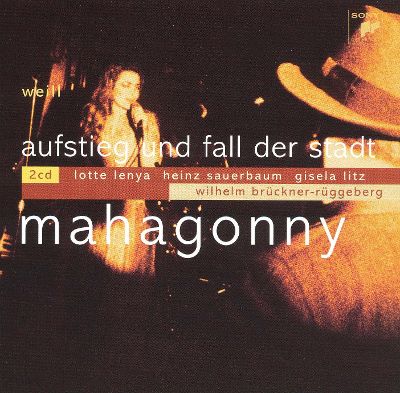
    Kurt Weill & Bertolt Brecht - Aufstieg und Fall der Stadt Mahagonny (Lotte Lenya, Wilhelm Brückner-Rüggeberg, 1956)

    In the mid-'50s, Lotte Lenya, Kurt Weill's widow, contracted with Columbia Records to participate in a series of new recordings of her late husband's major German works.

    Here, she is featured as Jenny Hill in a 1956 studio cast album of "Aufstieg und Fall der Stadt Mahagonny" ("Rise and Fall of the City of Mahagonny"), Weill's 1930 musical written with lyricist Bertolt Brecht. That allows her to sing the show's most famous number, "Alabama-Song." (Although Mahagonny is presented in the original German, "Alabama-Song" was written and is sung in English.). It is an ensemble work, not a star vehicle, with the other principal parts handled by Heinz Sauerbaum (as Jimmy Mahoney) and Gisela Litz (as Leokadja Begbick). The orchestra is conducted by Wilhelm Brückner-Rüggeberg.

    As its title suggests, Mahagonny traces the founding of a fictional American city and its evolution into a sort of modern Sodom and Gomorrah with the characters being lowlife types such as gamblers and prostitutes. It is similar in many ways to its predecessor, "The Threepenny Opera". But where that song-based work was more of a conventional Broadway-style musical, Mahagonny is more of an operetta, with extended recitatives and a larger orchestra playing more elaborate music. It is at once more ambitious and less accessible than "The Threepenny Opera" and consequently has been less often performed. This recording aims to be definitive and, with a talented cast and musicians, plus excellent sound courtesy of a Hamburg studio, it arguably achieves that goal.     
              

    Tracklist:

    Akt I
    Nr. 1
    1-1 Gesucht werden Leokadja Begbick 3:41
    1-2 Sie soll sein wie ein Netz 3:52
    Nr. 2
    1-3 Rasch wuchs / Oh, show us the way 4:13
    Nr. 3
    1-4 Die Nachricht 4:26
    Nr. 4
    1-5 In den nächsten Tagen 2:04
    Nr. 5
    1-6 Damals kam unter anderen 2:14
    1-7 Heraus, ihr Schönen von Mahagonny 0:55
    1-8 Ach, bedenken sie 2:00
    Nr. 6
    1-9 Ich habe gelernt 1:55
    Nr. 7
    1-10 Alle grosse Unternehmungen 1:23
    1-11 Auch ich bin einmal 3:34
    Nr. 8
    1-12 Alle wahrhaft Suchenden 2:44
    1-13 Aber etwas fehlt 3:47
    Nr. 9
    1-14 Klaviersolo / Das ist die ewige Kunst 4:16
    1-15 Sieben Jahre 2:28
    Nr. 10
    1-16 Ein Taifun! 2:21
    Nr. 11
    1-17 In dieser Nacht des Entsetzens 5:30
    1-18 Nein, jetzt sage ich 1:50
    1-19 So tuet nur, was euch beliebt 3:28
     
    Akt II
    Nr. 12
    1-20 Hurrikan bewegt 3:26
    1-21 O wunderbare Lösung 1:19

    Nr. 13
    2-1 Von nun an war der Leitspruch 1:08
    2-2 Jetzt habe ich gegessen zwei Kalber 4:00
    Nr. 14
    2-3 Zweitens kommt die Liebe dran! 6:18
    2-4 Sieh jene Kraniche 5:02
    2-5 Erstens, vergesst nicht, kommt das Fressen 0:37
    Nr. 15
    2-6 Wir, meine Herren 4:28
    2-7 Dreimal hoch Dreieinigkeitsmoses! 2:30
    Nr. 16
    2-8 Freunde kommt, ich lade euch ein 7:37
    2-9 Meine Herren, meine Mutter prägte 5:58
    Nr. 17
    2-10 Wenn der Himmel hell wird 4:09
     
    Akt III
    Nr. 18
    2-11 Haben alle Zuschauer Billette? 2:01
    2-12 Zweitens der Fall des Jimmy Mahoney 8:37
    Nr. 19
    2-13 In dieser Zeit gab es in Mahagonny 4:04
    Nr. 20
    2-14 Hinrichtung und Tod des Jimmy Mahoney 3:30
    2-15 Erstens, vergesst nicht, kommt das Fressen 3:25
    Nr. 21
    2-16 Wohlt ihr mich denn wirklich hinrichten? 4:08
    2-17 In diesen Tagen fanden in Mahagonny 6:29


    Kurt Weill & Bertolt Brecht - Aufstieg und Fall der Stadt Mahagonny (Lotte Lenya, Wilhelm Brückner-Rüggeberg, 1956)
    (256 kbps, cover art included)