Mittwoch, 26. Januar 2011

Massiel - Baladas y canciones de Bertolt Brecht (1977)

Massiel (real name María de los Ángeles Santamaría Espinosa) is a Spanish singer. She was born on August 2, 1947 in Madrid.

Image

She won the Eurovision Song Contest 1968 with the song "La, la, la", which earned 29 points, beating out famous British pop crooner Cliff Richard, who placed second that year with "Congratulations". Some years later she performed dramatic roles in theatrical productions like "A los hombres futuros, yo Bertolt Brecht" (1972), "Corridos de la revolución: Mexico 1910" (1976) and "Antonio and Cleopatra" in the early '80s.

In 1977, she released an album covering the music of Bertolt Brecht/Kurt Weill in Spanish, called "Baladas Y Canciones De Bertolt Brecht".

Massiel - Baladas y canciones de Bertolt Brecht (1977)
(192 kbps)

Donnerstag, 20. Januar 2011

Joe Bataan - Riot (1968)

In the 1970s New York Afro-Filipino Joe Bataan from Spanish Harlem landed one success after another. Bataan mixed Latin music with English lyrics and was a true pioneer of Latin soul, salsa and hip-hop. He penned such disco-rap-funk hits as "Rap-O Clap-O", one of the first raps ever recorded.

He disappeared from the scene from the mid-1980s until 1996, when colleagues Tito Puente and Eddie Palmieri persuaded him to take to the stage again. In 2004 a young producer signed him on to record a new disc. With his first album in twenty years, "Call My Name", he is back, updating Nuyorican boogaloo with the raw sounds of indie rock and neo-funk.

"Riot" is a real killer from the legendary Joe Bataan - an album of righteous power that really lives up to the dynamic promise of the title and cover!

Joe Bataan's in top form throughout - serving up a blend of Latin grooves and 60s soul influences that few other artists of the time could touch - soaring and upbeat one minute, but mellow and laidback the next.

There's a number of longer tracks on here that really move past the standard Latin Soul modes - bringing in bits of descarga jazz, instrumental soul, and mellower ballads to Joe's already-great blend of styles. The depth here is tremendous. Titles include the slamming "It's A Good Feeling (Riot)", "Muneca", and "Mambo De Bataan" -- plus the soul tracks "What Good Is A Castle", "My Cloud", "Daddy's Coming Home", "Ordinary Guy", and "For Your Love".


Joe Bataan - Riot (192 kbps, front cover included)

Dienstag, 18. Januar 2011

Sun Ra - The Other Side Of The Sun

The Sun Ra Arkestra looks both forwards and backwards in time on this obscure small lable LP. The tracks were recorded 11/1/78 and 1/4/79 at Blue Rock Studios, NYC.

Ten years earlier, one couldnot have imagined Ra and his men romping through "On the Sunny Side of the Street" or reinventing "Flamingo."
However, those versions certainly sound quite original, and there is no mistaking the band for any other orchestra on "Space Fling," "Manhattan Cocktail" and the trademark "Space Is the Place."

The music on this album features a version of the Arkestra consisting of six reeds (including John Gilmore and Marsahll Allen), three trumpets (including Michael Ray and Eddie Gale), two trombones (with a young Robin Eubanks), the French Horn of Vincent Chancey, guitarist Dale Williams, three bassists, four percussionists, singer June Tyson and the leader's keyboards. A stimulating set!

Tracks:

  1. Space Fling
  2. Flamingo
  3. Space Is The Place
  4. The Sunny Side Of The Street
  5. Manhattan Cocktail
No Link

Montag, 17. Januar 2011

Ella Fitzgerald & Louis Armstrong - Stompin´ At The Savoy

"The First Lady of Song," Ella Fitzgerald was arguably the finest female jazz singer of all time (although some may vote for Sarah Vaughan or Billie Holiday). Blessed with a beautiful voice and a wide range, Fitzgerald could outswing anyone, was a brilliant scat singer, and had near-perfect elocution; one could always understand the words she sang.

Whatever the contractual agreements were that allowed Ella Fitzgerald and Louis Armstrong to record together for Verve Records over a year's time (1956-57), producer Norman Granz managed to sponsor some truly classic jazz vocalizing in that brief window of opportunity:  It was a bittersweet mix of massively talented yet totally mismatched voices, of course; just the question of what key to choose was a repeated challenge, mostly resolved by careful key changes in the midst of songs.

The magic most specifically tripped the light on a superb "Stompin' at the Savoy." In earlier times, that big band ditty had Lindy Hopped right out the Savoy doors and around the block in high-stepping versions by Ella's old boss Chick Webb, busy hitman Benny Goodman, bandmeister Isham Jones, and umpteen others, but nothing could match the hi-fi swing plus ultra of Satch and Miss E.

Ella Fitzgerald & Louis Armstrong - Stompin´ At The Savoy
(192 kbps, front cover included)

Sonntag, 9. Januar 2011

"The Essential Rosa Luxemburg: Reform or Revolution and the Mass Strike"

The Essential Rosa Luxemburg: Reform or Revolution and the Mass Strike

This introduction to Rosa Luxemburg’s two most important works presents the full text of "Reform or Revolution" and "The Mass Strike", with explanatory notes, appendices, and introductions.

One of the most important Marxist thinkers and leaders of the twentieth century, Rosa Luxemburg is finding renewed interest among a new generation of activists and critics of global capitalism.

Rosa Luxemburg, a Polish-born revolutionary, was a leader of the left-wing movement in Germany until her murder in 1919.

The Essential Rosa Luxemburg: Reform or Revolution and the Mass Strike
(pdf)

Samstag, 8. Januar 2011

Rosa Luxemburg - The Accumulation Of Capital (1913, pdf)

image
In January 1919, after being arrested for her involvement in a workers' uprising in Berlin, Rosa Luxemburg was brutally murdered by a group of right-wing soldiers. Her body was recovered days later from a canal.

Six years earlier she had published what was undoubtedly her finest achievement, "The Accumulation of Capital" - a book which remains one of the masterpieces of socialist literature.

Taking Marx as her starting point, she offers an independent and fiercely critical explanation of the economic and political consequences of capitalism in the context of the turbulent times in which she lived, reinterpreting events in the United States, Europe, China, Russia and the British Empire. Many today believe there is no alternative to global capitalism. This book is a timely and forceful statement of an opposing view.

Rosa Luxemburg - The Accumulation Of Capital (1913, pdf)

Thanks to the original uploader!

Commemorating Rosa Luxemburg and Karl Liebknecht


"Revolution is magnificent. Everything else is nonsense." - (Rosa Luxemburg)

This weekend the annual Rosa Luxemburg and Karl Liebknecht demonstration, initiated in the German Democratic Republic and continued in today’s conditions takes place on Sunday 9 January 2011, 10am at Berlin Friedrichshain.

The demonstration commemorates the murder of the two leaders of the German workers movement by reactionary Freikorps on the orders of the Social Democrat minister Friedrich Ebert.

For the first time in Marxist literature Karl Liebknecht took up the question of militarism in the imperialist period in his book Militarism and Anti-Militarism which came out in 1907 and which led him to being sentenced to imprisonment. As a member of the Prussian Chamber of Deputies and the Reichstag he exposed the bosses of the military industries headed by Krupp for their warmongering policies and called for international proletarian solidarity as the decisive weapon in the struggle against militarism. Liebknecht welcomed the 1905 Revolution in Russia and came into a sharp political clash with the revisionists, defending the general mass strike as a special proletarian means of struggle. He denounced the assistance given by the German government to tsarism which was engaged in the suppression of the revolution and called upon the German proletariat to emulate the struggle of the Russian workers.

At the beginning of the First World War he did not initially break with the discipline of the Social-Democratic Party, voting for war credits on August 4th, 1914. Liebknecht soon corrected his position and on 2nd December, 1914 he cast the sole vote against war credits. In a statement which was submitted to the Chairman of the Reichstag he characterised the war as one of annexation. This document was later circulated as an illegal leaflet. Even when drafted to the front, Liebknecht skilfully utilised his membership of the Prussian and Reichstag Chambers to continue the struggle. He adopted the Bolshevik slogan of transforming the imperialist war into a civil war. Together with Rosa Luxemburg he established the Spartacus group. From the rostrum of the Prussian Chamber of Deputies he called upon the Berlin proletariat to join the Mayday demonstration of 1916. In the course of this Liebknecht called for the overthrow of the government which was conducting an imperialist war : for this action he was arrested and sentenced by a military court to jail for four years. It was there that he learnt the news of the October Revolution.

Rosa Luxemburg was born in Poland in 1871 and lived and worked in Germany from 1898. She was an early opponent of the revisionist E. Bernstein, actively opposing the ministerialism of Millerand and the opportunist compromises with bourgeois parties. Her writings on these questions were collected in 1899 in Social Reform or Revolution? With regard to the split in the Russian Social-Democratic Labour Party Rosa Luxemburg did not accept the Leninist views on the need to construct a proletarian party. Stalin noted that Luxemburg had declared for the Mensheviks, arguing that the Bolsheviks had tendencies to Blanquism and ultra-centralism. During the Russian Revolution of 1905-07 she drew closer to the Bolsheviks on many questions of the strategy and tactics of the revolutionary struggle. Rosa Luxemburg correctly understood the role of the working class as the decisive force of the revolution, recognised the need for an armed uprising against tsarism and the establishment of the dictatorship of the proletariat. Luxemburg expressed complete agreement with the Bolshevik view that the liberal bourgeoisie was a counter-revolutionary force and that the peasantry constituted a revolutionary class. Drawing on the experience of the 1905 revolution she supported the greatest possible development of the extra-parliamentary struggle of the masses and stressed the need to use the mass political strike. For her anti-militarist struggle she was imprisoned during the First World War.
In her major theoretical works on political economy Rosa Luxemburg presented a critique of capitalism and imperialism where the aggressive colonial policies were described; she upheld the view, however, that the accumulation of capital under capitalism was possible through the expansion of the sphere of exploitation of the non-capitalist sectors so that imperialism was defined as the struggle of the capitalist states for the non-capitalist environment. Despite her important theoretical contribution Rosa Luxemburg deviated from Marxism on a number of questions: to wit, on the denial of the right of national self-determination and an underestimation of the revolutionary potentialities of the peasantry.

From the beginning of the First World War she criticised the imperialist character of the war and the betrayal of the social-democratic leadership. As a founder and leader of the Spartacus League she authored a number of anti-war tracts. Luxemburg greeted the October revolution, commended the role of the Bolsheviks while incorrectly evaluating the Bolshevik tactics on the agrarian and national question, and the dispersal of the Constituent Assembly. Her critiques of Bolshevik tactics have been widely advertised by the spokesmen of U.S. imperialism notwithstanding the fact that she retraced her steps on a number of questions relating to the Bolshevik revolution and made a turn towards Leninism defending the dictatorship of the proletariat and the Soviets in Germany.

Karl Liebknecht and Rosa Luxemburg were among the founders of the Communist Party of Germany which held its constituent congress from 30th December, 1918 to January 1, 1919. After the suppression of the Berlin workers' uprising of January 1919, the ruling classes organised the brutal killings of the two communists on 15th January 1919. The roots of the murders lay in the secret accommodation reached between the right-wing socialist leader Chancellor Friedrich Ebert and General Groener which was established in November, 1918 "in order to prevent the spread of terroristic Bolshevism in Germany".

Freitag, 24. Dezember 2010

Happy X-Mas - War Is Over (If You Want It)


Happy X-Mas to you all!
We want it!
R.I.P, John!

Samstag, 11. Dezember 2010

Holy Modal Rounders - Alleged In Their Own Time (1975)


The Holy Modal Rounders were almost the very definition of a cult act. This isn't a case of a group that would be described by such clichés as "if only they got more exposure, they would certainly reach a much wider audience." Their audience was small because their music was too strange, idiosyncratic, and at times downright dissonant for mainstream listeners to abide. What makes the Rounders unusual in this regard is that they owed primary allegiance to the world of acoustic folk -- not one that generates many difficult, arty, and abrasive performers.
"It wasn't until 1970 that we started Rounder Records but one of the reasons for the name was the Holy Modal Rounders. It was they who introduced us to Charlie Poole. Since we started, 'Rounders On Rounder' was one of the things we wanted to do the most. Another is a Ramblin' Jack Elliott record. It gets kind of confusing when both sets of Rounders are together since everybody's talking about the Rounders but it's not always clear about which set. We wanted to do a Stampfel and Weber album but Robin was there and he wrote Euphoria and was legendary, and Peter brought friend Luke Faust up and it grew and grew. Weber was kind of out of it most of the time, unfortunately. Well, it's finally here. We don't have much else to say right now, at least about this."
- The Rounder Collective

Tracklist:

01 Low Down Dog
02 Don't Seem Right
03 New Reuben's Train
04 Voodoo Queen Marie
05 Chitlin' Cookin' Time In Cheatham County
06 Nova
07 Sally In The Alley
08 She's More To Be Pitied
09 Rocky Road
10 Across The Alley From The Alamo
11 Synergy
12 Red Rocking Chair
13 Random Canyon
14 Monday Morning
15 Shoot That Turkey Buzzard


Holy Modal Rounders - Alleged In Their Own Time
(224 kbps, complete cover art inlcuded)

Donnerstag, 9. Dezember 2010

The New Orleans Rhythm Kings - The Cradle Of Jazz

.
"The New Orleans Rhythm Kings" were a big influence on many of the white bands and musicians of the 1920s.

In 1920, Paul Mares and George Brunies were working on the Mississippi riverboat S.S. Capitol when it stopped in Davenport, Iowa, where they teamed with Leon Roppolo on clarinet. They eventually added Elmer Schobel on piano, Frank Snyder on drums, Alfred Loyacano on bass and Louis Black played banjo.

They got a gig at the Friar's Club in Chicago in 1922. At first they called themselves "The Friar's Society Orchestra", after the club the Friars Inn at 1834 Wabash Street at Van Buren in Chicago, but they changed their name to "The New Orleans Rhythm Kings" in 1923 after losing that gig.

Unlike Nick LaRocca, the leader of the "Original Dixieland Jazz Band", Paul Mares did not try to deny the African-American roots of Jazz. The New Orleans Rhythm Kings were heavily influenced by "King Oliver's Creole Jazz Band" and became the first group to put out a "racially mixed" Jazz record in 1923 with "Sobbin' Blues", featuring Jelly Roll Morton. Morton went on to record five more tunes with the band. "The New Orleans Rhythm Kings" were in existence from 1922 to 1925 when Paul Mares left the music business and went back to New Orleans to work at the family fur business. In 1934 and 1935 two recording sessions took place that revived the "New Orleans Rhythm Kings" name, but George Brunies was the only original memeber of the band to take part in the sessions.


Here´s a compilation of some of their fine recordings:


link dead

Dienstag, 9. November 2010

Luciano Berio / Cathy Berberian - Recital I for Cathy / Folk Songs / Three Songs By Kurt Weill (1995, 3 Kurt Weill Songs)

Cathy Berberian, singer and wife of Luciano Berio, was one of music's true originals. Equally adept at Monteverdi and the wildest effusions of the avant-garde, her performances brought her husband's music to new and appreciative audiences, while permitting Berio to create some of his most gripping work at the same time.

Folk Songs is exactly what the title says - a collection of folk songs from around the world which gives Berberian the opportunity to demonstrate her ability to sing in different languages and styles. Recital 1 is something else again - a monologue for soprano that reveals the slow disintegration of her personality. It's a nervous breakdown in music. Berberian performs everything on this disc brilliantly.

"Recital I for Cathy" (1971) typifies his "collage" technique. Recital includes a Monteverdi aria, more or less straight, a mock-Baroque aria Berio had written in the Forties, various phrases from Mahler, Schubert, Verdi, Prokofieff, Purcell, Schoenberg, and others, all set against a swirly, scintillating background. Berio requires his ex to turn from one to another after as few as three notes. This sort of thing could easily become pointless, but Berio provides a dramatic situation. A mezzo rehearsing for a recital waits for her accompanist to show up and becomes unhinged, skittering from one item in her repertoire to another. The work becomes a modern equivalent of the operatic "mad scene," a toothsome duck soup to Berberian. She certainly knows how to act while she sings, although less so when she speaks or sprechstimms – that is, speaks on approximate pitches in a specified rhythm. Consequently, the work succeeds best when Berio gives her actual pitches. For me, however, the main attraction is Berberian, rather than the work, which strikes me as too easy. It's Berberian who gives it class.

"Folk Songs", from 1964, yet another collage, this time mixes settings written over roughly two decades together in one work. Purists will find the work misnamed. It includes folk tunes, fake folk, and pop – 11 in all – from the United States, France, Italy, Sicily, Sardinia, Armenia, and Azerbaijan. To me one of the most beautiful vocal works of the post-war era, Folk Songs uses a chamber instrumentation of flute, clarinet, harp, viola, cello, and percussion. It begins with a fiddler "playing himself in" as the singer begins "Black is the color of my true love's hair" and moves into "I wonder as I wander," both by John Jacob Niles. Simple though these tunes may be, they are artfully simple. Berberian brilliantly catches their flavor by turning herself into a concert version of "mountain soprano" Jean Ritchie, thinning out the tonal heft while remaining sweet and true. As in Recital I, largely traditional settings are put into avant-garde environments. Yet, the tunes keep their vernacular character. The Italian set (including Sicily and Sardinia) surprised me the most, since most of them sound Falla-Spanish to me. The Sardinian "Motettu de tristaru" and the French "La fiolairé" (from Canteloube's Chants d'Auvergne) receive the most extreme treatment. Berio, to his credit, throws the spotlight on the basic material, rather than on his contributions per se. Nevertheless, it remains, in its post-modern eclecticism, a resolutely contemporary, even prophetic work. Throughout, Berberian virtuosically changes her vocal colors to suit the music and the text. In the French "Rossignolet du bois," she becomes a young girl on the edge of first love. In the Italian "A la feminisca," she becomes possessed by Spanish duende. In a second song from Canteloube, where Berio essentially translates Canteloube's orchestra to chamber proportions, "Malurous qu'o uno fenno" (roughly, "Women! Ya can't live with 'em, ya can't live without 'em"), Berberian manages to dance through sass, cynicism, and merriment. One of the finest performances by a singer who routinely turned out great ones.

The disc ends with three songs by Kurt Weill, two of them classics: "Ballad von der sexuellen Hörigkeit" (ballad of sexual dependency) from Die Dreigroschenoper, "Le grand Lustucru" (Lustucru the Great) from Marie Galante, and "Surabaya Johnny" from Happy End. Berio, for some reason, orchestrated these. After all, Weill, a master of instrumental color, orchestrated them himself. Berio differs from Weill, essentially offering up more wholesome timbres than the originals. I prefer Weill's sourer sound, reeking of spilled whiskey, urinal cakes, and stale cigarettes. Berberian sings both German items in English, translating them herself. She provides credible lyrics. I prefer Blitzstein's version of the "Ballad," but at least Berberian avoids the trap academic translators fall into, essentially so concerned with literal meaning that they forget Brecht's zip and wit. Again, these tracks' reason for being comes down to Berberian's performance. She has carved out her own niche with these songs, apart from Lotte Lenya, Gisela May, and the lesser Ute Lemper. For one thing, she sings them without the throaty rasp. However, what puts her in the exalted company of Lenya and May is once again the fact that she is such a splendid singing actress.


Tracklist:

1. Recital I For Cathy: Se I Languidi Miei Sguardi (Monteverdi)
2. Recital I For Cathy: Amor, Dov'e La Fe (Monteverdi)
3. Recital I For Cathy: 'Ah! He Hadn't Been There Before...'
4. Recital I For Cathy: 'Clarinet That's The Sound That Has Been Haunting Me...'
5. Recital I For Cathy: Avendo Gran Desio (Berio-Da-Lentini)
6. Recital I For Cathy: 'Who Hasn't Taken A Piece Out Of My Life?'
7. Recital I For Cathy: Musician Exchange: 'These 5 Men...'
8. Recital I For Cathy: Exc: Mahler, Delibes, Rossini, Etc
9. Recital I For Cathy: Calmo E Lontano: 'Libera Nos'
10. Folk Songs: Black Is The Colour...
11. Folk Songs: I Wonder As I Wander...
12. Folk Songs: Loosin Yelav...
13. Folk Songs: Rossignolet Du Bois
14. Folk Songs: A La Femminisca
15. Folk Songs: La Donna Ideale
16. Folk Songs: Ballo
17. Folk Songs: Motettu De Tristura
18. Folk Songs: Malurous Qu' O Uno Fenno
19. Folk Songs: Lo Fiolaire
20. Folk Songs: Azerbaijan Love Song
21. Song Of Sexual Slavery
22. Le Grand Lustucru
23. Surabaya Johnny


"Recital 1 For Cathy" was composed in 1971 and ecorded on September 19-25, 1972 in EMI Studios, London.
"Folk Song"s (composed in 1964) and "3 Songs by Kurt Weill" were recorded on December 21 & 23, 1968, in Webster Hall, New York City.

Luciano Berio / Cathy Berberian - Reictal I for Cathy / Folk Songs /Three Songs by Kurt Weill
(192 kbps, cover art inlcuded)

Sonntag, 31. Oktober 2010

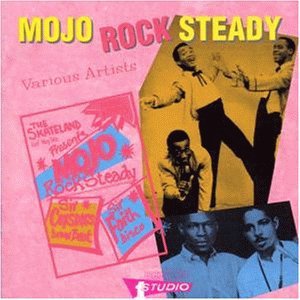
VA - Mojo Rock Steady

The term "reggae," often used to describe any music coming from Jamaica, is in reality a term that represents a whole canon of music that has grown, developed, and branched off from Jamaica's first native popular music, ska. Rock steady, the next form the island developed, is the precursor to the specific sub-genre of reggae, as well as the politically and culturally directed music that followed it called roots. In the rock steady era of the '60s and '70s, ska's blaring horns were minimized, and an electric bass and syncopated horn line carried the rhythm. The lyrics became more centered upon political and social concerns, especially the plight of Jamaica's black citizens. MOJO ROCK STEADY is an excellent introduction to this important era in the development of reggae music. Rhythmically and contextually, the songs contained herein represent important markers in reggae's growth. There are classic instrumental pieces like "Rockfort Rock" (originally titled "Psychedelic Rock" but renamed because a DJ from the Rockfort area of Kingston claimed it as his neighborhood's theme song), protean social protest songs from the Gaylads ("Africa") and the Bassies ("River Jordan"), and an example of one of reggae's lesser-known female vocalists, Denise Darlington ("Feel So Good"). You´ll find the tracklist in the comment.

Mojo Rock Steady (192 kbps)

Freitag, 29. Oktober 2010

Pete Seeger - The Royal Albert Hall (03/07/78)

More than any other individual, Pete Seeger had conceived and fostered a tradition of protest song that drew from a number of cultural roots, had significant political consequence, and reshaped the forms and content of popular music.

This is a recording for the Chile solidartiy concert at the Royal Albert Hall, London, 1978.

Tracks:

Intro
You’ve Got To Walk That Lonesome Valley (trad.)
Garbage
Victor Jara
Estadio Chile
Guantanamera
The Wagoner’s Lad
Song Of A Strike
Photographer’s Ballad
Where Have All The Flowers Gone
If I Had A Hammer
(320 kbps, no cover)

Three Johns - The World By Storm (1986)

Far and away the best Three Johns album. Funnier, sharper, and more focused than "Atom Drum Bop", "The World By Storm" really lets the guitars rip, creating a more manic, tuneful wall of noise behind which the Johns rant and rave.

The record featured the three best singles the band ever recorded, "Atom Drum Bop" (this is not a mistake — there's no song by this title on the LP "Atom Drum Bop"), "Sold Down the River," and the scaborously funny "Death of the European" (with its John Lydon-like opening lines, "Big mouth/open wide/open up the pearly gates of freedom").

The lyrical concerns are the same as always — mindless, conspicuous consumption, empty-headed conservatism — but here the Johns sound more in control, and that begets a ferocity and urgency that makes this a compelling record. The Three Johns cult and Mekons fans lapped this up when it came out, but it was only available in America as an import (still is, as far as I know) and sank without a trace. Too bad, as it was one of the best records of 1986.

Three Johns - The World By Storm (1986)
(192 kbps)

Dienstag, 26. Oktober 2010

Maniacs vs. Sarkiat - Don´t Climb The Pyramids

Cram an electric trio and seven egyptian musicians in a little room in the heart of Cairo for ten days and see what happens. The first steps of egyptian hard core? An oriental version of end-of -the millenium electric rock`n`roll? The rebirth of arabic pop muisc?

It`s a dream Alain Croubalian, from the Maniacs (based in Geneva), and Fathy Salama, leader of Sharkiat (means "coming from the east), wanted to bring to life. They felt, more than they exactly knew, the common ground where egyptian folk music, international pop, electronic sounds and independent rock could meet. And they made it happen.

After concerts in the Cairo Opera House and a tour of swiss underground clubs they recorded 10 songs in an old studio in Shobra, the heart of popular Cairo.


Escaping the usual cliches about oriental music isn`t easy. When talking about Egypt, you automatically think of sand, camels and pyramids. But Cairo is a busy urban city where 13 million people struggle for everyday life. Traffic is hell and the pop muisc is all electronic beats twisted in a mayheim of selfish pop. This encounter doesn`t really fit your usual world music standards, where exotism counts more than reality. Maniacs and Sharkiat agree and sincerely feel this "Don`t climb the pyramids" album is as authentic as music gets; at the same time a strange encounter. At the end of the recording sessions everybody looked at each other wondering: "It`s great music ! But what is it ?" Neither of us had heard such sounds collide excepts in our wildest fantasies. Today they are reality.
.

Up, Bustle & Out - Che Guevara ... A Dream Of Land And Freedom

With influences drawn from diverse sources all over the world — from Istanbul to Bolivia, Andalusia to North Africa — Up, Bustle and Out is one of the harder groups to pin down on the experimental breakbeat landscape. Hailing from the English town of Bristol, home also to Tricky and Massive Attack, Up, Bustle and Out comprises producers Rupert Mould and D. "Ein" Fell, who formed the group in the early '90s as an adjunct to their respective interests in non-Western musics, funk and soul, jazz, and experimental underground club styles like house, techno, ambient, and trip-hop.

Up, Bustle & Out take their romantic Latin dabblings to their most ambitious extreme with this limited 7-track CD, released to coincide with the 30th anniversary of the death of Cuban revolutionary Che Guevara. A must for those who appreciate good intellectual music dedicated to a man who will live in our memories for ever.
.
No link.

Swing Is Here - Small Band Swing 1935 - 1939

The mid-1930s were golden years for jazz. The music on this CD is quite exciting but much of it is issued here in incomplete fashion.

There are all four titles from Gene Krupa's Swing Band (a superb pickup group with trumpeter Roy Eldridge, clarinetist Benny Goodman and Chu Berry on tenor in additon to two Helen Ward vocals) but just three numbers from a session led by arranger Gene Gifford with trumpeter Bunny Berigan, six of the ten titles recorded by Mezz Mezzrow's bands during 1936-37 (featuring trumpeter Frankie Newton, Bud Freeman on tenor and a rare outing outside of the Jimmy Lunceford orchestra by trumpeter Sy Oliver), two jams by Frankie Newton in 1939 and seven songs from Wingy Manone.

Swing Is Here - Small Band Swing 1935 - 1939 (192 kbps)

Montag, 25. Oktober 2010

Laurel Aitken & Girlie - Scandal In A Brixton Market (1969)

Known as "the Godfather of Ska," Laurel Aitken was Jamaica's first real recording star. He was a pioneer in many other respects as well: he was one of the first artists ever to release a ska record, the first to work at promoting his music in the U.K., and one of the first to record for the seminal Island label, itself a major force in the international popularity of Jamaican music. Cutting his teeth on the sort of jump blues and boogie shuffles popular during the early days of American R&B, Aitken recorded numerous hits for a variety of labels over the years, enjoying his heyday during the '60s. His continued presence in the U.K. made him an elder statesman to the Two Tone ska revival movement of the punk era, and he continued to tour even into the new millennium.

"Scandal In A Brixton Market" was released in 1969 on the Pama label.

Tracks:

Side 1:
Laurel Aitken & Girlie: Scandal In A Brixton Market
Laurel Aitken & Girlie: Madame Streggae
Laurel Aitken: Stupid Married Man
Laurel Aitken: Tammering
Laurel Aitken: Have Mercy
Laurel Aitken: Night Cricket

Side 2: Laurel Aitken: Run Powell Run
Laurel Aitken: Teddy Bear
Laurel Aitken: Mr Soul
Laurel Aitken: Woke Up This Morning
Laurel Aitken & Rico Rodriguez: Babylon
Laurel Aitken & Rico Rodriguez: Stop The War In Vietnam

Laurel Aitken & Girlie - Scandal In A Brixton Market (1969)
(192 kbps)

Donnerstag, 21. Oktober 2010

Ari Up - Rest In Peace! - The Slits Debut 12" (Island, 1979)

ARI UP (SLITS) - On stage 1977
Ari Up, member of the Slits, died on Wednesday at age 48. Up’s stepfather, the Sex Pistols’ John Lydon, announced her death from a “serious illness” on his website. Up, a.k.a. Arianna Forster, formed the Slits with Palmolive (Paoloma Romero) and Viv Albertine when she was just 14, and the band’s mix of punk, reggae, and politics made them trailblazers. Meanwhile, the Slits’ last video, “Lazy Slam,” has been released posthumously according to Up’s wishes.
There’s no denying the importance of the Slits, especially their 1979 album "Cut". The group’s dizzy blend of dub rhythms, post-punk artiness, punk attitude and unpracticed enthusiasm was thrilling and unique, both when it first came out and 30 years later as well. On top of the glorious clatter and bounce of the music were Ari Up’s vocals. Yes, they may have wandered, they may have grated at times, but her style was perfect for the band and perfect for the times.

After "Cut", both the band and Up went through all kinds of changes that led to some interesting music at times - espcially her work with the Adrian Sherwood-produced, avant-garde reggae group the New Age Steppers.

Up’s death this week at the tragically young age of 48 gives us pause, and spurs us to remember just how influential, and fun, the Slits were at their peak.

To honour Ari Up we post the debut 12″ release from The Slits on Island records in 1979 with the wonderful tracks "Typical Girls" and "Grapevine".


Tracks:
01. Typical Girls / Brink Style
02. I Heard It Through The Grapevine / Liebe And Romanze

The Slits - Debut 12 Inch (Island, 1979)
(128 kbps, cover art included)

Rest in peace!

Children Of September

The PinkPudelCrew is lucky to present the film "Children Of September" next tuesday, (October, 26) at "Größenwahn", Kinzigstr. 9, 10247 Berlin.

"Children Of September" is a documentary film about the military putsch in Turkey on 12th September 1980 from the view of five eyewitnesses.

Five young people, four cities (Berlin, Copenhagen, Zurich and Paris). Everyone of them was born in a different region of Turkey. What their biographies have in common is the fact that their families had gone through the violence of the putsch on 12th September 1980.

How do the children who hanging on to their families apron strings had to emigrate to those countries live today? Are they, as were their parents, involved in politics? Do they have some special characteristics which make them the “Children of September”?

One of the directors and one of the protagonists will take part at the screening and invite you to a discussion about the topic and the film. The entry is free and you are welcome!